West Bengal Government Pledges to Restore Mangroves in Sundarbans
Source:The Hindu ↗
Why It Matters
Highly relevant for WBCS aspirants tracking regional environmental policies, geography, and biodiversity conservation efforts in West Bengal's fragile Sundarbans delta.
Summary
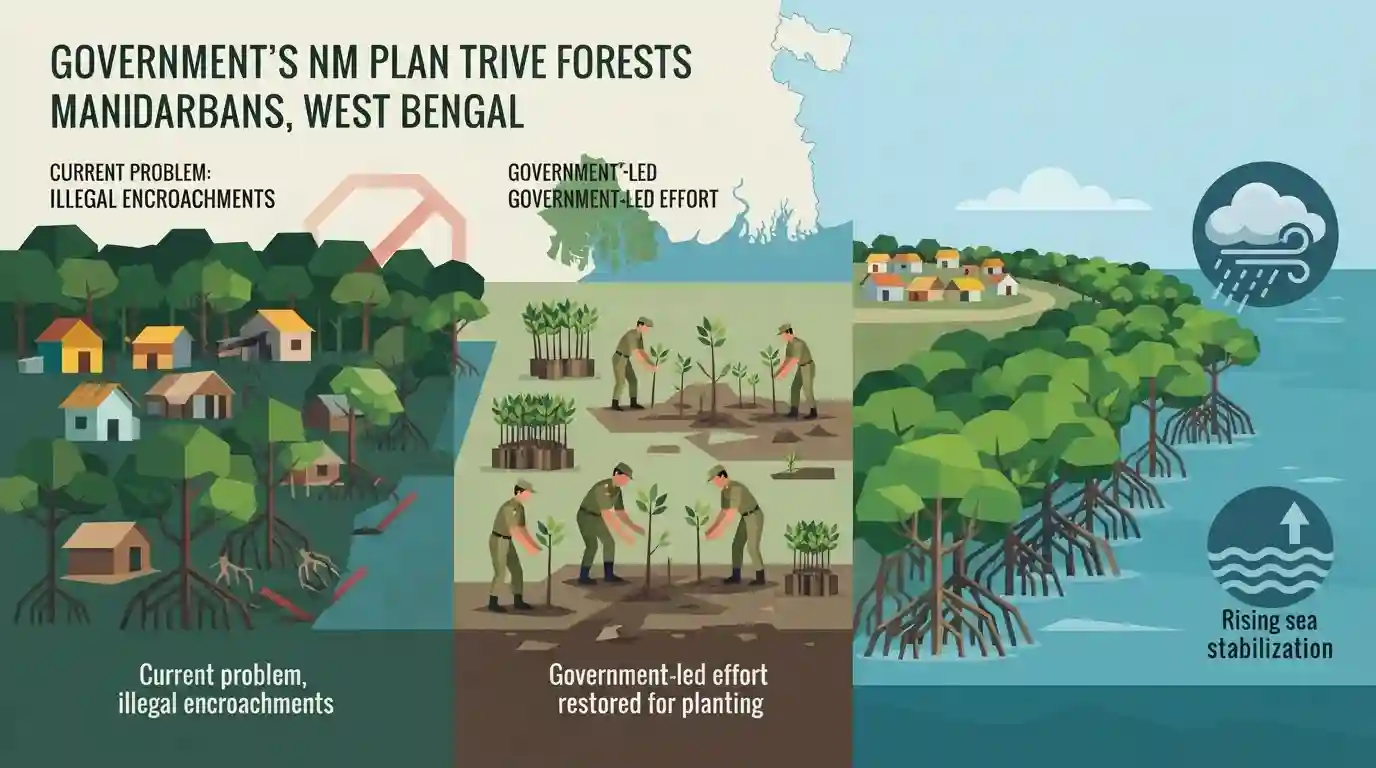
The West Bengal government announced rigorous steps to restore mangrove forests lost to illegal encroachments in the Sundarbans. State authorities plan to clear unauthorized occupations and initiate extensive plantation drives to safeguard the vulnerable coastal ecosystem against natural disasters and climate change.
Key Points
- The West Bengal government has pledged to restore mangroves lost to encroachments in the Sundarbans region.
- State Minister for Sundorban Affairs Bankim Chandra Hazra highlighted initiatives to clear illegal encroachments and launch large-scale mangrove plantation drives.
- Mangroves play a vital role in protecting the deltaic region from severe cyclonic storms, soil erosion, and climate change impacts.
Important Terms
Sundarbans

A vast mangrove delta in the Ganga-Brahmaputra-Meghna basin shared by India and Bangladesh, known for its unique tidal halophytic vegetation, endangered Royal Bengal Tigers, and high vulnerability to tropical cyclones and climate change.
UPSC context
Crucial for WBCS Paper I (Geography of West Bengal & Environment); tests knowledge of coastal ecology, disaster management, and regional biodiversity.
Mangroves
Salt-tolerant coastal trees and shrubs that grow in intertidal zones, acting as a crucial natural biological shield against storm surges, coastal erosion, and cyclonic winds while supporting rich estuarine fisheries.
UPSC context
Important for WBCS Paper I and IV (Environmental Conservation); tests knowledge of coastal protection, flora, and climate change adaptation.
Bheries
Traditional or unauthorized brackish water fisheries and aquaculture enclosures constructed within coastal or estuarine wetlands, often formed by clearing mangrove forests and blocking tidal flushing.
UPSC context
Tested in WBCS West Bengal Geography and socio-economic topics; evaluates understanding of land-use conflicts, local aquaculture, and ecological degradation.
Prelims Trap
The Sundarbans mangrove ecosystem is exclusively located within the state of West Bengal in India.
Aspirants often assume the Sundarbans is entirely located within Indian territory, ignoring that over 60% of the mangrove forest lies within Bangladesh.
Static Concepts Connected
What are the key ecological features and geographical limits of the Sundarbans in West Bengal?
- Global Extent:: Largest mangrove forest in the world, spanning across India and Bangladesh in the Ganges-Brahmaputra-Meghna delta.
- Designations:: Declared a UNESCO World Heritage Site in 1987 and designated as a Ramsar Wetland of International Importance.
- Biodiversity:: Home to the endangered Royal Bengal Tiger (Panthera tigris tigris) and unique endemic flora like Sundri (Heritiera fomes).
Cross-Topic Patterns
Mangrove Bio-shields & Coastal Disaster Resilience
The fragile deltaic ecology of the Sundarbans links directly to disaster management frameworks under the National Disaster Management Authority (NDMA) guidelines for cyclone-prone coastal zones.
Sundarbans Wetlands & Ramsar Conservation Obligations
West Bengal's mangrove restoration intersects with international biodiversity commitments under the Ramsar Convention, given the Sundarbans' status as a Ramsar Wetland of International Importance.

Sundarbans mangrove ecology, geographical extent, and protective role against cyclones frequently appear in WB Civil Service geography/environment MCQs.
Linked PYQs · 2
Linked PYQs · 2
- 2019WBCS_PRELIMSGS1
Sundarban is declared as 'World Heritage Site' for
- 2012WBCS_PRELIMSGS1
'Sundarban' has been sited as a world heritage site due to its :
