West Bengal pledges to restore encroached mangrove areas in Sundarbans
Source:The Hindu ↗
Why It Matters
The Sundarbans is a critical geographical and ecological topic for WBCS Prelims. This development highlights the conflict between local livelihoods (aquaculture/bheries) and ecological conservation in a highly vulnerable deltaic region, emphasizing the importance of institutional governance and sustainable practices in climate-sensitive zones.
Summary
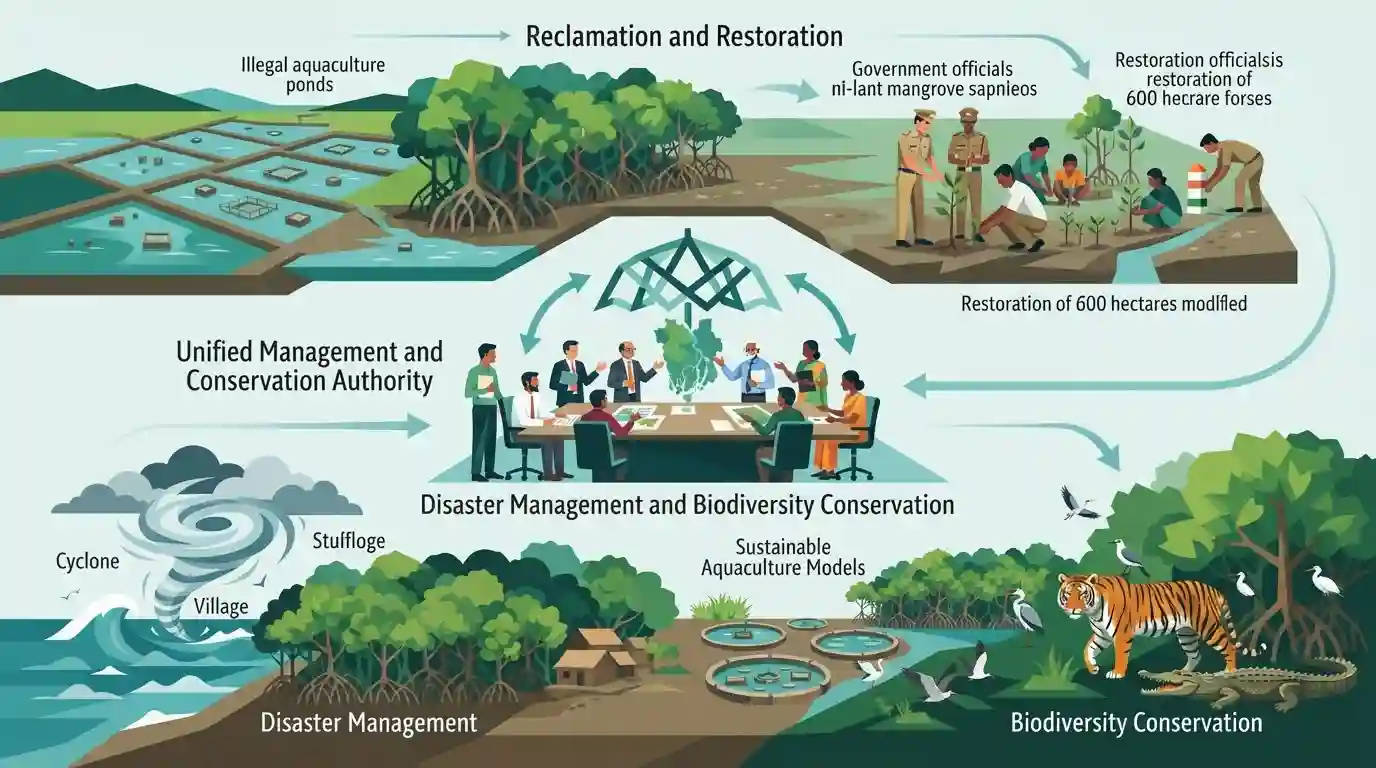
West Bengal's Environment and Forest Minister has vowed to reclaim and restore over 600 hectares of mangrove forests in the Sundarbans lost to illegal aquaculture encroachments (bheries). During a workshop organized by the Nature Environment and Wildlife Society (NEWS) and the State Forest Department, experts highlighted the urgent need for a unified Mangrove Management and Conservation Authority. The Sundarbans, holding India's largest mangrove cover and a unique tiger population, is under severe stress from both human activities and repeated cyclones, prompting international recognition for sustainable aquaculture models to balance livelihoods and conservation.
Key Points
- West Bengal's Environment and Forest Minister pledged to restore over 600 hectares of mangrove forests in the Sundarbans that were encroached upon for illegal shallow fish ponds (bheries).
- Experts proposed the creation of a dedicated Mangrove Management and Conservation Authority to overcome overlapping jurisdictional issues among multiple state departments.
- The Sundarbans constitutes 42.45% of India's total mangrove cover and is the only mangrove forest globally to host tigers (approx. 100) alongside hundreds of saltwater crocodiles.
- A sustainable mangrove-linked aquaculture project by the Nature Environment and Wildlife Society (NEWS) received Global Technical Recognition from the FAO in October 2025.
- The fragile ecosystem faces compounding threats from both anthropogenic encroachments and severe climatic events, including recent cyclones like Bulbul, Amphan, and Yash.
Important Terms
Sustainable Aquaculture in Mangrove Ecosystems (SAIME)

An ecosystem-based, climate-adaptive aquaculture model in the Sundarbans that integrates mangrove conservation with shrimp farming (5%–30% canopy inside ponds), lowering chemical inputs and doubling local profits.
UPSC context
GS Paper III (Agriculture & Biodiversity); tests sustainable aquaculture techniques and community-driven coastal adaptation models.
Food and Agriculture Organization (FAO)
A specialized agency of the United Nations established in 1945 that leads international efforts to defeat hunger, improve nutrition, and promote sustainable forestry, fisheries, and agricultural development.
UPSC context
GS Paper II (International Institutions); tests the mandate and global developmental initiatives of major UN-affiliated agencies.
Nature Environment and Wildlife Society (NEWS)
A Kolkata-based conservation NGO founded in 1991, working on mangrove restoration, wetland management, climate-resilient livelihoods, and community-led natural resource conservation across the Sundarbans.
UPSC context
GS Paper III (Biodiversity & Conservation); tests the role of non-governmental organizations in ecological restoration and sustainable livelihood creation.
Bheries
Traditional brackishwater aquaculture impoundments surrounded by earthen embankments in West Bengal, typically used for low-intensity fish and shrimp farming reliant on natural tidal water exchange.
UPSC context
GS Paper I & III (Geography & Agriculture); tests traditional farming practices, coastal land-use changes, and wetland-based livelihoods.
State Forest Department (West Bengal)
The state government department responsible for administering reserve forests, executing mangrove afforestation campaigns, enforcing wildlife protection, and curbing illegal encroachments in the Sundarbans.
UPSC context
GS Paper III (Environmental Governance); tests state-level administrative bodies and their conservation policies against illegal encroachments.
Prelims Trap
Gujarat possesses the largest state-wise mangrove cover in India due to its extensive coastline.
West Bengal has the highest total mangrove cover (42.3%), followed by Gujarat (23.6%). Aspirants often mistake Gujarat's long coastline as indicating the highest mangrove cover.
Static Concepts Connected
What factors make Mangroves highly efficient "Blue Carbon" sinks?
- Anaerobic Conditions: Waterlogged coastal soils are oxygen-depleted, which drastically slows down organic matter decomposition and locks carbon underground for centuries.
- Sediment Accretion: Complex root networks trap suspended organic sediments from tides, burying carbon deep into the soil and preventing atmospheric oxidation.
- Below-ground Biomass: A significant portion of mangrove biomass is allocated to root systems, storing more carbon below-ground than terrestrial forests.
How do Brackish Bheries differ from Wastewater Bheries in West Bengal?
- Wastewater Bheries: Pioneered in the East Kolkata Wetlands, these use municipal sewage as a nutrient source to grow fish, acting as natural urban sewage treatment.
- Brackish Bheries: Located in the coastal Sundarbans, these use tidal saline water for shrimp farming, often leading to mangrove deforestation if left unregulated.
Cross-Topic Patterns
Blue Carbon & Carbon Markets
Integrating coastal mangrove restoration with Article 6 of the Paris Agreement allows developing nations to fund local climate adaptation through global blue carbon offset credits.
Eco-DRR & Coastal Resilience
Mangroves serve as critical bio-shields. Degradation of Sundarbans' mangroves directly intensifies cyclone impacts, linking coastal ecosystem health to India's disaster management framework.

ISFR mangrove rankings, blue carbon soil chemistry, and the FAO-recognized SAIME model could be synthesized into a 2026 prelims MCQ.
Linked PYQs · 4
Linked PYQs · 4
- 2019WBCS_PRELIMSGS1
Sundarban is declared as 'World Heritage Site' for
- 2024WBCS_PRELIMSGS1
On a per hectare basis which of the following forests will hold maximum amount of carbon?
- 2020WBCS_PRELIMSGS1
The severe cyclonic storm that struck West Bengal in 2019 was
- 2024WBCS_PRELIMSGS1
East Kolkata Wetland has been declared as
