West Bengal State Budget Sustainable Development Goal Integration
Source:downtoearth-org ↗
Why It Matters
Crucial for understanding West Bengal's state policy framework on climate change mitigation, sustainable development goal tracking, and regional resource allocation for vulnerable areas like the Sundarbans.
Summary
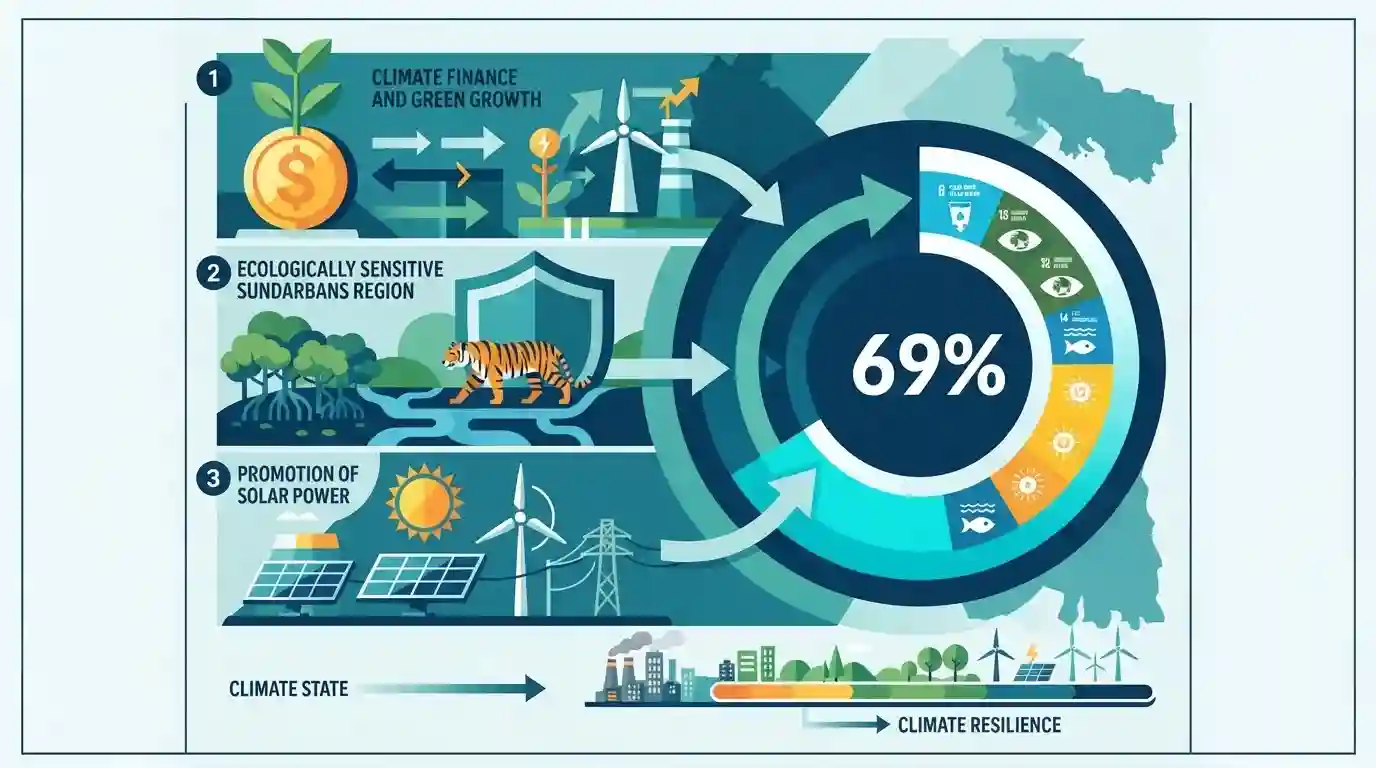
West Bengal has integrated 69 per cent of its budget with the Sustainable Development Goals (SDGs), with particular emphasis on climate finance, the ecologically sensitive Sundarbans region, and promotion of solar power to enhance green growth and climate resilience.
Key Points
- West Bengal has linked 69 per cent of its budget allocations directly to the Sustainable Development Goals (SDGs).
- The state budget highlights a targeted focus on climate finance, vulnerable ecosystems like the Sundarbans, and expanding solar power adoption.
- This integration aligns fiscal policy with ecological preservation and climate resilience, addressing critical vulnerabilities in coastal and deltaic regions.
Important Terms
Sustainable Development Goals (SDGs)

A collection of 17 global goals established by the United Nations to address poverty, inequality, climate change, and environmental degradation by 2030.
UPSC context
Important for WBCS General Studies Paper II (Economic Development and Environment), testing knowledge of international sustainability frameworks and state-level policy integration.
Climate Finance
A specialized financial mechanism and institutional framework established to channel funds toward mitigating and adapting to climate change impacts.
UPSC context
Vital for WBCS Environment and Economy sections, assessing measures taken by state governments to build disaster resilience and fund green initiatives.
Sundarbans
The world's largest mangrove delta region situated in the lower part of the Gangetic delta, spanning India and Bangladesh, known for its extreme ecological vulnerability.
UPSC context
Crucial for WBCS Geography and Environment papers, testing understanding of West Bengal's unique regional ecosystems, coastal vulnerability, and conservation strategies.
Prelims Trap
West Bengal has integrated 100 per cent of its state budget with the United Nations Sustainable Development Goals.
Aspirants often confuse state-level SDG budget tagging with centrally sponsored schemes, assuming 100% of state expenditure is mandated by the UN.
Static Concepts Connected
What are the key ecological features and management challenges of the Sundarbans biosphere reserve?
- Ecosystem Status: Largest mangrove delta globally, spanning India and Bangladesh, recognized as a UNESCO World Heritage Site and Ramsar Wetland.
- Climate Vulnerability: Faces severe threats from rising sea levels, coastal erosion, saline intrusion, and tropical cyclones like Amphan and Yaas.
- Flora and Fauna: Home to the endangered Royal Bengal Tiger (Panthera tigris tigris) and unique flora like Sundari trees (Heritiera fomes).
Cross-Topic Patterns
Climate Finance + Fiscal Federalism
State climate budgets and SDG linkage directly overlap with GS-3 environmental management and decentralized fiscal federalism under the Finance Commission.
Sundarbans Ecology + Coastal Zone Regulation
Delta management in the Sundarbans connects state-level wetland preservation under the Ramsar Convention with national coastal zone regulation.

WB budget SDG integration + Sundarbans climate funds likely to appear as a matching or statement-based question in Prelims.
Linked PYQs · 3
Linked PYQs · 3
- 2019WBCS_PRELIMSGS1
Sundarban is declared as 'World Heritage Site' for
- 2024WBCS_PRELIMSGS1
Wind Energy Project was set up in West Bengal at:
- 2013WBCS_PRELIMSGS1
Indian constitution allows state legislatures to pass
