West Bengal Budget Links 69 Percent Outlay To Sustainable Goals
Source:downtoearth-org ↗
Why It Matters
Crucial for WBCS aspirants to understand state-level policy measures linking public finance with climate goals and regional ecological management in vulnerable zones like the Sundarbans.
Summary
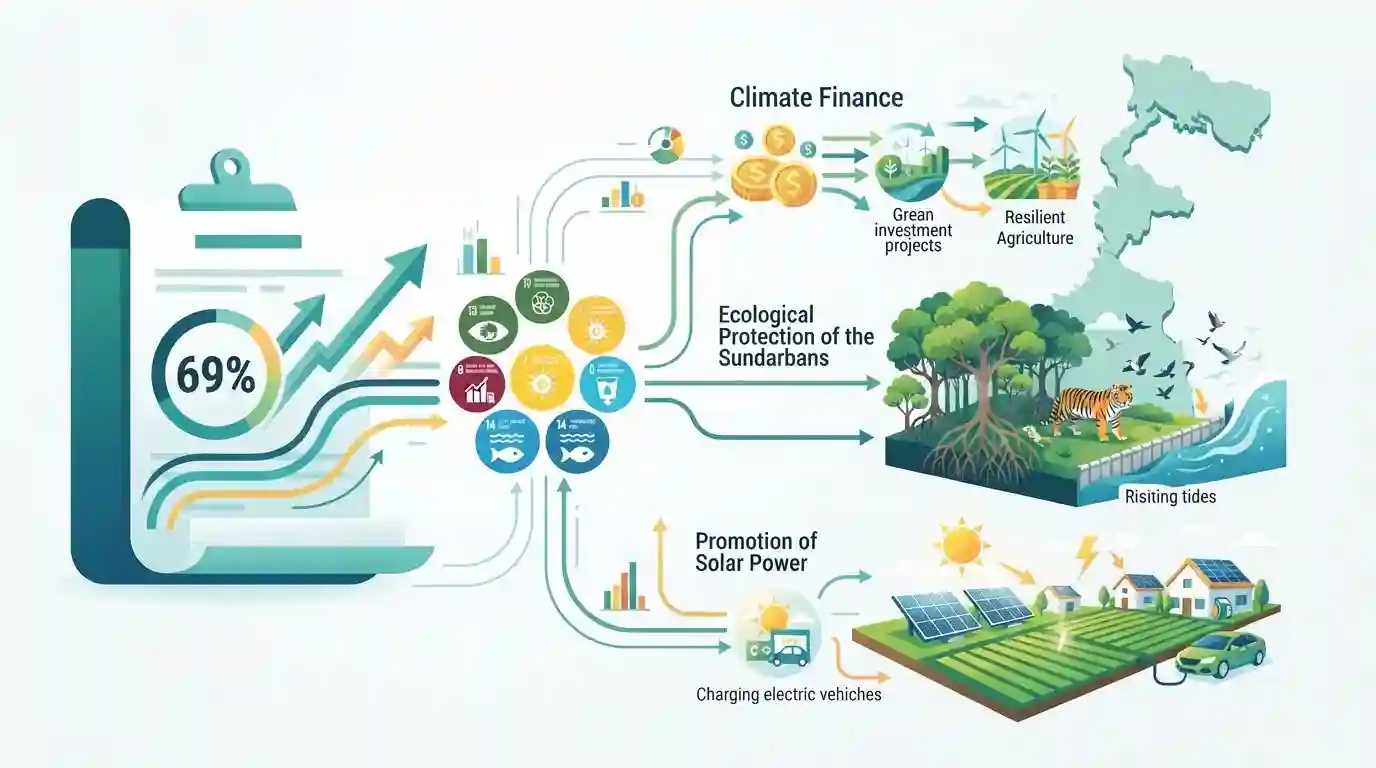
The Government of West Bengal has integrated 69% of its state budget with Sustainable Development Goals (SDGs), highlighting key areas such as climate finance, ecological protection of the Sundarbans, and the promotion of solar power. This move aligns fiscal policy with climate action and regional environmental sustainability.
Key Points
- West Bengal has linked 69 per cent of its budget to Sustainable Development Goals (SDGs), placing a major strategic focus on climate finance, the Sundarbans ecosystem, and solar power expansion.
- The state's financial allocation targets vulnerability reduction in the fragile Sundarbans deltaic region, addressing sea-level rise, coastal erosion, and climate resilience.
- Promotion of renewable energy, particularly solar power, forms a key pillar of West Bengal's green budgeting initiative to lower carbon emissions and transition toward sustainable energy sources.
Important Terms
Sustainable Development Goals (SDGs)

A collection of 17 global goals established by the United Nations to address social, economic, and environmental challenges by 2030.
UPSC context
Crucial for WBCS Paper V (Economy and Environment) and Paper IV (Public Administration), testing fiscal policy alignment with global sustainability targets.
Climate Finance
Local funding initiatives and institutional mechanisms aimed at supporting green livelihoods, climate resilience, and adaptation projects within the Sundarbans and wider state geography.
UPSC context
Important for WBCS Geography and Environment sections, focusing on disaster management, climate vulnerability, and regional sustainable development funds.
Sundarbans
The unique deltaic region spanning West Bengal and Bangladesh, internationally recognized as a biodiversity hotspot and vulnerable to climate change, cyclones, and sea-level rise.
UPSC context
Directly relevant to WBCS West Bengal Geography and Environmental Ecology, testing knowledge of mangrove ecosystems, conservation, and deltaic vulnerabilities.
Static Concepts Connected
What are the key geographical and ecological features of the Sundarbans?
- Mangrove Ecosystem:: Largest mangrove forest globally, spread across India and Bangladesh, designated as a UNESCO World Heritage Site and Ramsar wetland.
- Biodiversity:: Home to the endangered Royal Bengal Tiger and fragile deltaic flora like Heritiera fomes (Sundari tree).
- Vulnerability:: Extremely vulnerable to tropical cyclones (Amphan, Yaas), sea-level rise, coastal erosion, and high soil salinity.
Cross-Topic Patterns
Green Budgeting Meets Fiscal Federalism
Green budgeting intersects fiscal federalism when states deploy dedicated climate funds alongside central schemes like PM-KUSUM.
Multilateral Finance and Delta Management
Sundarbans deltaic resilience relies on ADB/World Bank loans, connecting state development administration with international financial institutions.

Expect WBPSC to test exact figures: the 69% budget integration with SDGs and specific allocations like SDG 10 for inequality reduction.
Linked PYQs · 2
Linked PYQs · 2
- 2019WBCS_PRELIMSGS1
Sundarban is declared as 'World Heritage Site' for
- 2024WBCS_PRELIMSGS1
On a per hectare basis which of the following forests will hold maximum amount of carbon?
