West Bengal adopts Ayushman Bharat scheme to expand health coverage
Source:The Hindu ↗
Why It Matters
Healthcare is a State subject in India, leading to friction in implementing centrally sponsored schemes. West Bengal's adoption of AB PM-JAY is a crucial example of cooperative federalism overcoming political differences to provide social security and reduce out-of-pocket healthcare expenses.
Summary
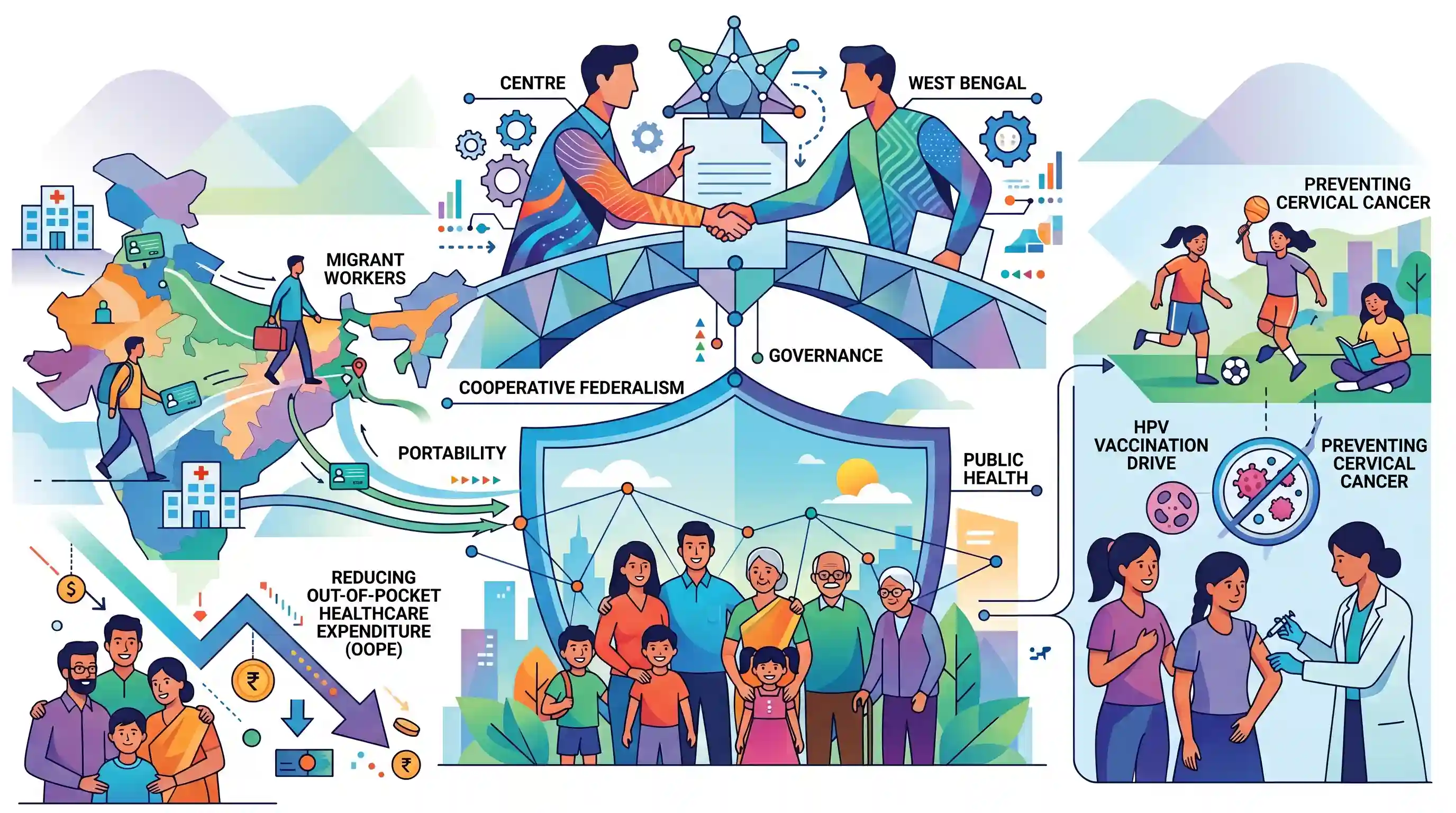
West Bengal has officially integrated into the Ayushman Bharat Pradhan Mantri Jan Arogya Yojana (AB PM-JAY), making it the 36th State/UT to adopt the flagship national health insurance scheme. Marked by an MoU between the National Health Authority and the state's health department, this development highlights the strengthening of cooperative federalism in healthcare delivery. The integration extends the scheme's portability benefits to West Bengal's migrant workers, ensuring they can access cashless treatment anywhere in the country. The initiative underscores the ongoing national effort to reduce out-of-pocket healthcare expenditures (OOPE) and achieve Universal Health Coverage. Concurrently, the state launched an HPV vaccination drive for adolescent girls to prevent cervical cancer.
Key Points
- West Bengal joined the Ayushman Bharat PM-JAY, becoming the 36th State/Union Territory to implement the nationwide health scheme.
- An MoU was signed between the National Health Authority (NHA) and the West Bengal Department of Health and Family Welfare to facilitate the rollout.
- The implementation allows residents and migrant workers from West Bengal to access cashless secondary and tertiary care hospitalization across India using the scheme's portability feature.
- AB PM-JAY has significantly contributed to decreasing India's out-of-pocket health expenditure from 64.6% before 2018 to 43.4%.
- Alongside AB PM-JAY, West Bengal launched the HPV Vaccination Programme aimed at protecting adolescent girls against cervical cancer.
Important Terms
Ayushman Bharat PM-JAY

The world’s largest government-funded health assurance scheme, providing ₹5 lakh annual coverage per family for secondary and tertiary hospitalization to over 12 crore poor and vulnerable households.
UPSC context
GS II: Welfare schemes for vulnerable sections; tests social safety nets and public health delivery.
National Health Authority (NHA)
The apex body under the Ministry of Health and Family Welfare responsible for implementing flagship programs like PM-JAY and the Digital Health Mission with functional autonomy.
UPSC context
GS II: Statutory and regulatory bodies; tests executive governance and implementation of healthcare policies.
Universal Health Coverage (UHC)
A public health goal ensuring all individuals have access to quality health services without facing financial hardship, aligned with Sustainable Development Goal (SDG) 3.8.
UPSC context
GS II: Social Justice/Health; tests conceptual clarity on health equity and global developmental targets.
Out-of-Pocket Expenditure (OOPE)
Direct payments made by individuals for healthcare at the point of service, not covered by insurance. High OOPE is a major cause of medical impoverishment in India.
UPSC context
GS III: Indian Economy/Public Finance; tests understanding of health economics and socio-economic vulnerability.
HPV Vaccination Drive
A national initiative targeting adolescent girls (typically aged 9-14) to prevent cervical cancer, which is the second most common cancer among women in India.
UPSC context
GS III: Science & Technology; GS II: Health; tests preventive healthcare and indigenous vaccine developments.
Cooperative Federalism
A constitutional principle where the Centre and States work together to solve national problems, exemplified by all 36 States/UTs now implementing the PM-JAY scheme.
UPSC context
GS II: Federal Structure; tests Centre-State relations and collaborative governance in policy implementation.
Prelims Trap
"PM-JAY provides up to Rs 5 lakh cashless coverage for primary, secondary, and tertiary healthcare across India."
PM-JAY specifically targets secondary and tertiary hospitalization. Primary healthcare is addressed by the scheme's other foundational pillar: Ayushman Arogya Mandirs (Health and Wellness Centres).
Static Concepts Connected
What are the fundamental features of Centrally Sponsored Schemes (CSS)?
- Funding pattern: Typically shared between the Centre and States (e.g., 60:40 for general category states, and 90:10 for North-Eastern and Himalayan states).
- Execution authority: Executed by State governments. This structural reliance makes cooperative federalism and MoUs essential for achieving uniform national implementation.
- Constitutional basis: Grants for CSS are generally routed under Article 282, allowing the Union or a State to make grants for any public purpose.
How does the Human Papillomavirus (HPV) vaccine function?
- Recombinant technology: It is a recombinant vaccine using virus-like particles (VLPs) that mimic the virus's structure to provoke an immune response without causing the actual infection.
- Target variants: Protects against high-risk variants, particularly HPV-16 and HPV-18, which are responsible for approximately 70% of all cervical cancer cases globally.
Cross-Topic Patterns
Welfare Portability & Circular Migration
PM-JAY’s national portability mirrors the One Nation One Ration Card (ONORC) scheme, reflecting a governance shift towards decoupling welfare delivery from the beneficiary's domicile state to support circular migrants.
Preventive vs. Curative Healthcare Synergy
Pairing PM-JAY (curative) with the HPV vaccination drive (preventive) aligns with the National Health Policy 2017 framework, which emphasizes reducing the tertiary disease burden through robust early-stage interventions.

Expect a 2026 Prelims multi-statement question combining PM-JAY portability rules, OOPE exclusions, and the recombinant HPV vaccine.
Linked PYQs · 3
Linked PYQs · 3
- 2022PrelimsGS1
With reference to Ayushman Bharat Digital Mission, consider the following statements: 1. Private and public hospitals must adopt it. 2. As it aims to achieve universal health coverage, every citizen of India should be part of it ultimately. 3. It has seamless portability across the country. Which of the statements given above is/are correct?
- 2024MainsGS2
In a crucial domain like the public healthcare system the Indian State should play a vital role to contain the adverse impact of marketisation of the system. Suggest some measures through which the State can enhance the reach of public healthcare at the grassroots level.
- 2024MainsGS2
What changes has the Union Government recently introduced in the domain of Centre-State relations ? Suggest measures to be adopted to build the trust between the Centre and the States and for strengthening federalism.
