West Bengal Government Organises State Wide Raksha Bandhan Events
Source:theprint ↗
Why It Matters
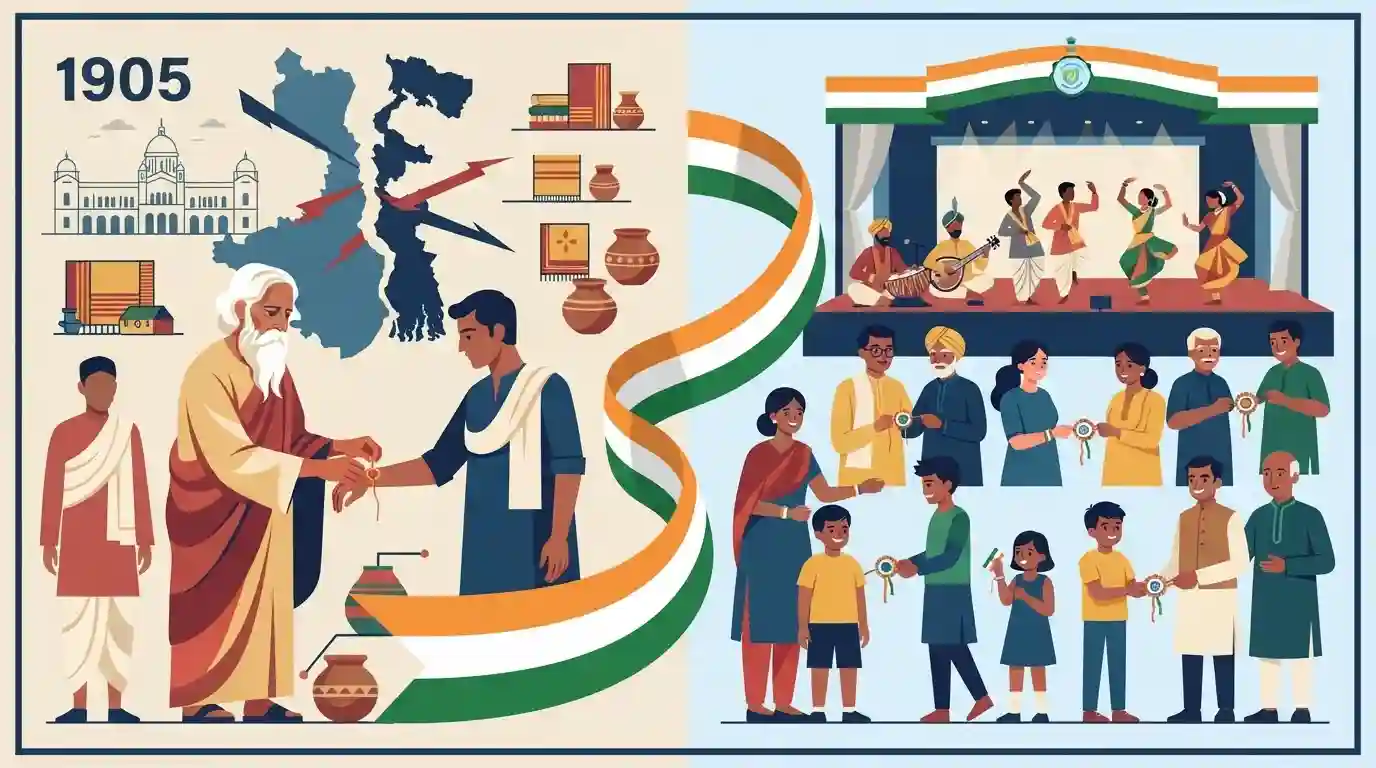
The modern-day observance of Raksha Bandhan for unity in West Bengal is a direct callback to Rabindranath Tagore's historic political use of the festival in 1905 during the Anti-Partition (Swadeshi) Movement. Questions regarding Tagore's initiation of the Rakhi festival and the chronology of the Partition of Bengal are highly recurring and fundamental topics in the WBCS Preliminary examination.
Summary
The West Bengal government has directed the organization of state-wide Raksha Bandhan celebrations on August 28 to foster national unity, social harmony, and cultural heritage. Managed by the Information and Cultural Affairs and Youth Services departments, the events will include tricolor rakhi-tying ceremonies, Rabindra Sangeet, and folk performances. This modern government initiative deeply echoes Rabindranath Tagore's historic use of the Rakhi Bandhan festival on October 16, 1905, to protest Lord Curzon's Partition of Bengal and symbolize unbreakable brotherhood between Hindus and Muslims.
Key Points
- The West Bengal government is organizing state-wide Raksha Bandhan celebrations on August 28 to promote national unity and social harmony.
- The event is being spearheaded by the state's Information and Cultural Affairs Department along with the Department of Youth Services and Sports.
- Celebrations will feature performances of Rabindra Sangeet, Rabindra Nritya, and traditional Bengal folk arts to highlight the state's rich cultural heritage.
- People will tie tricolor-themed rakhis on each other's wrists as a symbol of fraternity and unity.
- Historically, Rabindranath Tagore used Raksha Bandhan in 1905 as a powerful symbol of Hindu-Muslim unity and resistance against the British Partition of Bengal.
Important Terms
Information and Cultural Affairs Department

The West Bengal nodal agency tasked with disseminating government information, managing public relations, and preserving the state's vibrant cultural heritage, including folk arts, music, and cinema.
UPSC context
Important for WBCS Paper V (Polity), testing knowledge of state-level ministries, administrative bodies, and the execution of socio-cultural policies.
Department of Youth Services and Sports
A West Bengal state department focused on developing sports infrastructure, empowering student-youth through vocational training, and promoting physical culture among vulnerable sections and the broader public.
UPSC context
Relevant for WBCS Paper V and Current Affairs; highlights state governance mechanisms for youth welfare, sports administration, and community engagement initiatives.
West Bengal Government
The sub-national administrative authority governing the Indian state of West Bengal, responsible for state-level policymaking, implementing welfare initiatives, and maintaining public administration.
UPSC context
Fundamental for WBCS Paper V (Indian Constitution and Polity), testing the understanding of state executives, federal structure, and state-sponsored public welfare schemes.
Prelims Trap
"Tagore initiated the Rakhi Bandhan festival on the day the Partition of Bengal was formally announced."
Tagore initiated Rakhi Bandhan on October 16, 1905—the day the partition came into effect—not on the day it was formally announced (July 1905).
Static Concepts Connected
What are the critical timeline milestones of the Partition of Bengal?
- Formal Announcement: The plan to partition Bengal was formally announced by Viceroy Lord Curzon in July 1905.
- Implementation Date: The partition came into effect on October 16, 1905, observed across Bengal as a day of mourning and Rakhi Bandhan.
- Annulment: The partition was finally revoked in 1911 by Lord Hardinge to curb massive political unrest and revolutionary terrorism.
How did Rabindranath Tagore contribute to the Swadeshi Movement (1905)?
- Rakhi Bandhan: He used the traditional Rakhi tying ceremony as a political tool to symbolize unbreakable brotherhood between Hindus and Muslims.
- Cultural Awakening: He composed the patriotic song 'Amar Sonar Bangla' to inspire solidarity among Bengalis, which later became Bangladesh's national anthem.
- National Education: He established the National Council of Education to promote indigenous learning, distancing himself from the aggressive boycott of British goods.
Cross-Topic Patterns
Swadeshi symbols in modern governance
Current state events repurposing 1905 Swadeshi tactics frequently serve as a current-affairs trigger for static Indian National Movement questions on Bengal's partition and Tagore's political phase.
Cultural heritage as state soft power
The promotion of Rabindra Sangeet and folk performances alongside government schemes highlights the intersection of state welfare and Bengal's regional cultural heritage, a growing theme in WBCS Mains.

State events invoking 1905 Rakhi Bandhan make chronological matching of Bengal Partition milestones (Announcement vs Effect) highly probable.
Linked PYQs · 5
Linked PYQs · 5
- 2022WBCS_PRELIMSGS1
Who pioneered ‘Rakhi Bandhan’ festival during partition of Bengal?
- 2019WBCS_PRELIMSGS1
Which of the following movements immediately followed the partition of Bengal?
- 2021WBCS_PRELIMSGS1
The Partition of Bengal was annulled in
- 2015WBCS_PRELIMSGS1
Partition of Bengal was withdrawn in
- 2010WBCS_PRELIMSGS1
Partition of Bengal was withdrawn in
