West Bengal government notifies enhanced Dearness Allowance hike
Source:ddindia ↗
Why It Matters
Understanding how Dearness Allowance is indexed to inflation metrics (like the CPI for Industrial Workers) provides essential context for questions on inflation, consumer purchasing power, and state fiscal responsibilities. Moreover, policies addressing workers outside the Minimum Wages Act highlight ongoing structural dynamics within India's unorganized and informal labor markets.
Summary
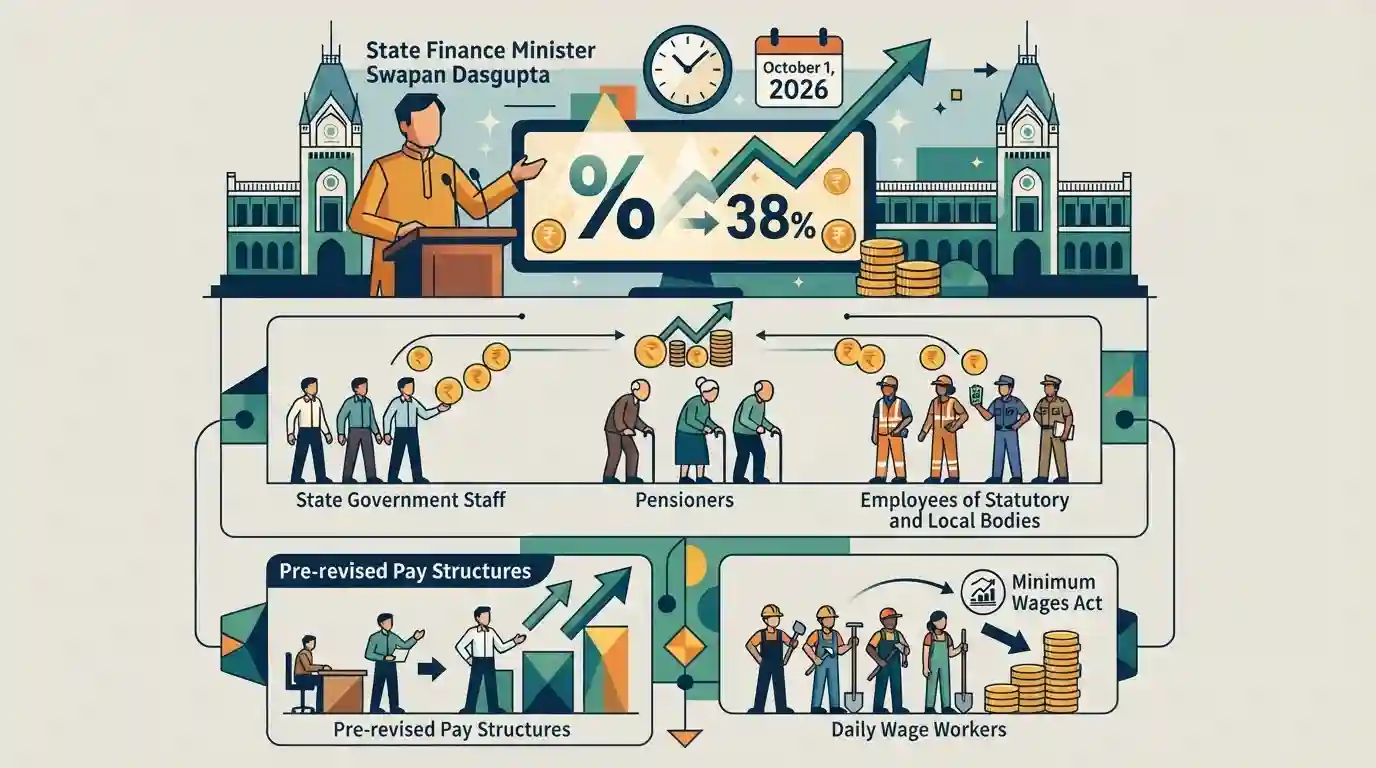
The West Bengal government has notified a Dearness Allowance (DA) hike for state government employees, raising it to 38% of their basic pay effective October 1, 2026. The move, outlined by State Finance Minister Swapan Dasgupta, applies to government staff, pensioners, and employees of statutory and local bodies. Additionally, adjustments were announced for staff under pre-revised pay structures and daily wage workers outside the purview of the Minimum Wages Act, reflecting broader state efforts to index public sector earnings to inflation.
Key Points
- The West Bengal government announced an increase in Dearness Allowance (DA) to 38% of basic pay, effective October 1, 2026.
- The hike extends to state government employees, teaching and non-teaching staff in aided institutions, and employees of local and statutory bodies.
- Dearness Relief for state pensioners and family pensioners has been proportionally increased alongside the DA hike.
- Employees under the pre-revised pay structures (ROPA 2009 / Fifth Pay Commission) will see their DA raised from 171% to 223%.
- Daily wage workers who are not covered under the Minimum Wages Act will receive an ad-hoc increase of Rs 110 per day.
Important Terms
Dearness Allowance (DA)

A cost-of-living adjustment allowance paid to government employees and pensioners, calculated as a percentage of basic salary and pegged to the Consumer Price Index to offset inflation.
UPSC context
GS Paper 3 (Indian Economy). Tests understanding of inflation management, wage indexing, and public expenditure impacts.
Minimum Wages Act, 1948
A statutory framework empowering central and state governments to fix and periodically revise minimum wage rates for skilled and unskilled workers to prevent exploitation.
UPSC context
GS Paper 2 & 3 (Social Justice, Labour). Tests knowledge of worker protections, welfare measures, and the Code on Wages.
Inflation Indexing
The macroeconomic practice of automatically adjusting wages, taxes, or interest rates in line with inflation changes to maintain consumers' real purchasing power.
UPSC context
GS Paper 3 (Indian Economy). Important for questions on demand-pull inflation, monetary policy, and macroeconomic stabilization.
Revision of Pay and Allowance (ROPA) Rules
State-level statutory rules, such as those in West Bengal, designed to restructure the pay matrix, grade pay, and allowances for civil servants following Pay Commission recommendations.
UPSC context
GS Paper 2 (Governance). Relevant for understanding state-level administrative frameworks, civil service reforms, and public finance.
Prelims Trap
Dearness Allowance (DA) is calculated and indexed based on the Consumer Price Index-Combined (CPI-C).
DA for government employees is calculated using the Consumer Price Index for Industrial Workers (CPI-IW) compiled by the Labour Bureau, not CPI-Combined.
Static Concepts Connected
How are government salaries and DA payouts classified in the Budget?
- Revenue Expenditure: Salaries, pensions, and DA are recurring, operational costs. They neither create physical/financial assets nor reduce government liabilities.
- Fiscal Impact: Rising DA payouts directly increase the Revenue Deficit, which can limit the government's fiscal capacity for productive capital outlays.
Which inflation index is used to calculate Dearness Allowance (DA)?
- CPI-IW: DA and Variable Dearness Allowance (for minimum wages) are linked to this index to offset the impact of inflation on living costs.
- Labour Bureau: Unlike CPI-Combined (compiled by NSO), CPI-IW is compiled and released by the Labour Bureau under the Ministry of Labour and Employment.
Cross-Topic Patterns
State Fiscal Space + Committed Expenditure
State-level DA hikes increase committed revenue expenditure, often squeezing out capital expenditure. This tension frequently features in RBI's annual 'State Finances: A Study of Budgets' report.
Code on Wages + Unorganised Sector
The ad-hoc raises for workers outside the Minimum Wages Act highlight coverage gaps that the new Code on Wages seeks to bridge by extending statutory floor wages to all workers.

Expect a prelims statement contrasting the use of CPI-IW for Dearness Allowance calculation versus CPI-C for RBI's inflation targeting.
Linked PYQs · 4
Linked PYQs · 4
- 2009WBCS_PRELIMSGS1
The basis for determination of Dearness Allowance of urban salaried workers and government employees in India is
- 2021WBCS_PRELIMSGS1
Inflation is
- 2024WBCS_PRELIMSGS1
Which of the following is not a problem of the unorganized sector?
- 2020WBCS_PRELIMSGS1
Unemployment in India is concentrated in
