West Bengal invokes Goonda Act against violent protesters in Kolkata
Source:opindia ↗
কেন এটি গুরুত্বপূর্ণ
Highlights the constitutional intersection between Fundamental Rights (right to protest) and 'Law and Order', which falls under the State List. Understanding state-specific preventive or anti-social activities laws is pertinent to polity and governance questions in WBCS.
সারসংক্ষেপ
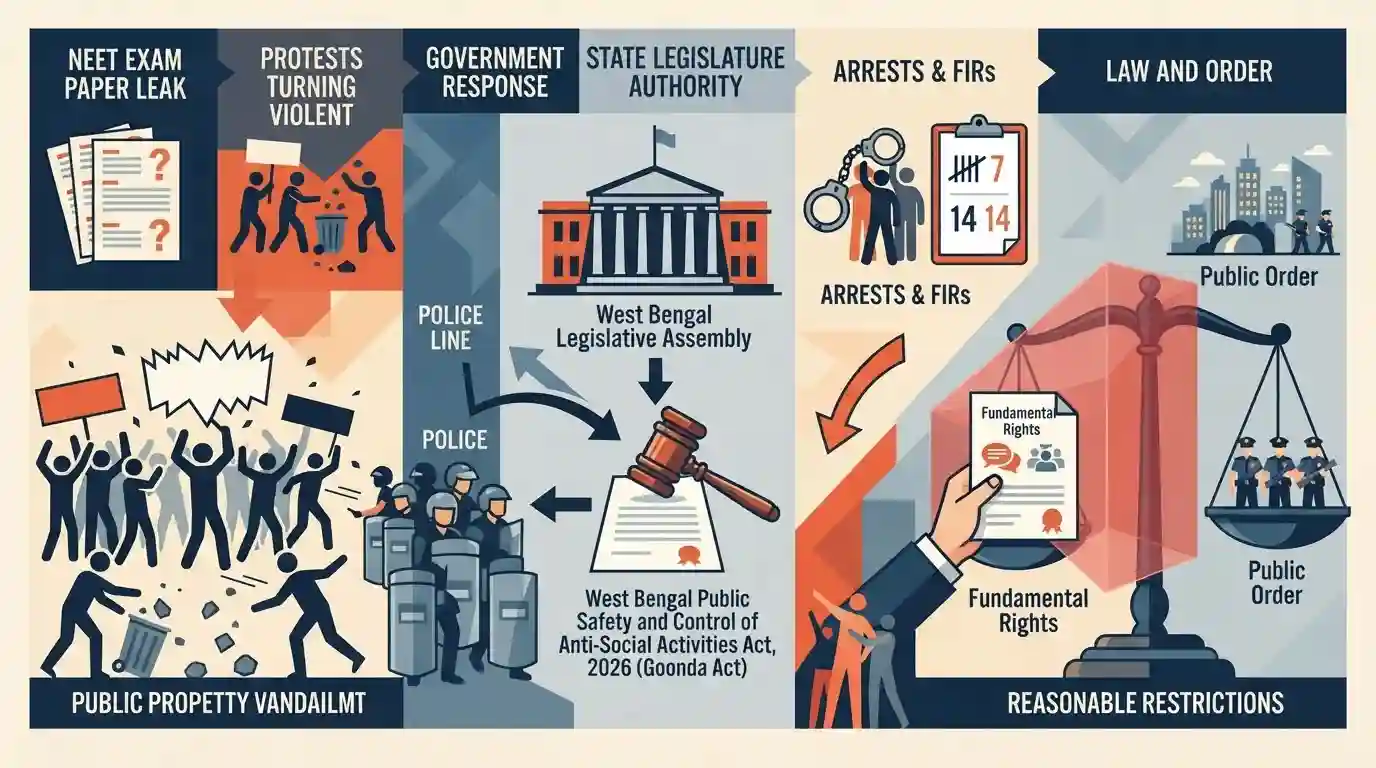
The West Bengal government has invoked the West Bengal Public Safety and Control of Anti-Social Activities Act, 2026 (Goonda Act) against violent protesters in Kolkata who were demonstrating over the NEET exam paper leak. Chief Minister Suvendu Adhikari stated in the Assembly that the protests had turned violent with public property being vandalised, resulting in 14 arrests and 7 FIRs. This highlights the State Government's authority over 'Law and Order' and the imposition of reasonable restrictions on fundamental rights during protests.
মূল বিষয়
- The West Bengal government has invoked the Goonda Act against violent protesters in Kolkata.
- The protests erupted over the alleged NEET examination paper leak, leading to the vandalisation of public property.
- Chief Minister Suvendu Adhikari announced in the State Assembly that 14 people have been arrested and seven FIRs filed.
- The application of such Acts relates to state powers over 'Public Order' and reasonable restrictions on protests under Article 19.
গুরুত্বপূর্ণ শব্দ
West Bengal Public Safety and Control of Anti-Social Activities Act, 2026

A state law enacting strict preventive detention for up to 12 months, externment orders, and asset confiscation to curb organized crime and violent anti-social activities.
UPSC context
GS-2 (State Legislature, Fundamental Rights). Tests knowledge of preventive detention laws and their impact on constitutional civil liberties.
Goonda Act
A colloquial label for stringent state-level preventive detention legislations targeting habitual offenders, mafia syndicates, and disruptive elements to maintain public order and safety.
UPSC context
GS-2 and GS-3 (Internal Security). Focuses on the balance between state policing powers and constitutional safeguards under Article 22.
State Assembly
The directly elected lower house of India's state legislature. It is constitutionally empowered to debate and enact laws on subjects under the State List, such as police and public order.
UPSC context
GS-2 (State Legislature). Tests the legislative process, functioning of the state government, and the separation of powers.
West Bengal Government
The executive branch governing the state of West Bengal, headed by the Chief Minister. It wields administrative control over State List subjects, including policing and public safety.
UPSC context
GS-2 (Polity & Governance). Relevant for understanding federalism, state executive powers, and governance responsibilities under the Constitution.
প্রিলিমস ফাঁদ
Only Parliament is empowered to enact laws related to preventive detention under the Indian Constitution.
States can enact preventive detention laws under the Concurrent List for maintaining public order. Parliament holds exclusive power only when detention relates to defense, foreign affairs, or India's security.
সংযুক্ত স্থির ধারণা
What is the constitutional framework for Preventive Detention in India?
- Division of Power: Parliament holds exclusive power for defense/security of India. Parliament and States share power for public order and essential supplies under the Concurrent List.
- Article 22(4) Limit: Detentions cannot exceed three months unless an Advisory Board (comprising individuals qualified as High Court judges) reports sufficient cause for extension.
- Rights of Detenue: The detaining authority must communicate the grounds of detention (unless against public interest) and afford the earliest opportunity to make a representation against the order.
How does the Supreme Court distinguish 'Law and Order' from 'Public Order'?
- Concentric Circles: The SC defines them as concentric circles: 'Law and Order' is the largest sphere, 'Public Order' is inside it, and 'Security of State' forms the narrow core.
- Public Order vs Law: Public order involves acts that disturb the "even tempo of the life of the community," whereas isolated criminal acts fall merely under law and order.
- Constitutional Basis: 'Public Order' is explicitly mentioned as a ground for imposing reasonable restrictions under Article 19(2) and 19(3), while 'Law and Order' is not.
আন্তঃবিষয় প্যাটার্ন
Protest Violence and Public Property Laws
The Prevention of Damage to Public Property Act, 1984, alongside SC guidelines, allows holding protest organizers liable for damages, bridging the right to protest (Article 19) with statutory duties.
State vs. Union under the Concurrent List
State-specific Goonda Acts often require Presidential Assent under Article 254(2) to resolve repugnancy with central statutes like the CrPC (now BNSS) regarding detention and procedural safeguards.

Expect a 2026 prelims question testing Concurrent List powers over Preventive Detention and the limits of 'Public Order' under Article 19.
সংযুক্ত PYQ · 2
সংযুক্ত PYQ · 2
- 2017WBCS_PRELIMSGS1
'Law and Order' is included in the
- 2023WBCS_PRELIMSGS1
Who among the following has been given the power by the Indian Constitution to 'impose reasonable restrictions' on the fundamental rights?
