West Bengal Industrial Policy: State Government Initiates Tata Talks
Source:businessaajkal ↗
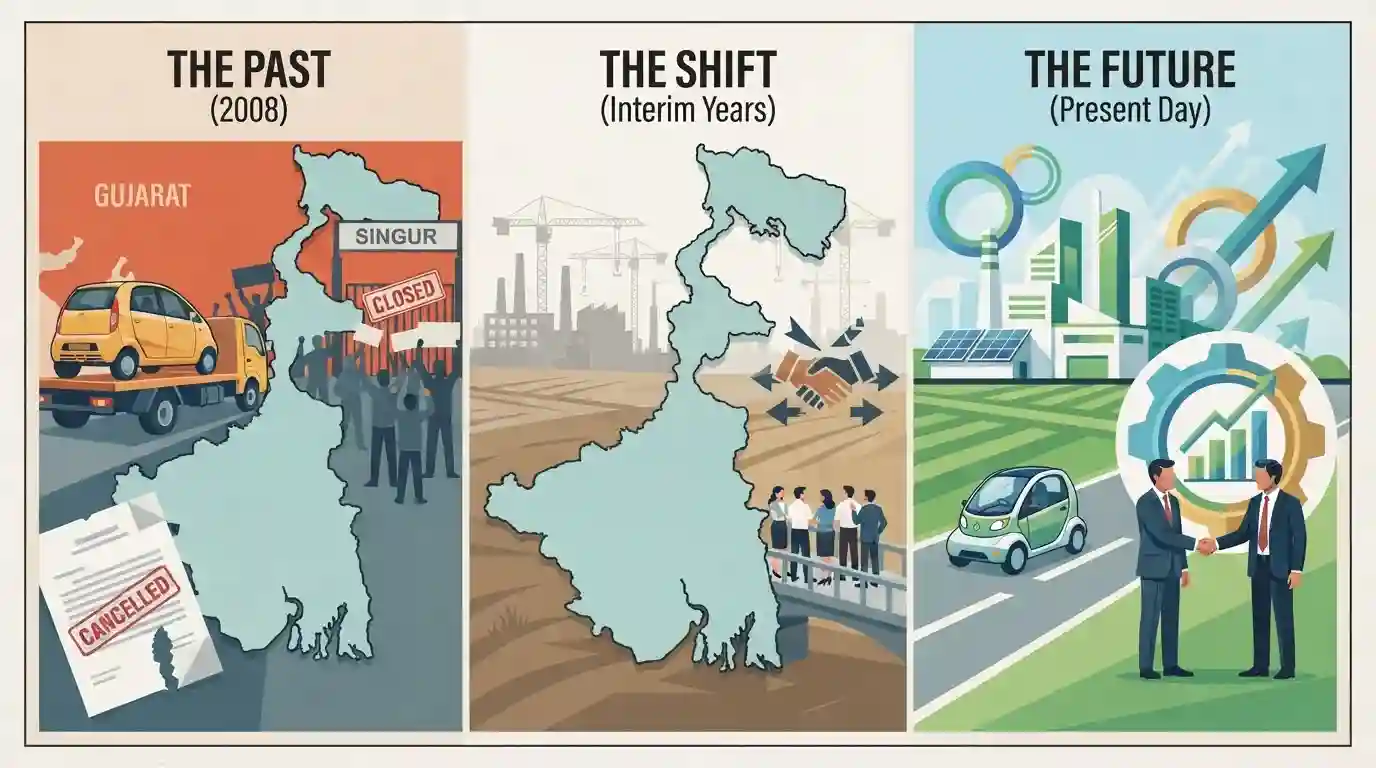
Why It Matters
The potential return of the Tata Group to West Bengal represents a critical turning point for the state's industrial climate and economic policies, closing a chapter on the historic 2008 Singur land acquisition protests and opening avenues for major private sector investments.
Summary
The West Bengal government has initiated discussions with the Tata Group to explore potential fresh investments in the state, according to Industry Minister Tapas Roy. This outreach marks a significant shift in industrial policy, coming years after the Tata Group withdrew its Nano car plant from Singur in 2008 and relocated it to Gujarat due to intense land acquisition protests spearheaded by Mamata Banerjee.
Key Points
- West Bengal Industry Minister Tapas Roy announced ongoing talks with the Tata Group to explore fresh investment opportunities in the state.
- This outreach is a strategic move to boost industrial engagement and attract capital to West Bengal.
- The discussions are historically significant as they follow the withdrawal of the Tata Nano car project from Singur in October 2008.
- The Nano project was shifted to Sanand, Gujarat, following massive protests against land acquisition led by Mamata Banerjee.
Important Terms
Tata Group

A major Indian multinational conglomerate founded in 1868. Its subsidiary, Tata Motors, relocated its proposed Nano car plant from Singur, West Bengal, to Gujarat in 2008 due to intense protests over land acquisition.
UPSC context
GS Paper III (Infrastructure and Growth); tests industrial development, investment models, and corporate-state relations.
Singur Land Dispute
A landmark 2006 controversy over the acquisition of 997 acres of farmland in West Bengal for Tata Motors' plant. It led to a 2016 Supreme Court ruling declaring the acquisition illegal and ordering land restoration.
UPSC context
GS Paper II and III; tests land reforms, rights of farmers, judicial oversight, and development conflicts.
RFCTLARR Act, 2013
The Right to Fair Compensation and Transparency in Land Acquisition, Rehabilitation and Resettlement Act, 2013, which replaced the colonial-era 1894 Act. It mandates fair compensation, social impact assessments, and landowner consent.
UPSC context
GS Paper II and III; tests regulatory legislation, agricultural security, and state-led development frameworks.
Ease of Doing Business
A policy metric reflecting regulatory simplicity, transparent clearances, and stable land acquisition procedures, which governments use to attract private and foreign investments into manufacturing and services.
UPSC context
GS Paper III (Indian Economy); tests investment climate, regulatory reform, and competitive federalism.
Eminent Domain
A legal doctrine giving the state power to acquire private property for public use without the owner's consent, subject to paying compensation. It was heavily misused under colonial-era laws.
UPSC context
GS Paper II (Constitutional Rights); tests Right to Property, state power, and judicial review limits.
Prelims Trap
The LARR Act 2013 mandates 80% consent for public sector projects and 100% consent for private acquisitions.
Public sector projects require no mandatory landowner consent under the central Act. Private projects require 80% consent, and PPPs require 70%.
Static Concepts Connected
What is the Doctrine of Eminent Domain under the Indian Constitution?
- Sovereign Power: Refers to the inherent power of the state to acquire private property for public use without the owner's consent.
- Article 300A: Demoted the Right to Property to a constitutional right, requiring legislative authority ("authority of law") to deprive property.
- Public Purpose: Judicial review ensures land acquisitions are genuinely for public benefit, preventing arbitrary use for purely private enterprises.
What are the core mandates of the LARR Act 2013?
- Consent Requirements: Mandates consent of 80% landowners for private projects and 70% for Public-Private Partnership (PPP) projects.
- Social Impact Assessment: Requires a mandatory study to evaluate the project's impact on local livelihoods and food security before acquisition.
- Rehabilitation & Resettlement: Couples land compensation with statutory packages to restore livelihoods of both landowners and landless laborers.
Cross-Topic Patterns
Land acquisition and cooperative federalism
State-level exemptions to the central LARR Act 2013 highlight federal tensions, as states dilute consent clauses to attract competitive industrial investment.
Industrial location and regional disparity
The migration of capital highlights how state-level land regulatory environments override traditional transport-cost models, altering India's regional industrial distribution.

Mains questions may analyze how state-level dilutions of the LARR Act 2013 balance 'Ease of Doing Business' with the Doctrine of Eminent Domain.
Linked PYQs · 4
Linked PYQs · 4
- 2024WBCS_PRELIMSGS1
Wind Energy Project was set up in West Bengal at:
- 2024WBCS_PRELIMSGS1
Golden Quadrilateral is a
- 2020WBCS_PRELIMSGS1
The Governor of West Bengal is
- 2015WBCS_PRELIMSGS1
NABARD is associated with
