West Bengal committee formed to examine uniform civil code draft
Source:etvbharat ↗
Why It Matters
Understanding the Uniform Civil Code is crucial for WBCS Prelims, as it touches upon fundamental constitutional principles (Article 44), DPSP, legislative relations between the Centre and the States, and ongoing debates regarding secularism and personal laws.
Summary
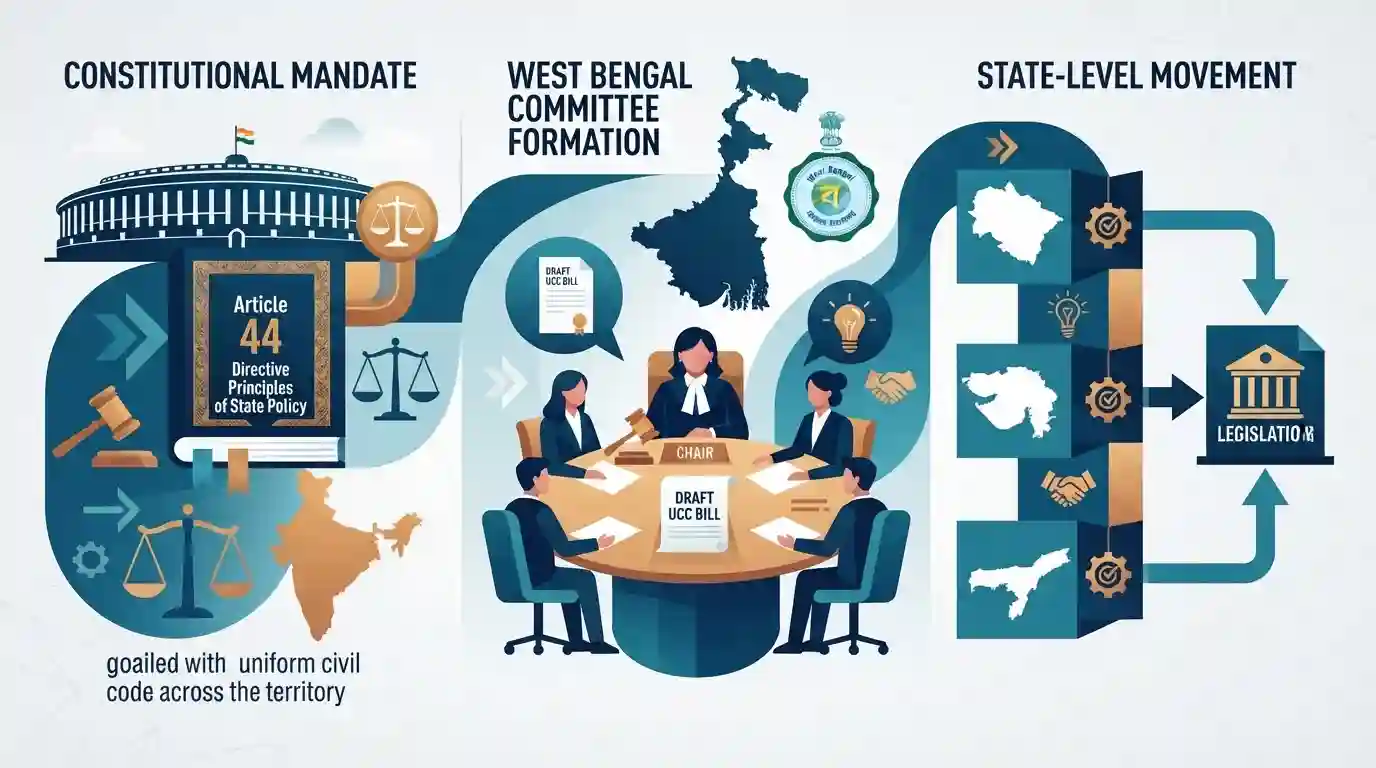
The West Bengal government has constituted a committee, headed by former Supreme Court judge Justice Ranjana Prakash Desai, to examine a draft Uniform Civil Code (UCC) bill. This move aligns with the constitutional mandate under Article 44 of the Directive Principles of State Policy, which advocates for a uniform civil code across the territory of India. With this step, West Bengal is set to follow other states like Uttarakhand, Gujarat, and Assam that have taken measures toward implementing state-level UCC legislation.
Key Points
- The West Bengal government has established a committee to examine a draft Uniform Civil Code (UCC) bill for the state.
- The committee is chaired by former Supreme Court judge Justice Ranjana Prakash Desai.
- Article 44 of the Indian Constitution, enshrined in the Directive Principles of State Policy, directs the State to secure a Uniform Civil Code for citizens.
- West Bengal follows in the footsteps of states like Uttarakhand, Gujarat, and Assam, which have also moved to implement a UCC at the state level.
Important Terms
Uniform Civil Code (UCC)

A comprehensive legal framework designed to replace religion-based personal laws with a single set of rules governing marriage, divorce, succession, and adoption for all citizens.
UPSC context
Highly relevant for GS Paper 2 (Polity); tests understanding of secularism, gender justice, and constitutional directives.
Article 44
A constitutional provision under Part IV (Directive Principles of State Policy) that directs the State to endeavour to secure a Uniform Civil Code for all citizens throughout India's territory.
UPSC context
Core GS Paper 2 topic; frequently tested on constitutional debates, minority rights, and the non-justiciable nature of DPSPs.
Justice Ranjana Prakash Desai Committee
An expert panel chaired by former Supreme Court Justice Ranjana Prakash Desai, constituted by states like Uttarakhand, Maharashtra, and West Bengal to draft and examine state-level UCC legislation.
UPSC context
Relevant for GS Paper 2 (State Legislation); highlights the use of judicial expertise in drafting complex socio-legal state policies.
Directive Principles of State Policy (DPSP)
Non-justiciable constitutional guidelines outlined in Part IV that instruct the government on socio-economic principles to follow while formulating policies and enacting laws.
UPSC context
Essential for GS Paper 2; tests the balance between fundamental rights and state obligations in driving social reform.
Prelims Trap
"Only Parliament has the power to enact a Uniform Civil Code for citizens."
Personal laws fall under Entry 5 of the Concurrent List. State legislatures can enact their own UCCs, though they require Presidential assent if they conflict with existing central laws.
Static Concepts Connected
How is legislative power regarding personal laws distributed in India?
- Concurrent List: Marriage, divorce, inheritance, and adoption fall under Entry 5 of List III (Concurrent List).
- Joint Competence: Both Parliament and State Legislatures have the competence to draft laws governing personal civil matters.
- Repugnancy Rule: Under Article 254(2), if a state law on a concurrent subject conflicts with a central law, it needs Presidential assent to prevail.
What is the constitutional nature of Article 44?
- Constitutional Mandate: It directs the State to endeavor to secure for citizens a Uniform Civil Code throughout India.
- Non-justiciable: As a Directive Principle of State Policy (Part IV), it is fundamental in governance but not enforceable by any court (Article 37).
- Ideological Category: It is classified by scholars as a liberal-intellectual directive, promoting equality and national integration.
Cross-Topic Patterns
State UCCs & Article 254(2)
Since personal laws are in the Concurrent List, any state UCC conflicting with existing central laws (e.g., Hindu Marriage Act) requires the President's assent under Article 254(2) to be valid.
Tribal Rights vs. Civil Uniformity
State UCCs (like Uttarakhand's) explicitly exempt Scheduled Tribes to avoid conflicts with customary law protections guaranteed under the Fifth and Sixth Schedules of the Constitution.

Expect a 2026 Prelims question pairing Article 44 (UCC) with Entry 5 of the Concurrent List and Presidential assent rules for State bills.
Linked PYQs · 3
Linked PYQs · 3
- 2019WBCS_PRELIMSGS1
The ideal of 'Welfare State' in the Indian Constitution in enshrined in its
- 2007WBCS_PRELIMSGS1
The Directive Principles of State Policy of India have similarity with
- 2014WBCS_PRELIMSGS1
The new Chief Justice of the Supreme Court is
