West Bengal Occupational Safety and Working Conditions Rules
Source:lexplosion ↗
Why It Matters
Labour falls in the Concurrent List, and state-level labour reforms and rules are crucial for ensuring ease of doing business alongside robust worker welfare. Understanding such state-specific draft rules helps in polity and economy questions related to governance, migrant workers, and social security.
Summary
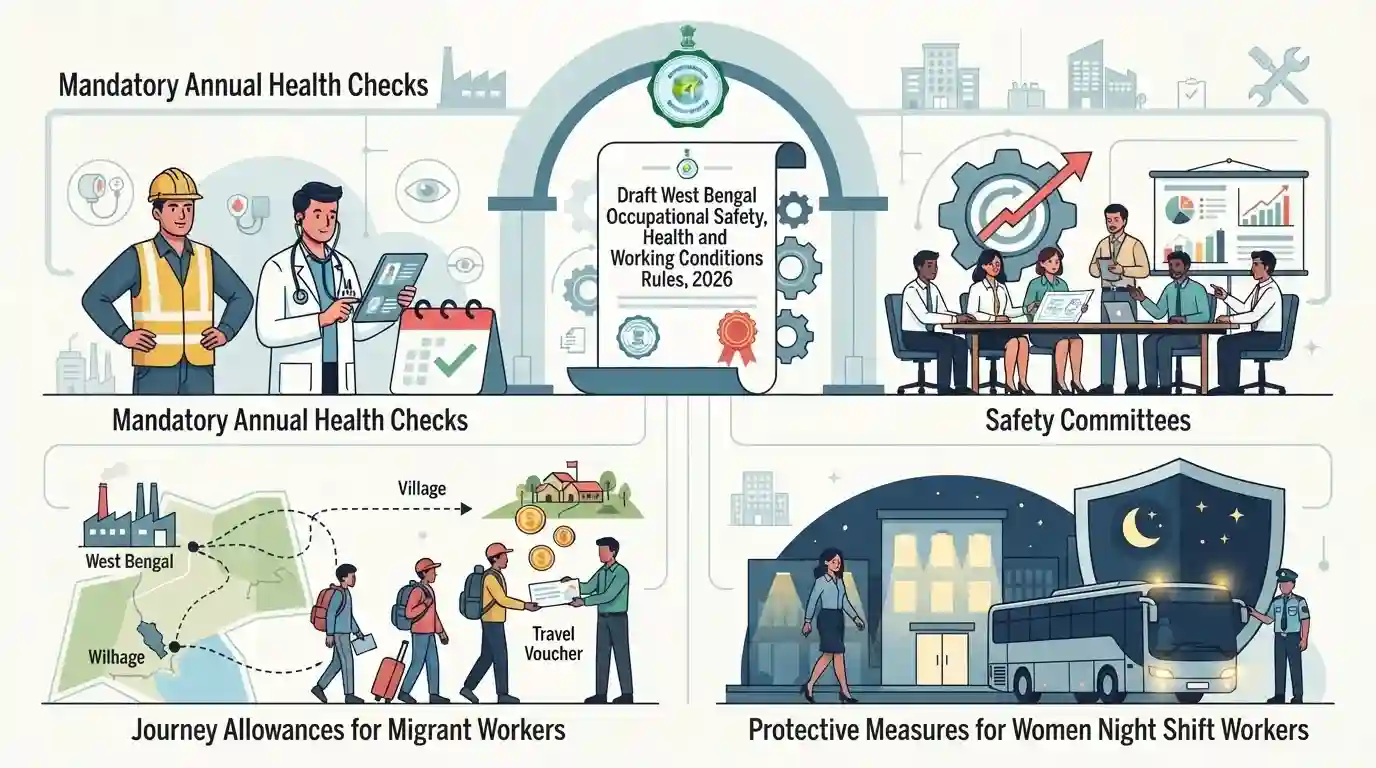
The Government of West Bengal has proposed the Draft West Bengal Occupational Safety, Health and Working Conditions Rules, 2026. Aligned with the central Occupational Safety, Health and Working Conditions Code, 2020, the draft rules aim to enhance workplace safety, define employer obligations, and protect vulnerable worker categories. Key provisions include mandatory annual health checks, the constitution of Safety Committees for large establishments, journey allowances for inter-state migrant workers, and protective measures for women working night shifts.
Key Points
- The draft rules mandate employers to provide annual health examinations and issue formal letters of appointment to workers.
- Establishments employing 500 or more workers are required to constitute a Safety Committee.
- Women workers may be employed in night shifts (before 6 AM and after 7 PM) subject to specific safety conditions, safe transportation, and their consent.
- Inter-State Migrant Workers are entitled to a yearly journey allowance for travel to and from their home states.
- The rules outline the maintenance of registers and specific reporting mechanisms for dangerous operations in factories and building works.
Important Terms
Draft West Bengal Occupational Safety, Health and Working Conditions Rules, 2026

A proposed state-level regulatory framework to implement the central OSH Code, 2020, in West Bengal, detailing rules for workplace safety, annual health examinations, and migrant worker benefits.
UPSC context
GS Paper 2 (Governance) & GS Paper 3 (Labour Reforms); tests regional implementation of national central labor codes.
Occupational Safety, Health and Working Conditions Code, 2020
A central Indian legislation consolidating 13 legacy labor laws to establish unified national standards for occupational safety, health, and employee welfare across industries.
UPSC context
GS Paper 3 (Labour Reforms/Economy); tests understanding of law consolidation and ease of doing business.
Safety Committee
A joint consultative committee comprising equal employer and worker representatives, mandated under Section 22 of the OSH Code, 2020, to monitor on-site safety and health.
UPSC context
GS Paper 2 (Social Justice) & GS Paper 3 (Safety); tests bipartite workplace grievance and hazard management systems.
Delegated Legislation
Rules or regulations framed by the executive branch using powers delegated under a parent Act passed by the legislature to operationalize statutory provisions.
UPSC context
GS Paper 2 (Polity); tests conceptual clarity on the separation of powers and executive rule-making.
Inter-State Migrant Workers
Workers who migrate to another state for employment, protected under modern labor rules with targeted benefits like journey allowances and social security coverage.
UPSC context
GS Paper 2 (Vulnerable Sections); tests welfare policy, safety nets, and legal protections for mobile workforces.
Prelims Trap
The OSH Code gives exclusive jurisdiction to the Central Government to formulate occupational safety rules.
Labour falls under the Concurrent List of the Seventh Schedule. While Parliament enacted the unified Labour Codes, states must notify their own rules for implementation.
Static Concepts Connected
Which Constitutional provisions mandate the state to protect workers' health and working conditions?
- Article 39(e): Directs the state to ensure the health and strength of workers are not abused and citizens aren't forced into unsuitable vocations due to economic necessity.
- Article 42: Mandates the state to make provisions for securing just and humane conditions of work and for maternity relief.
- Concurrent List: Trade unions, industrial and labour disputes, and labour welfare (including conditions of work) fall under List III (Entries 22-24).
What are the four unified Labour Codes passed by Parliament (2019-2020)?
- Code on Wages: Subsumes laws like the Minimum Wages Act, universalizing minimum wages and timely payment to all employees across sectors.
- Industrial Relations Code: Consolidates the Trade Unions Act, Industrial Employment (Standing Orders) Act, and Industrial Disputes Act to streamline dispute resolution.
- Social Security Code: Extends social security net to unorganized workers, gig workers, and platform workers by consolidating 9 distinct labour laws.
- OSH Code: Consolidates 13 laws regulating occupational safety, health, and working conditions, mandating safety committees and journey allowances for migrants.
Cross-Topic Patterns
Women in Night Shifts & Gender Equality
Reversing the erstwhile Factories Act ban on night shifts for women aligns with economic empowerment goals and pushes to expand female labour force participation (FLFP).
Inter-state Migrants & Pandemic Lessons
Retaining journey allowances for inter-state migrants targets vulnerabilities exposed during the pandemic, connecting labour rules with internal migration and disaster management policies.

Expect multi-statement questions mixing constitutional provisions (Concurrent list, DPSP 39e/42) with OSH Code mandates on migrant workers.
Linked PYQs · 2
Linked PYQs · 2
- 2021WBCS_PRELIMSGS1
How many new Government Medical Colleges have become functional in West Bengal during the last ten years?
- 2022WBCS_PRELIMSGS1
West Bengal Industrial Development Corporation Ltd. (WBIDC) was established in
