West Bengal introduces civic fines for roadside building materials
Source:indiatoday ↗
কেন এটি গুরুত্বপূর্ণ
State-level civic initiatives, public health directives (like dengue prevention), and urban administration policies are important topics under Polity and Governance (especially concerning the functioning of Urban Local Bodies) for WBCS Prelims.
সারসংক্ষেপ
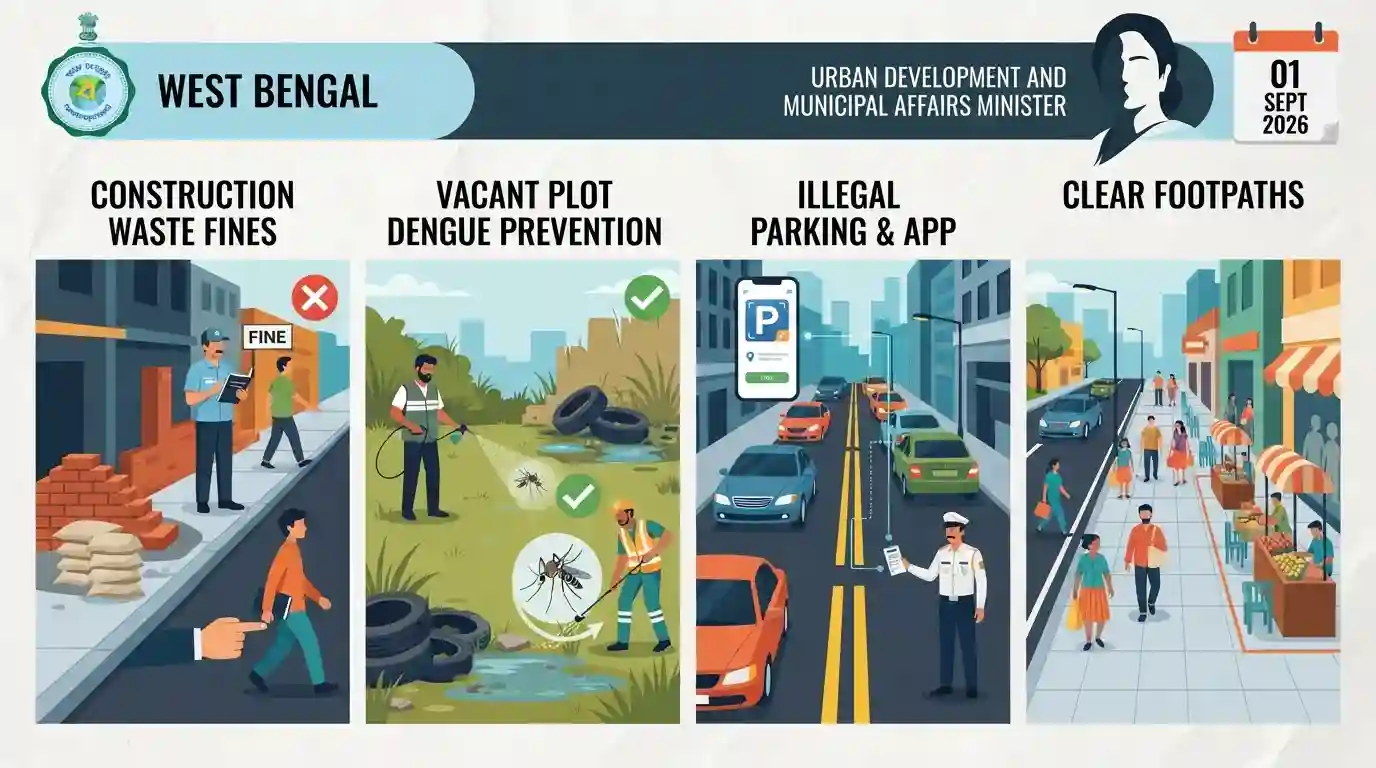
The West Bengal government, led by Urban Development and Municipal Affairs Minister Agnimitra Paul, announced strict new civic regulations effective September 1, 2026. The measures include fines for dumping construction materials on public roads and mandates for vacant plot owners to clear their land to prevent mosquito breeding and dengue outbreaks. Additionally, the government will strictly enforce rules against illegal parking, aided by a new parking app, and expects hawkers to maintain clear footpaths for pedestrian movement.
মূল বিষয়
- Starting September 1, 2026, West Bengal will impose fines for dumping construction materials on public roads to maintain civic discipline.
- Owners of vacant plots must keep their lands clean to prevent mosquito breeding and reduce the risk of vector-borne diseases like dengue.
- The state government is launching a crackdown on illegal parking, including on footpaths, and will introduce a dedicated parking app.
- Hawkers have been requested to keep footpaths clear for pedestrians, though no eviction drive is planned before Durga Puja.
গুরুত্বপূর্ণ শব্দ
Urban Development and Municipal Affairs Department

The nodal department of the West Bengal government responsible for urban governance, municipal affairs, civic infrastructure, public health initiatives in urban areas, and implementing state and central urban development schemes.
UPSC context
GS Paper 2 (State Administration). Highlights state-level governance structures, urban local bodies (ULBs) functioning, and civic management responsibilities.
West Bengal Government
The state government of West Bengal, India, currently headed by Chief Minister Mamata Banerjee, functioning through various departments like Urban Development to manage state-level administration, infrastructure, and public services.
UPSC context
GS Paper 2 (Federalism). Relevant for understanding state administration, execution of policies, and the division of powers between state and urban local bodies.
Urban Local Bodies (ULBs)
Elected local-level authorities (e.g., Municipalities, Municipal Corporations) responsible for civic administration, urban planning, sanitation, solid waste management, and public health in urban areas under the 74th Constitutional Amendment Act.
UPSC context
GS Paper 2 (Local Government). Tests knowledge of the 74th CAA, urban governance, decentralization, and the role of ULBs in public health and sanitation.
Dengue Outbreaks
A mosquito-borne viral infection primarily transmitted by Aedes aegypti mosquitoes. Outbreaks are often exacerbated by poor urban sanitation, stagnant water, and inadequate solid waste management.
UPSC context
GS Paper 2 (Public Health) & GS Paper 3 (Disaster Management). Connects public health challenges to urban infrastructure, vector control, and civic governance.
Street Vendors Act, 2014
A central legislation enacted in 2014 to protect the livelihood rights of street vendors while regulating street vending to minimize congestion and ensure unhindered pedestrian movement in public spaces.
UPSC context
GS Paper 2 (Social Justice/Vulnerable Sections). Examines the balance between the right to livelihood (informal economy) and urban mobility/pedestrian rights.
প্রিলিমস ফাঁদ
"Aedes mosquitoes, responsible for Dengue outbreaks, primarily breed in dirty, polluted stagnant water."
Unlike the Culex mosquito which breeds in polluted water, the Aedes aegypti mosquito (dengue vector) primarily breeds in clean, clear stagnant water.
সংযুক্ত স্থির ধারণা
What are the key provisions of the Construction and Demolition (C&D) Waste Management Rules, 2016?
- Applicability: Applies to all waste resulting from construction, remodeling, repair, and demolition of any civil structure.
- Source Segregation: Generators must segregate waste into concrete, soil, and others (wood, plastic) at the source before disposal.
- Prohibition: Strictly prohibits depositing C&D waste on roads, footpaths, or in drains to prevent civic obstruction.
How does the Street Vendors Act, 2014 regulate urban spaces and protect livelihoods?
- Town Vending Committees (TVC): Requires the constitution of TVCs with at least 40% representation directly from street vendors.
- Protection from Eviction: No street vendor can be evicted or relocated until the official survey is complete and a certificate of vending is issued.
- Livelihood Right: Operationalizes the fundamental right to practice any profession under Article 19(1)(g) while maintaining public order.
আন্তঃবিষয় প্যাটার্ন
Right to Walk vs Livelihood Rights
The Supreme Court balances pedestrians' Article 21 'Right to Walk' against street vendors' Article 19(1)(g) livelihood rights, emphasizing regulated vending zones over arbitrary eviction.
12th Schedule & Vector-Borne Diseases
Public health, sanitation, and solid waste management are part of the 18 functional items entrusted to ULBs under the 12th Schedule, making local bodies the frontline against vector-borne diseases.

Expect a 2026 Prelims question testing the Street Vendors Act 2014 provisions and Town Vending Committees against Article 21.
সংযুক্ত PYQ · 2
সংযুক্ত PYQ · 2
- 2018WBCS_PRELIMSGS1
Which Amendment of the constitution provided constitutional status to the Panchayats?
- 2022WBCS_PRELIMSGS1
Insert the right preposition in the blank space: He died ________ dengue.
