Election Commission Protocols For EVM Storage And Strongroom Security
Source:Indian Express ↗
Why It Matters
Understanding the functional protocols of the Election Commission of India is critical for UPSC aspirants, as questions frequently arise on electoral reforms, the role of constitutional bodies, and the institutional mechanisms required to ensure free and fair elections in India.
Summary
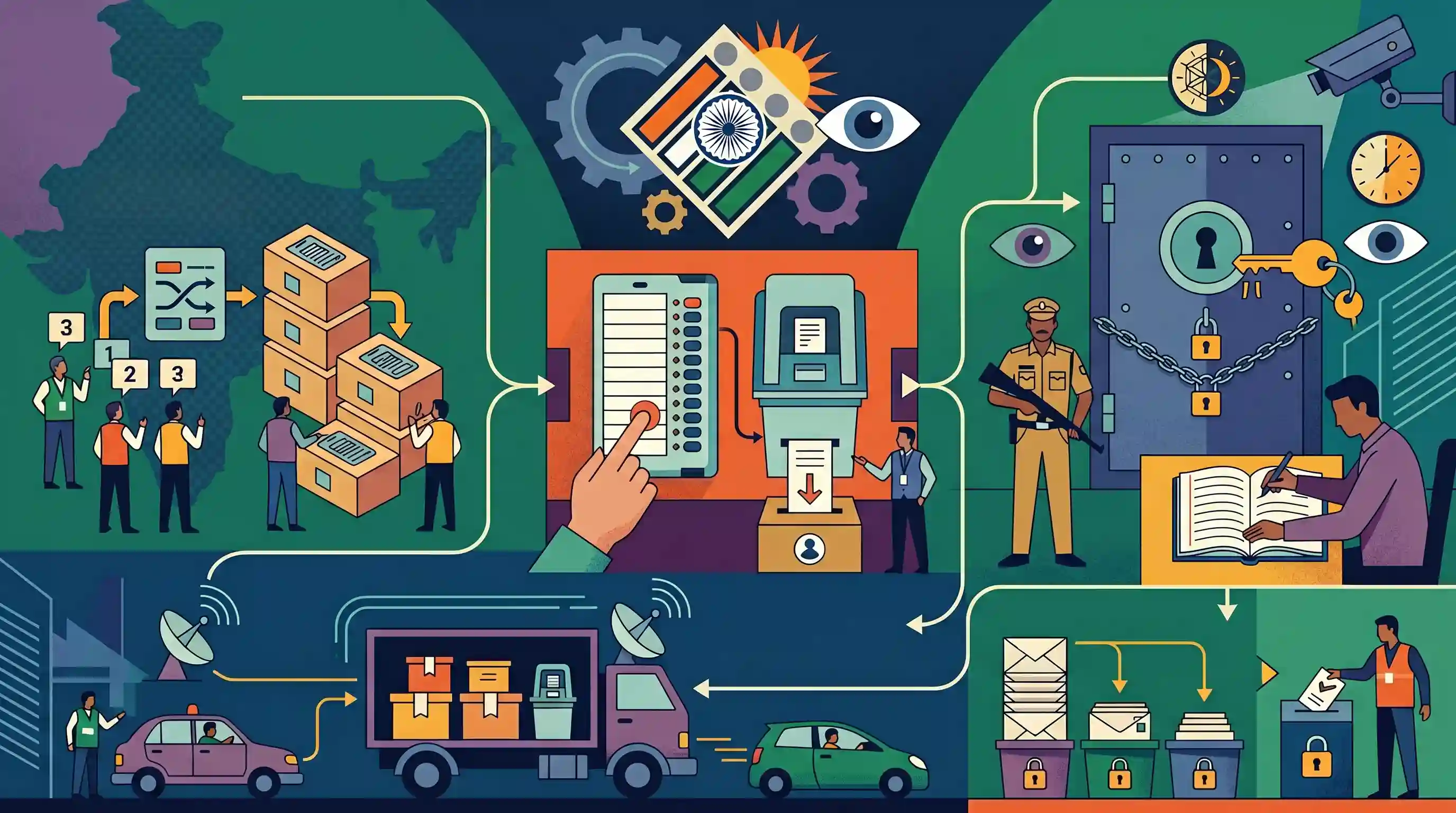
Following allegations of Electronic Voting Machine (EVM) and postal ballot tampering by West Bengal Chief Minister Mamata Banerjee during the state assembly elections, the Election Commission of India's (ECI) rigorous protocols for securing election materials have come into sharp focus. Guided by the comprehensive Manual on Electronic Voting Machines, the ECI mandates multi-layered security measures to maintain the sanctity of the electoral process. These protocols include continuous 24/7 CCTV monitoring, the deployment of armed central police forces, and the use of double-locked, single-entry strongrooms. Strict logbook maintenance is required for anyone accessing the inner perimeter. To ensure absolute transparency, the procedural framework involves candidates and their political representatives at every critical juncture, from the initial pre-poll randomization of EVMs to their post-poll transport and storage. Political party agents are permitted to track transport vehicles and keep a vigil outside the strongrooms until counting day. Similarly, postal ballots are meticulously managed and stored in daily segregated envelopes within dedicated strongrooms, reinforcing the ECI's mandate to conduct free and trustworthy elections.
Key Points
- The Election Commission of India (ECI) prescribes strict protocols in its Manual on Electronic Voting Machines for the storage and security of EVMs between polling and counting.
- EVM strongrooms must have a single entry/exit point sealed with a double-lock system, accompanied by 24/7 CCTV surveillance and at least one platoon of armed police.
- Political party representatives are actively involved in the process, from the initial randomization of EVMs to escorting them back to strongrooms after polling.
- Postal ballots are maintained in daily segregated envelopes and kept in a dedicated strongroom at the Returning Officer's headquarters.
- The procedural guidelines gained prominence following allegations of tampering with EVMs and postal ballots by West Bengal Chief Minister Mamata Banerjee ahead of counting day.
Important Terms
Election Commission of India (ECI)

An autonomous constitutional authority established under Article 324 to conduct and supervise free and fair elections for Parliament and State Legislatures in India.
UPSC context
GS Paper 2: Appointment to various Constitutional posts, powers, functions and responsibilities of various Constitutional Bodies.
Manual on Electronic Voting Machines
A comprehensive ECI document detailing technical, administrative, and security protocols for the management, storage, and randomization of Electronic Voting Machines and VVPATs.
UPSC context
GS Paper 2: Electoral reforms and the role of technology in ensuring transparency in the democratic process.
Strongroom
A highly secure, double-locked facility under 24/7 CCTV surveillance and armed security where polled EVMs and VVPATs are stored until the counting of votes.
UPSC context
GS Paper 2: Governance, transparency, and accountability measures to prevent electoral malpractice.
Postal Ballot
A method allowing specific categories of voters, such as service personnel, PwDs, or senior citizens, to cast their votes remotely via mail instead of at polling stations.
UPSC context
GS Paper 2: Salient features of the Representation of People Act and measures for inclusive voter participation.
Trinamool Congress (TMC)
A major political party in West Bengal, founded in 1998 by Mamata Banerjee, emphasizing secularism, welfarism, and regional identity; currently recognized as a state party.
UPSC context
GS Paper 2: Role of regional political parties and the criteria for national vs. state party status.
Bharatiya Janata Party (BJP)
A prominent national political party in India, founded in 1980, which advocates for Hindutva (cultural nationalism) and currently serves as the ruling party at the Center.
UPSC context
GS Paper 2: Political parties, their ideologies, and impact on India’s federal and electoral landscape.
Prelims Trap
"The Election Commission has the final authority to adjudicate EVM tampering disputes."
False. Under Article 329(b) and RPA 1951, election disputes post-polling must be challenged via an election petition directly to the High Court, not the ECI.
Static Concepts Connected
What is the legal framework governing EVMs and electoral dispute resolution in India?
- Section 61A (RPA 1951): Explicitly empowers the Election Commission of India to use Electronic Voting Machines in state and parliamentary elections.
- Article 329(b): Bars judicial interference in electoral matters during the process; disputes must be raised via an election petition to the High Court post-election.
How does the Electronically Transmitted Postal Ballot System (ETPBS) function?
- Service Voters: Primarily designated for Armed forces, paramilitary personnel, and government officials deployed outside their home state.
- Asymmetric Transmission: The blank ballot is dispatched electronically via a secured network but must be filled and returned physically via ordinary post.
- NRI Exclusion: Non-Resident Indians (NRIs) are currently not eligible for ETPBS and must vote in person at their registered constituency.
Cross-Topic Patterns
VVPAT guidelines and Judicial Review
The Supreme Court recently scrutinized VVPAT slip matching. EVM security guidelines are often read alongside the apex court's directives on VVPAT verification to ensure transparency.
RPA 1951 vs. Conduct Rules 1961
UPSC repeatedly tests the distinction between parent Act provisions (RPA Sec 61A for EVMs) and delegated legislation (1961 Rules detailing postal ballots and polling station procedures).

Expect a multi-statement Prelims question blending EVM/VVPAT statutory backing (RPA 1951) with rules for service voters and ETPBS.
Linked PYQs · 4
Linked PYQs · 4
- 2018MainsGS2
In the light of recent controversy regarding the use of Electronic Voting Machines (EVM), what are the challenges before the Election Commission of India to ensure the trustworthiness of elections in India?
- 2022MainsGS2
Discuss the role of the Election Commission of India in the light of the evolution of the Model Code of Conduct.
- 2017MainsGS2
To enhance the quality of democracy in India the Election Commission of India has proposed electoral reforms in 2016. What are the suggested reforms and how far are they significant to make democracy successful?
- 2017PrelimsGS1
Consider the following statements: 1. The Election Commission of India is a five-member body. 2. Union Ministry of Home Affairs decides the election schedule for the conduct of both general elections and bye-elections. 3. Election Commission resolves the disputes relating to splits/mergers of recognised political parties. Which of the statements given above is/are correct?
