West Bengal Election: Electoral Roll Revision and Political Transition
Source:Indian Express ↗
Why It Matters
The article is highly relevant for GS Paper 2 as it touches upon the functional transparency of constitutional bodies like the Election Commission, the implications of electoral processes (voter roll revisions) on minority representation, and the health of parliamentary democracy concerning the role of the opposition. It also provides case-study material on the limits of regional identity politics.
Summary
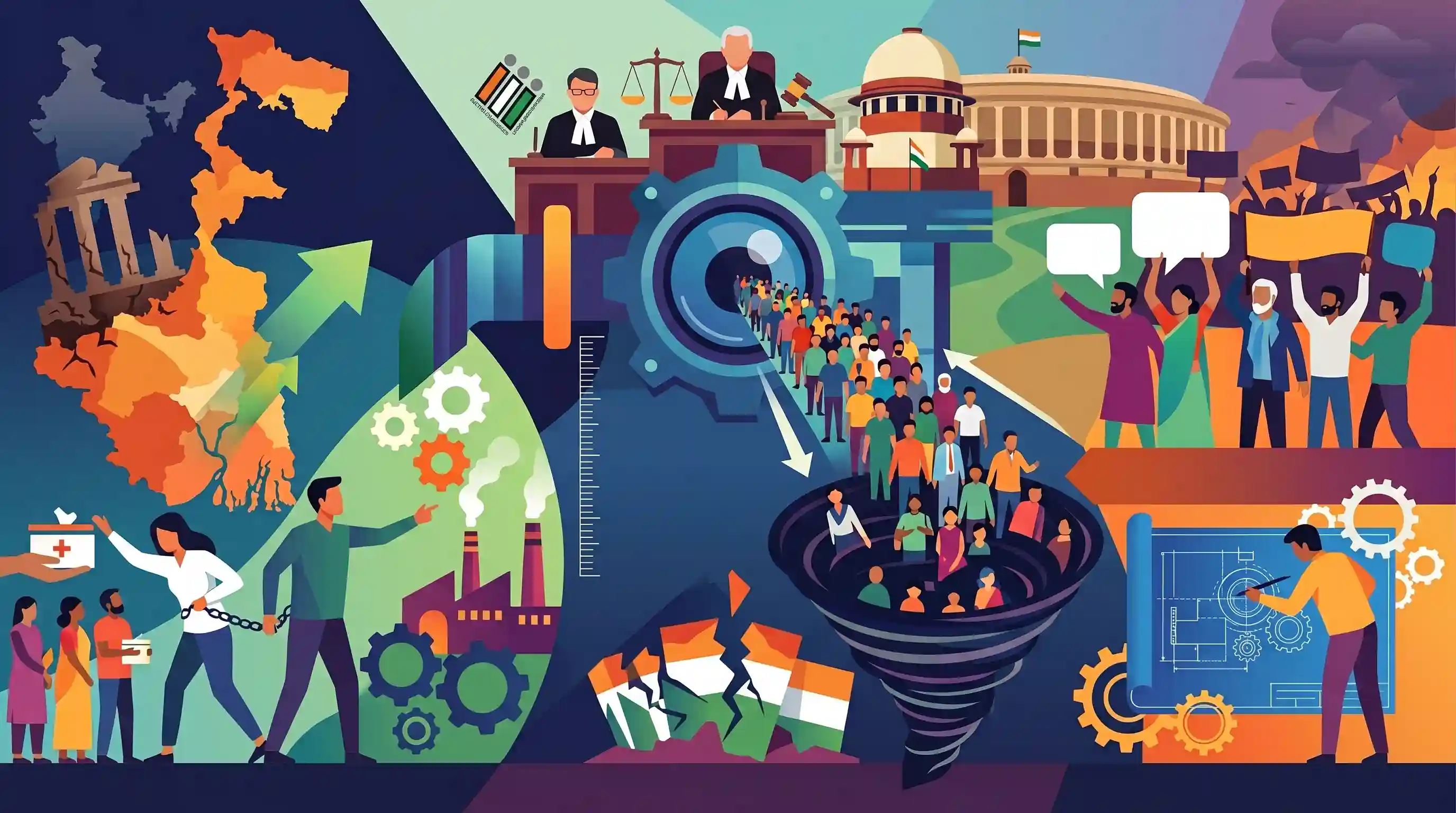
The BJP's unprecedented victory in the 2026 West Bengal election marks a major inflection point in Indian politics, ending the TMC's long-standing rule. The incoming government faces immense challenges, including dismantling the entrenched 'cadre-government nexus' and reviving the state's economy through industrialization rather than relying solely on welfare measures. Critically, the electoral process was overshadowed by the Special Intensive Revision (SIR), which led to the exclusion of over 90 lakh voters. This massive deletion raised fears of selective disenfranchisement of minorities and prompted questions regarding the transparency and institutional role of the Election Commission and the Supreme Court. Additionally, the failure of the TMC's regional identity politics and the continuing struggles of the INDIA bloc highlight the urgent need for the national opposition to formulate substantive policy alternatives rather than relying on rhetoric.
Key Points
- The BJP achieved a historic victory in the 2026 West Bengal election, dismantling the TMC's dominance and expanding its footprint across Eastern India.
- Governance challenges for the incoming government include reversing economic decline through industrialization rather than just welfare and building state capacity independent of a 'cadre-government nexus'.
- The Special Intensive Revision (SIR) of electoral rolls controversially excluded over 90 lakh voters, sparking fears of selective disenfranchisement of minorities and raising questions about the Election Commission's transparency.
- TMC's reliance on regional 'bhadralok' Bengali identity politics failed to counter severe anti-incumbency and the BJP's national narrative.
- The national opposition faces an existential crisis and must shift from rhetorical 'lip service' to developing substantive policy alternatives and creative communication to challenge the ruling party's dominance.
Important Terms
Special Intensive Revision (SIR)

A comprehensive house-to-house verification drive by the ECI to update electoral rolls, conducted under Section 21(3) of the RPA 1950 to ensure voter list accuracy by adding/deleting names.
UPSC context
GS Paper II: Electoral reforms and voter rights. Tests knowledge of ECI procedures and administrative integrity.
Representation of the People Act (RPA)
Legislative duo (1950 & 1951) forming the legal backbone of Indian elections, covering seat allocation, voter eligibility, electoral rolls, and the conduct/disputes of polls.
UPSC context
GS Paper II: Salient features of the RPA; essential for understanding the statutory framework of Indian democracy.
Election Commission of India (ECI)
The autonomous constitutional body established under Article 324 to superintend, direct, and control elections for Parliament, State Legislatures, and the offices of President and Vice-President.
UPSC context
GS Paper II: Constitutional bodies; tests powers, functions, and the importance of independent election management.
Supreme Court of India
The highest judicial court in India, acting as the guardian of the Constitution and fundamental rights, with powers of judicial review over electoral processes and executive actions.
UPSC context
GS Paper II: Judiciary; focuses on separation of powers and protection of democratic values through judicial oversight.
INDIA Bloc
A multi-party opposition alliance formed to challenge the dominant ruling coalition, reflecting the dynamics of coalition politics and the collective role of the opposition in India.
UPSC context
GS Paper II: Party systems and coalition politics; tests understanding of alliances and political pluralism.
Regionalism
A political ideology prioritizing regional identity and interests over national ones, often leading to the rise of regional parties and influencing federal relations.
UPSC context
GS Paper I & II: Diversity and Federalism; concerns local aspirations versus national integration and cooperative federalism.
Prelims Trap
The Special Intensive Revision of electoral rolls is conducted by the Election Commission under the Representation of the People Act, 1951.
Preparation, revision, and maintenance of electoral rolls (including Special Intensive Revisions) fall under RPA 1950. The RPA 1951 strictly deals with the actual conduct of elections and disqualifications.
Static Concepts Connected
What statutory and constitutional provisions govern the revision of electoral rolls?
- Constitutional Mandate: Article 324 vests the Election Commission with the power of superintendence, direction, and control over the preparation of electoral rolls.
- Statutory Backing: Section 21 of the Representation of the People Act, 1950 grants the ECI discretionary power to order special or intensive revisions of the rolls.
- Article 326: Guarantees universal adult suffrage, making arbitrary or opaque deletion of legitimate voters a violation of fundamental democratic rights.
Cross-Topic Patterns
RPA 1950 + Minority Disenfranchisement
The massive deletion of voters under SIR connects statutory electoral roll management to constitutional debates on minority disenfranchisement and the fundamental right to vote under Article 326.
Welfare economics vs State Capacity
The political pivot from state welfare dependency to industrialization mirrors national macroeconomic debates on redistributive revenue expenditure (subsidies) versus productive capital asset creation.

Expect a tricky prelims statement distinguishing the ECI's statutory powers under RPA 1950 (electoral rolls) versus RPA 1951 (election conduct).
Linked PYQs · 4
Linked PYQs · 4
- 2022MainsGS2
Discuss the role of the Election Commission of India in the light of the evolution of the Model Code of Conduct.
- 2024MainsGS2
Examine the need for electoral reforms as suggested by various committees with particular reference to "one nation one election" principle.
- 2013MainsGS1
Growing feeling of regionalism is an important factor in generation of demand for a separate State. Discuss.
- 2020MainsGS2
There is a need for simplification of procedure for disqualification of persons found guilty of corrupt practices under the Representation of Peoples Act". Comment.
