West Bengal Electoral Dynamics and Regional Political Shifts
Source:Indian Express ↗
Why It Matters
It provides a comprehensive case study of how regionalism and sub-nationalism can be overtaken by national political narratives when compounded by governance failures, systemic corruption, and economic stagnation. Useful for GS-2 (State Politics, Federalism, Electoral Behavior) and GS-4 (Ethics in Governance).
Summary
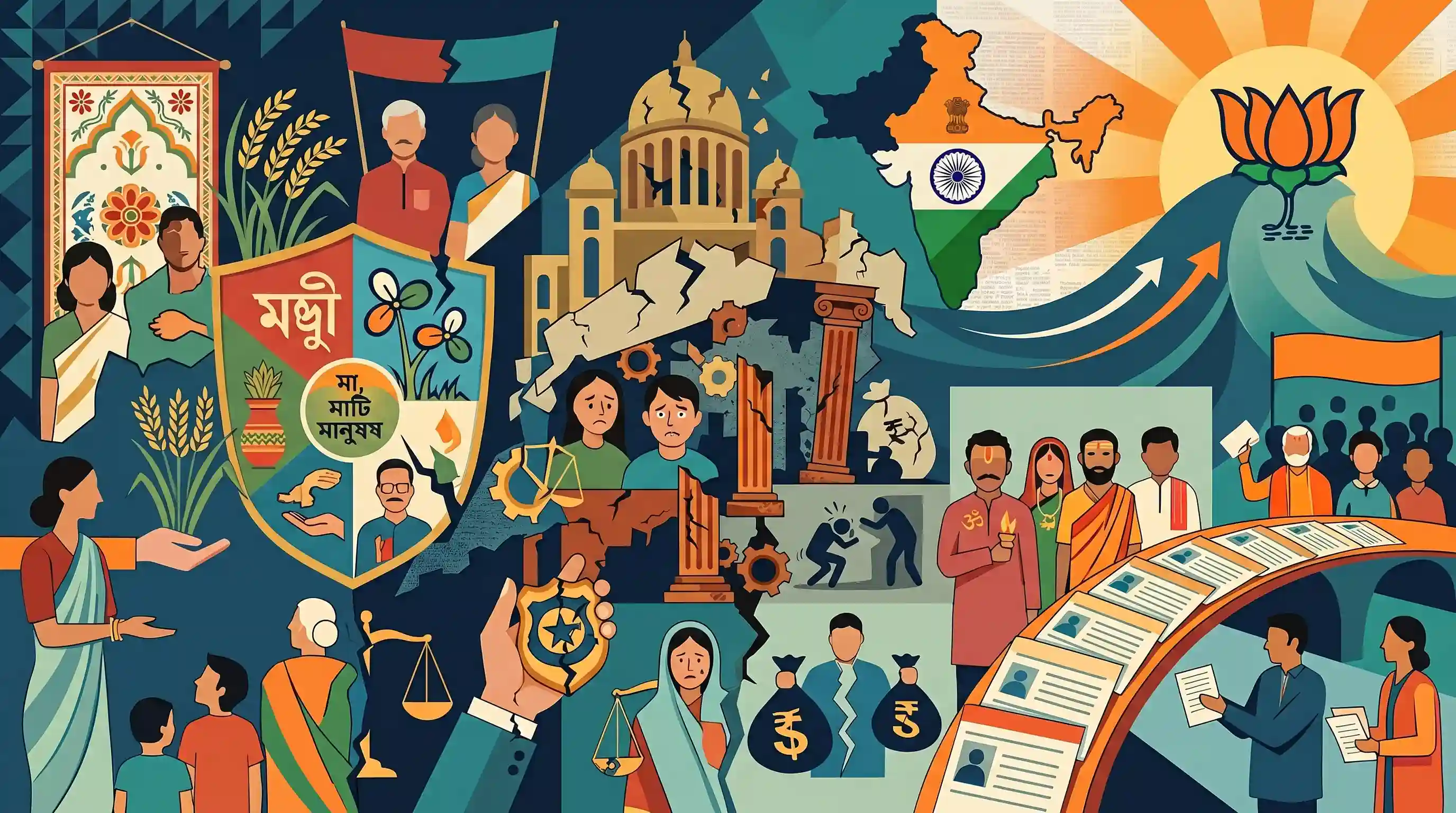
The article analyzes the political paradigm shift in West Bengal following the BJP's electoral victory over the Trinamool Congress, marking the end of 'Bengal exceptionalism.' For decades, West Bengal was perceived as immune to national majoritarian politics, dominated first by the Left Front and then the TMC through a blend of Bengali sub-nationalism and welfare politics. However, severe anti-incumbency driven by widespread corruption scandals, institutional decay, economic stagnation, and deteriorating law and order (evidenced by the Sandeshkhali and RG Kar incidents) created a massive governance deficit. The BJP capitalized on this by projecting itself as the only viable alternative amidst the collapse of the Left-Congress alliance. Furthermore, the BJP successfully engineered a subaltern Hindutva coalition by integrating marginalized communities like the Matuas and Rajbanshis, using the Citizenship Amendment Act (CAA) to address their demographic and citizenship anxieties.
Key Points
- The BJP’s victory in West Bengal shatters the long-held myth of 'Bengal exceptionalism', bringing the state’s political trajectory in line with the national narrative of Hindu nationalism.
- The Trinamool Congress (TMC) faced severe anti-incumbency fueled by systemic corruption (SSC recruitment, Saradha, and Narada scams) and governance failures highlighted by incidents in Sandeshkhali and RG Kar.
- A stagnant economy, rampant unemployment, and institutional decay alienated the youth and urban middle classes, neutralizing the electoral dividends of the TMC's welfare schemes.
- The BJP effectively mobilized subaltern and marginalized communities, such as the Matuas and Rajbanshis, by addressing citizenship anxieties through the CAA and border security rhetoric.
- The marginalization of the Left-Congress alliance transformed the election into a bipolar contest, allowing the BJP to consolidate the entire anti-incumbency vote bank.
Important Terms
Citizenship Amendment Act (CAA)

A 2019 law providing an expedited pathway to Indian citizenship for persecuted religious minorities (Hindus, Sikhs, Buddhists, Jains, Parsis, Christians) from Afghanistan, Bangladesh, and Pakistan.
UPSC context
GS Paper II: Significant for topics on Citizenship, constitutional provisions, and the principle of Secularism.
Bengal Exceptionalism
The socio-political belief that West Bengal’s political culture, rooted in secularism and class-based mobilization, was uniquely resistant to the majoritarian/communal narratives prevalent in North India.
UPSC context
GS Paper I & II: Relevant to Regionalism, Indian Federalism, and the evolution of state-specific political identities.
Matuas
A socio-religious sect of the Namasudra (Scheduled Caste) community, primarily refugees from East Bengal/Bangladesh, whose demand for legal citizenship makes them a critical electoral bloc in West Bengal.
UPSC context
GS Paper I & II: Important for Social Empowerment, identity politics, and welfare of vulnerable sections.
Left Front
A CPI(M)-led coalition of left-wing parties that governed West Bengal for 34 consecutive years (1977–2011), characterized by radical land reforms and cadre-based grassroots mobilization.
UPSC context
GS Paper II: Pertains to the history of Political Parties, Coalition Politics, and regional governance models.
Subaltern Hindutva
A political strategy that mobilizes marginalized communities (SCs, STs, OBCs) by integrating their local cultural identities and developmental needs into the broader framework of Hindu nationalism.
UPSC context
GS Paper I & II: Tests understanding of Communalism, Secularism, and shifting social bases in Indian elections.
Trinamool Congress (TMC)
A major regional party in West Bengal that champions Bengali sub-nationalism and "Ma, Mati, Manush" (Mother, Land, People) populism; it is currently the primary challenger to the BJP.
UPSC context
GS Paper II: Relevant to Federalism and the growing influence of Regional Parties in national politics.
Prelims Trap
"Rajbanshis and Matuas are recognized as Particularly Vulnerable Tribal Groups (PVTGs) in West Bengal."
Matuas are a Namasudra Scheduled Caste (SC) sect originally from East Bengal, not a PVTG. Koch-Rajbongshis are categorized as SC in Bengal but ST in parts of Assam.
Static Concepts Connected
What are the core provisions and exemptions of the Citizenship Amendment Act (CAA), 2019?
- Eligible communities: Grants citizenship to Hindus, Sikhs, Buddhists, Jains, Parsis, and Christians from Afghanistan, Bangladesh, and Pakistan.
- Cut-off date: Applies only to migrants from these communities who entered India on or before December 31, 2014.
- Geographical exemptions: Exempts tribal areas of Assam, Meghalaya, Mizoram, Tripura (Sixth Schedule) and Inner Line Permit (ILP) areas.
How do regional parties influence Indian federalism?
- Sub-national representation: Regional parties mobilize on linguistic or ethnic identity, acting as a federal counterweight to centralized, national majoritarian narratives.
- Electoral bipolarity: The collapse of regional third-fronts transforms multi-cornered state elections into nationalized bipolar contests, homogenizing state and national issues.
Cross-Topic Patterns
CAA and Border Demography
The political use of CAA links local citizenship anxieties of cross-border migrants (like Matuas) with national border security frameworks, merging GS2 Polity with GS3 Internal Security.
Limits of Welfare Politics
UPSC often questions the efficacy of populism. This case study demonstrates that structural corruption and joblessness can neutralize direct-benefit transfers, proving welfare schemes cannot replace core governance (GS2).

Expect a Mains GS2 question on how border demography, migration, and citizenship laws (like CAA) are reshaping India's federal structure.
Linked PYQs · 3
Linked PYQs · 3
- 2022MainsGS2
“While the national political parties in India favour centralisation, the regional parties are in favour of State autonomy.” Comment.
- 2023MainsGS4
Corruption is the manifestation of the failure of core values in the society." In your opinion, what measures can be adopted to uplift the core values in the society ?
- 2015MainsGS4
Today we find that in spite of various measures like prescribing codes of conduct, setting up vigilance cells/commissions, RTI, active media and strengthening of legal mechanisms, corrupt practices are not coming under control. Evaluate the effectiveness of these measures with justifications.
