West Bengal Election Manifestos and Competing Cultural Narratives
Source:Indian Express ↗
Why It Matters
Provides insight into modern Indian electoral politics, illustrating how political parties balance competitive welfarism with distinct ideological and cultural mobilization strategies to capture vote banks.
Summary
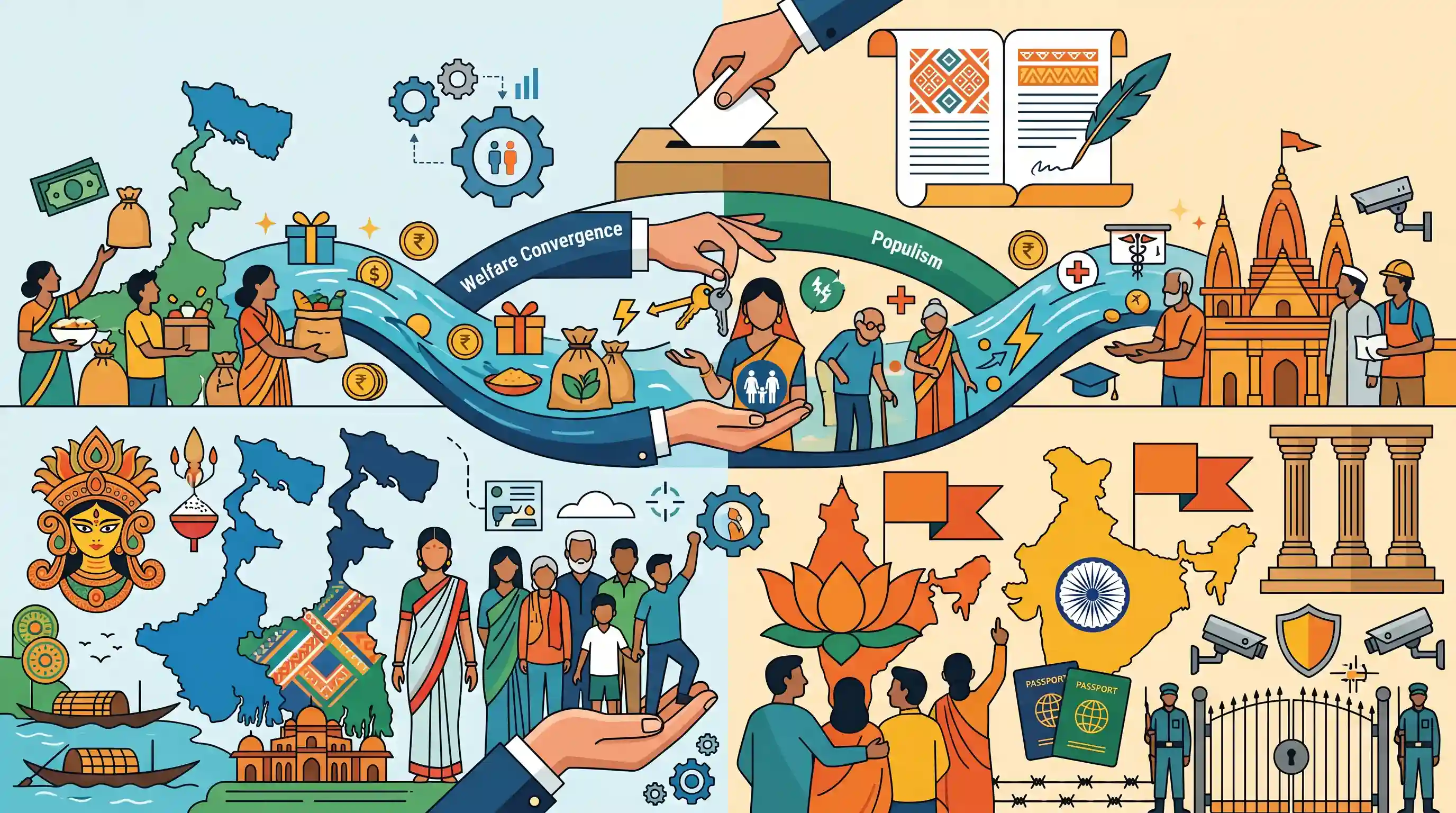
The article analyzes the election manifestos of the BJP and TMC in West Bengal, noting a convergence in welfare economics but stark divergence in ideological and cultural narratives. Both parties engage in competitive populism, offering extensive freebies, cash transfers, and schemes targeted at women and marginalized sections. However, they conflict fundamentally on cultural framing: TMC champions regional Bengali sub-nationalism and specific minority/caste welfare, while BJP anchors its promises in a pan-Indian, Hindu civilizational identity and stringent stances on citizenship and internal security.
Key Points
- Both BJP and TMC manifestos heavily emphasize competitive welfare populism, focusing on cash transfers, agriculture, women, and infrastructure.
- The parties diverge significantly on cultural narratives: TMC promotes regional Bengali identity and heritage, while BJP frames Bengal within a pan-Indian civilizational ethos.
- There is a clear distinction in addressing social justice: TMC outlines specific provisions for SC/ST/OBCs and minorities, whereas BJP focuses on Hindu refugees and internal security rhetoric (e.g., laws against 'love jihad').
- Women are a crucial electoral demographic, leading to promises like cash transfers and reservations in state government jobs and police forces.
Important Terms
Citizenship Amendment Act (CAA)

A 2019 law providing an accelerated pathway to Indian citizenship for persecuted religious minorities from Afghanistan, Bangladesh, and Pakistan who entered India on or before December 31, 2014.
UPSC context
GS II: Governance/Polity. Tests knowledge of citizenship laws, secularism, and constitutional provisions like Article 14.
Pradhan Mantri Awas Yojana (PMAY)
A flagship central housing scheme aiming to provide affordable 'Housing for All' through financial assistance and interest subsidies for urban (PMAY-U) and rural (PMAY-G) populations.
UPSC context
GS II/III: Welfare Schemes/Infrastructure. Evaluates understanding of social-sector initiatives and cooperative federalism in implementation.
Lakshmir Bhandar
A West Bengal social security scheme providing monthly cash transfers to women heads of households (aged 25–60) to promote financial independence and gender equity.
UPSC context
GS II: Social Justice/Welfare. Serves as a case study for gender budgeting and state-led social security models.
Competitive Populism
A political strategy where rival parties compete to win votes by offering short-term economic benefits, such as subsidies and freebies, often impacting long-term fiscal health.
UPSC context
GS II: Elections/Governance. Tests analysis of electoral reforms and the fiscal impact of populist policies.
Sub-nationalism
The assertion of regional, linguistic, or cultural identity within a nation-state, acting as a constitutive element of plural democracy as long as it is not secessionist.
UPSC context
GS I/II: Regionalism/Federalism. Relevant for discussing national integration and the "Unity in Diversity" framework.
Direct Benefit Transfer (DBT)
A governance mechanism that transfers subsidies and welfare benefits directly into the bank accounts of beneficiaries to reduce leakages and improve transparency.
UPSC context
GS II/III: E-governance/Economy. Critical for understanding administrative reforms and social security efficiency.
Prelims Trap
The ECI can deregister a party under the RPA 1951 for offering irrational freebies in its manifesto.
The ECI cannot deregister parties for manifesto promises. The Model Code of Conduct regulates manifestos (post-2013 SC ruling), but it lacks direct statutory backing.
Static Concepts Connected
How does the Supreme Court view election freebies and manifestos?
- Balaji Case 2013: SC ruled that manifesto promises do not constitute a 'corrupt practice' under Section 123 of the Representation of the People Act.
- MCC Guidelines: Prompted by the SC, the ECI added Part VIII to the Model Code of Conduct to regulate manifesto promises and demand financial rationale.
- Level Playing Field: While Part IV (DPSP) supports state welfare, the SC noted that distributing irrational freebies shakes the root of free and fair elections.
What are the territorial exemptions under the Citizenship Amendment Act (CAA) 2019?
- Sixth Schedule: Exempts tribal areas of Assam, Meghalaya, Mizoram, and Tripura administered under the Sixth Schedule of the Constitution.
- ILP Regime: Exempts areas protected by the Inner Line Permit (ILP) regime notified under the Bengal Eastern Frontier Regulation, 1873 (e.g., Arunachal Pradesh, Nagaland).
Cross-Topic Patterns
Welfare populism & State Fiscal Health
RBI frequently warns about rising state debt burdens from non-merit subsidies. This directly links electoral politics to FRBM Act compliance and macroeconomic stability.
Feminization of Electoral Politics
Targeted cash transfers to women represent their emergence as an independent vote bank, shifting GS2 debates from patriarchal proxy-voting to direct economic empowerment.

Expect a GS2 Mains question linking the 'feminization of electoral politics' via targeted cash transfers to state fiscal sustainability.
Linked PYQs · 4
Linked PYQs · 4
- 2022MainsGS2
Besides the welfare schemes, India needs deft management of inflation and unemployment to serve the poor and the underprivileged sections of the society. Discuss.
- 2023MainsGS2
“Development and welfare schemes for the vulnerable, by its nature, are discriminatory in approach.” Do you agree? Give reasons for your answer.
- 2024MainsGS1
Critically analyse the proposition that there is a high correlation between India's cultural diversities and socio-economic marginalities.
- 2019MainsGS2
“The reservation of seats for women in the institutions of local self-government has had a limited impact on the patriarchal character of the Indian Political Process.” Comment.
