West Bengal chief minister discusses tea garden worker welfare
Source:aninews ↗
Why It Matters
This development highlights the ongoing economic issues faced by the tea and textile industries in West Bengal, which are critical components of the state's geography and economy. For WBCS aspirants, understanding the socio-economic conditions of tea garden workers (especially in regions like Darjeeling) and the constitutional nuances of the Anti-Defection Law during political realignments is essential for the Prelims examination.
Summary
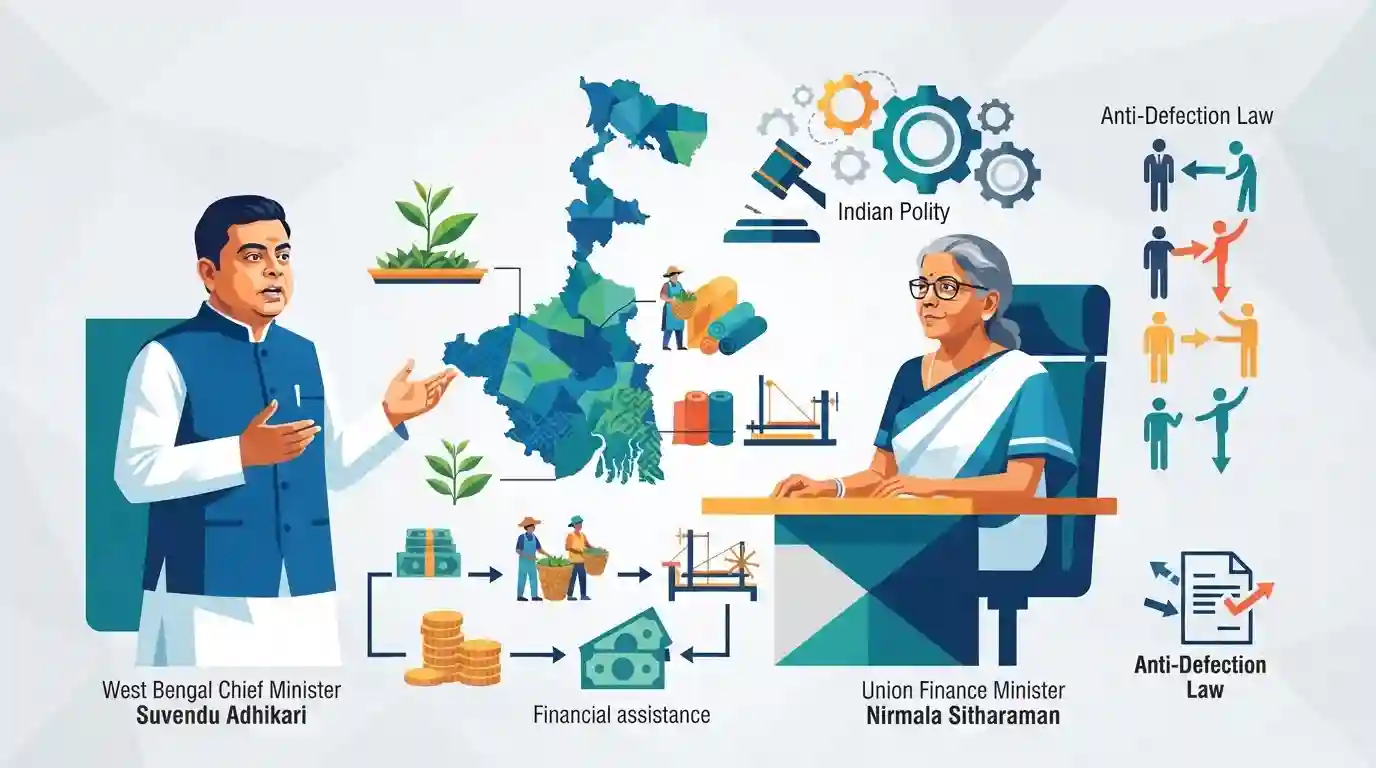
West Bengal Chief Minister Suvendu Adhikari met with Union Finance Minister Nirmala Sitharaman to advocate for the welfare of tea garden and textile workers in the state. The discussions centered on securing central financial assistance to support these crucial industries, which are vital to West Bengal's economy but have been facing ongoing challenges. The meeting also took place amid a dynamic political environment involving shifting party allegiances, raising discussions around the Anti-Defection Law.
Key Points
- West Bengal Chief Minister Suvendu Adhikari met Union Finance Minister Nirmala Sitharaman to discuss economic support for the state's industries.
- The primary focus of the meeting was on securing welfare measures and financial relief for workers in the struggling tea garden and textile sectors.
- The state is seeking central assistance to revitalize the tea industry, particularly in the Darjeeling and Dooars regions, which form a crucial part of West Bengal's economy.
- The meeting occurs amid a backdrop of significant political realignments in West Bengal, bringing constitutional provisions like the Anti-Defection Law into focus.
Important Terms
Anti-Defection Law

A constitutional provision designed to prevent political defections by disqualifying elected legislators who voluntarily leave their political party or defy party whips during voting.
UPSC context
Crucial for GS Paper 2 (Polity); frequently tested regarding parliamentary stability, the Speaker's powers, and democratic representation.
Tenth Schedule
Inserted into the Indian Constitution by the 52nd Amendment Act in 1985, this schedule officially houses the Anti-Defection Law and its rules for legislative disqualification.
UPSC context
Highly relevant for GS Paper 2 and Prelims; tests knowledge of constitutional amendments, legislative rules, and exceptions like party mergers.
Union Finance Ministry
The central government ministry responsible for managing India's public finances, drafting the Union Budget, taxation, capital markets, and formulating broad fiscal policies.
UPSC context
Vital for GS Paper 3 (Indian Economy); forms the foundation for questions on fiscal policy, budget allocation, and financial governance.
Prelims Trap
"A split of one-third of the members of a legislative party protects them from disqualification under the Tenth Schedule."
The 91st Amendment Act (2003) deleted the provision protecting a 1/3rd 'split'. Currently, only a 'merger' involving at least two-thirds of the legislative party protects members.
Static Concepts Connected
What geographical conditions are required for commercial tea and jute cultivation?
- Tea conditions: Requires a warm, humid climate (20-30°C), well-drained sloping terrain (like Darjeeling), and evenly distributed rainfall (150-300 cm) throughout the year without water stagnation.
- Jute conditions: Demands a hot, damp climate (24-35°C), heavy rainfall, fertile alluvial soil, and abundant fresh water for the retting process (widely found in the Hooghly basin).
What are the primary grounds for disqualification under the Tenth Schedule?
- Voluntary resignation: An elected member voluntarily giving up the membership of their original political party, which can be inferred from conduct.
- Defying party whip: Voting or abstaining from voting in the House contrary to any whip or direction issued by their political party without prior permission.
- Independent & Nominated: An independent member joining any political party, or a nominated member joining a political party after the expiry of six months from taking their seat.
Cross-Topic Patterns
Fiscal Federalism & Regional Industry
State requests for central assistance for regional industries (tea/jute) often link Article 282 discretionary grants with the broader political economy of federalism and statutory worker welfare (e.g., Occupational Safety Code).
Tenth Schedule & Judicial Review
Political realignments in states frequently trigger the Speaker's adjudication powers under the Anti-Defection law, heavily tested alongside the Kihoto Hollohan judgment regarding the scope of judicial review.

The 91st CAA's removal of the 'split' provision and the Kihoto Hollohan judgment on judicial review will likely form a 2026 Polity question.
Linked PYQs · 2
Linked PYQs · 2
- 2011WBCS_PRELIMSGS1
The most ideal region for cultivation of Tea in West Bengal is
- 2023WBCS_PRELIMSGS1
Which amendment of Indian Constitution is related to the Anti-defection law?
