Paschimbanga Lokotantra Senani Samman: Financial Aid Announced
Source:theprint ↗
কেন এটি গুরুত্বপূর্ণ
The article connects contemporary state-level welfare initiatives with significant historical and constitutional events, specifically the 1975 National Emergency and the Partition of Bengal, both of which are recurrent themes in civil services examinations.
সারসংক্ষেপ
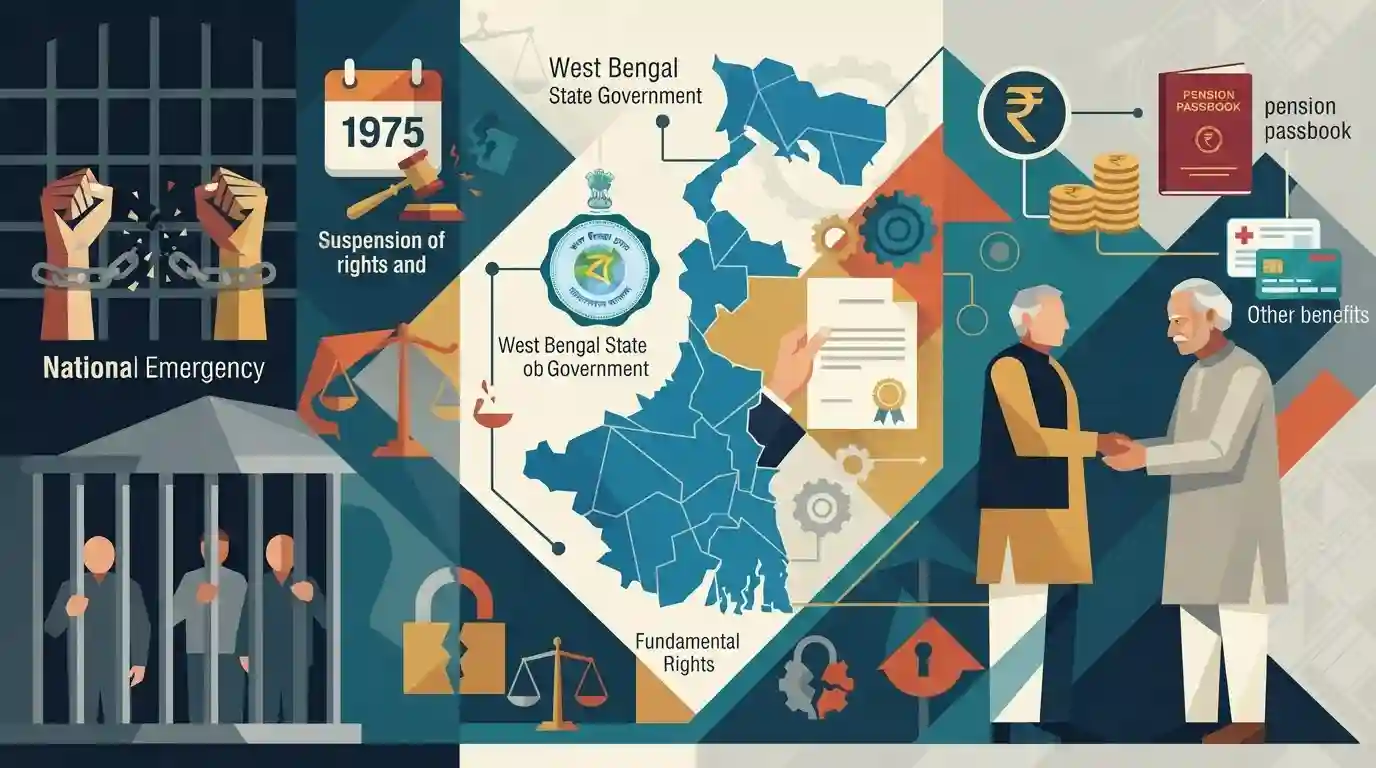
The West Bengal government has announced the 'Paschimbanga Lokotantra Senani Samman' scheme, offering a ₹10,000 monthly pension and other benefits to individuals who were incarcerated during the 1975 National Emergency.
মূল বিষয়
- The West Bengal government announced a ₹10,000 monthly pension for individuals jailed during the 1975 Emergency.
- The pension is distributed under the state's 'Paschimbanga Lokotantra Senani Samman' scheme.
- Beneficiaries will also receive free medical treatment and free travel on state-run transport buses.
- The announcement aligns with the observance of 'Samvidhan Hatya Diwas' (June 25) and commemorations of Syama Prasad Mookerjee's legacy concerning the Partition of Bengal.
গুরুত্বপূর্ণ শব্দ
Paschimbanga Lokotantra Senani Samman

A West Bengal government welfare scheme offering a ₹10,000 monthly pension, free bus travel, and medical assistance to 325 people incarcerated during the 1975 Emergency.
UPSC context
Important for GS-II (State Schemes). Tests awareness of state-level welfare initiatives recognizing political prisoners and democratic rights movements.
National Emergency (1975)
A 21-month period initiated on June 25, 1975, when a national emergency was declared in India, leading to the suspension of civil liberties and fundamental rights.
UPSC context
Relevant for GS-I (Post-Independence History) and GS-II (Polity), testing knowledge of India's democratic crises and constitutional amendments.
Article 352
A constitutional provision empowering the President of India to declare a National Emergency on grounds of war, external aggression, or armed rebellion (formerly "internal disturbance").
UPSC context
Core GS-II (Polity) topic. Questions frequently test the grounds for emergency declaration, parliamentary approval requirements, and the impact on federalism.
Samvidhan Hatya Diwas
An observance declared by the Union government on June 25 to mark the imposition of the 1975 Emergency and honor those who opposed the suspension of democracy.
UPSC context
Relevant for GS-II (Polity). Highlights contemporary political perspectives, official observances, and narratives surrounding post-independence constitutional history.
প্রিলিমস ফাঁদ
"Article 19 rights are automatically suspended when a National Emergency is declared on any ground."
Under Article 358 (post-44th Amendment), Article 19 is suspended ONLY when Emergency is declared on grounds of war or external aggression, NOT for armed rebellion.
সংযুক্ত স্থির ধারণা
How did the 44th Amendment alter National Emergency provisions?
- Ground changed: Replaced the vague phrase "internal disturbance" with the more specific "armed rebellion" for invoking Article 352.
- Written recommendation: Made it mandatory for the President to receive written advice from the Cabinet, not just the PM.
- Rights protected: Amended Article 359 to guarantee that Fundamental Rights under Articles 20 and 21 cannot be suspended.
- Approval timeframe: Reduced the time limit for parliamentary approval of the emergency proclamation from two months to one month.
What were Dr. Syama Prasad Mookerjee's key contributions to post-independence India?
- First Cabinet: Served as Independent India's first Minister for Industry and Supply in Jawaharlal Nehru's interim cabinet.
- Cabinet resignation: Resigned in 1950 protesting the Nehru-Liaquat Pact (Delhi Pact) over its handling of minority rights.
- Kashmir integration: Strongly opposed Article 370 and the permit system for entering Jammu & Kashmir.
আন্তঃবিষয় প্যাটার্ন
Politicization of Post-Independence History
State welfare schemes for political prisoners and central observances like 'Samvidhan Hatya Diwas' reflect how post-independence events (1975 Emergency) are actively utilized for modern political mobilization and syllabus relevance.
Emergency & Basic Structure Doctrine
The 1975 Emergency triggered severe constitutional centralization (42nd Amendment), subsequently leading to the 44th Amendment and landmark cases like Minerva Mills that cemented the Basic Structure doctrine in judicial review.

The 50th anniversary of the 1975 Emergency makes Article 358/359 limits and 44th Amendment changes highly probable in 2026 Prelims MCQs.
সংযুক্ত PYQ · 4
সংযুক্ত PYQ · 4
- 2024WBCS_PRELIMSGS1
Which Fundamental Rights cannot be suspended during a National Emergency under Article 359?
- 2021WBCS_PRELIMSGS1
The Partition of Bengal was annulled in
- 2023WBCS_PRELIMSGS1
After the partition of Bengal, the two new provinces which came into existence were
- 2015WBCS_PRELIMSGS1
What was the effective date of the partition of Bengal ?
