West Bengal Chief Secretary Issues Discipline Advisory for Bureaucrats
Source:indianmasterminds ↗
Why It Matters
Understanding administrative reforms and executive directives provides insight into how states enhance governance, ensure bureaucratic accountability, and streamline public administration for efficient policy implementation.
Summary
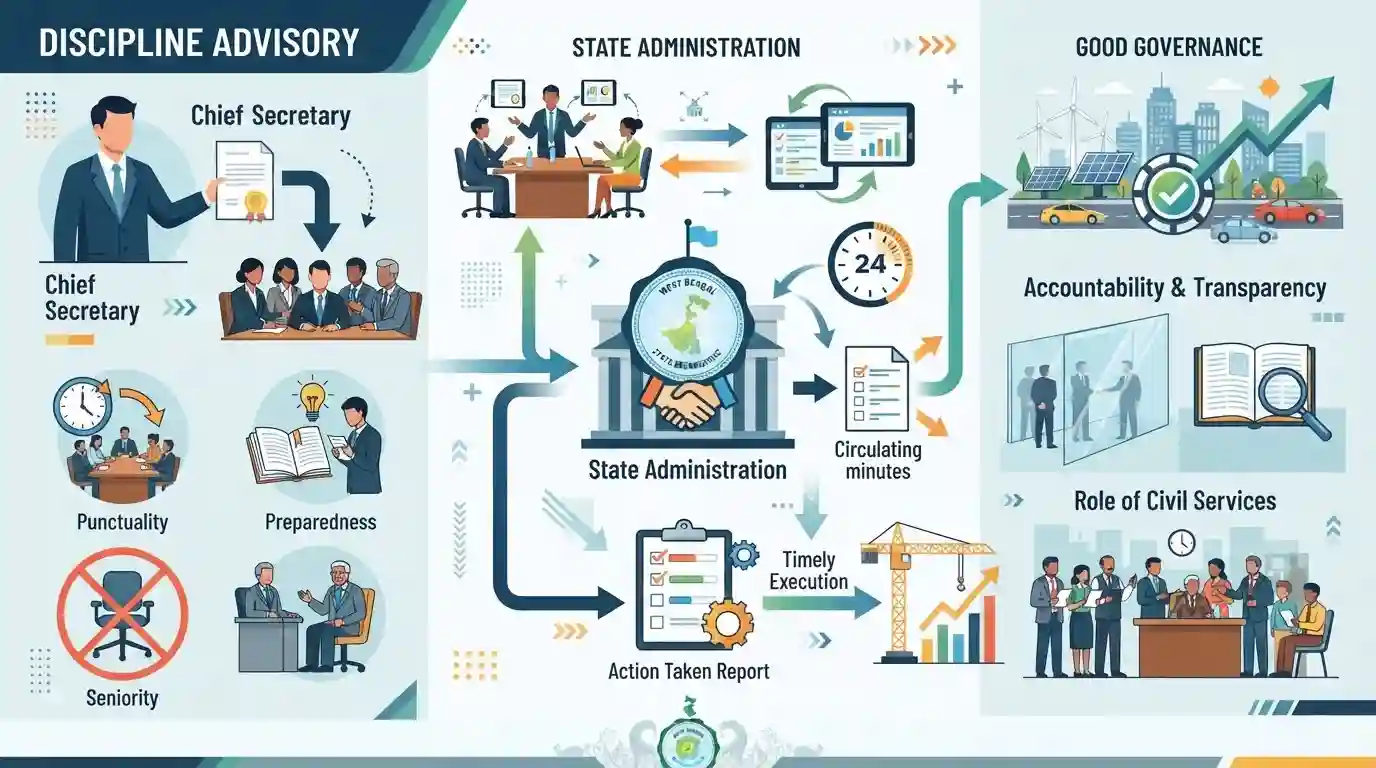
West Bengal Chief Secretary Manoj Agarwal has issued a comprehensive discipline advisory directed at senior bureaucrats in the state. The directive emphasizes the need for professionalism, punctuality, and strict accountability in administrative functions. Prompted by instances of officers attending key meetings unprepared or deputing juniors without approval, the advisory mandates that officers must arrive early, be fully versed in meeting agendas, circulate minutes within 24 hours, and submit Action Taken Reports on time to ensure efficient governance and timely execution of development projects.
Key Points
- West Bengal Chief Secretary Manoj Agarwal issued a discipline advisory for senior bureaucrats to ensure professionalism and accountability.
- Key directives include attending meetings personally, arriving 10 minutes early, and being fully prepared with agendas and financial implications.
- The advisory prohibits deputing junior officials to high-level meetings without prior approval.
- Meeting minutes must be circulated within 24 hours, and Action Taken Reports (ATRs) submitted within specified timelines.
- The initiative aims to prevent procedural delays, improve decision-making, and accelerate the implementation of state development projects.
Important Terms
Chief Secretary

The highest-ranking civil servant in a state government, functioning as the principal advisor to the Chief Minister, head of the state secretariat, and the primary coordinator for interdepartmental policy execution.
UPSC context
GS Paper 2 (State Executive). Tests knowledge of state-level governance, bureaucratic leadership, and the permanent executive.
Indian Administrative Service (IAS)
The premier All-India civil service whose officers manage government affairs, formulate and implement policies, and provide administrative continuity at both the central and state levels.
UPSC context
GS Paper 2 (Role of Civil Services). Relevant for understanding India's administrative framework, federal structure, and policy implementation.
Action Taken Report (ATR)
A formal compliance document submitted by government departments detailing the specific corrective or responsive measures implemented following a directive, audit, or committee recommendation to ensure accountability.
UPSC context
GS Paper 2 (Governance). Crucial for topics covering administrative transparency, grievance redressal, and institutional oversight mechanisms.
Prelims Trap
The State Chief Secretary has a constitutionally fixed tenure to ensure political neutrality.
The Chief Secretary is chosen by the Chief Minister and holds office at their pleasure, with no constitutionally fixed tenure.
Static Concepts Connected
What are the primary administrative roles of a State Chief Secretary?
- Cabinet Secretary: Prepares the agenda, records discussions, and circulates minutes for state cabinet meetings.
- Civil Services Head: Acts as the ex-officio head of the State Civil Services Board, handling key postings, transfers, and discipline of IAS officers.
- Chief Advisor: Serves as the principal administrative advisor to the Chief Minister regarding overall state policy and governance.
What key obligations do the All India Services (Conduct) Rules impose on civil servants?
- Devotion to Duty: Legally mandates promptness, efficiency, and preparedness in administrative functions, penalizing deliberate procedural delays and negligence.
- Political Neutrality: Strictly prohibits officers from taking part in political activities, campaigning, or aligning with specific political parties.
- Unbecoming Conduct: Bars any public or private actions that tarnish the image of the service or breach public trust.
Cross-Topic Patterns
Administrative reforms + E-Governance dashboards
Mandates for manual Action Taken Reports (ATRs) are conceptually linked to digital dashboard initiatives like PRAGATI, which similarly enforce bureaucratic accountability and track procedural delays.
GS-4 Ethics + Rule-Book Bureaucracy
Advisories against deputing unprepared juniors highlight the GS-4 ethical gap between formal rule compliance ("Rule-Book Bureaucracy") and true "devotion to duty."

Expect a GS-2 or GS-4 question assessing how internal accountability mechanisms like ATRs overcome 'rule-book bureaucracy' and policy delays.
Linked PYQs · 2
Linked PYQs · 2
- 2022WBCS_PRELIMSGS1
The Advocate General of a State is appointed by
- 2022WBCS_PRELIMSGS1
Who is the first Law Officer of the Government of India?
