West Bengal Chief Minister Condemns Detention of MPs in Delhi
Source:The Hindu ↗
Why It Matters
This issue is highly relevant for GS Paper 2 as it highlights the ongoing friction between the Union government and opposition-ruled States over the perceived politicization of central agencies like the ED and CBI. It brings up core constitutional themes such as federalism, the fundamental right to protest (Article 19), and the privileges of elected representatives.
Summary
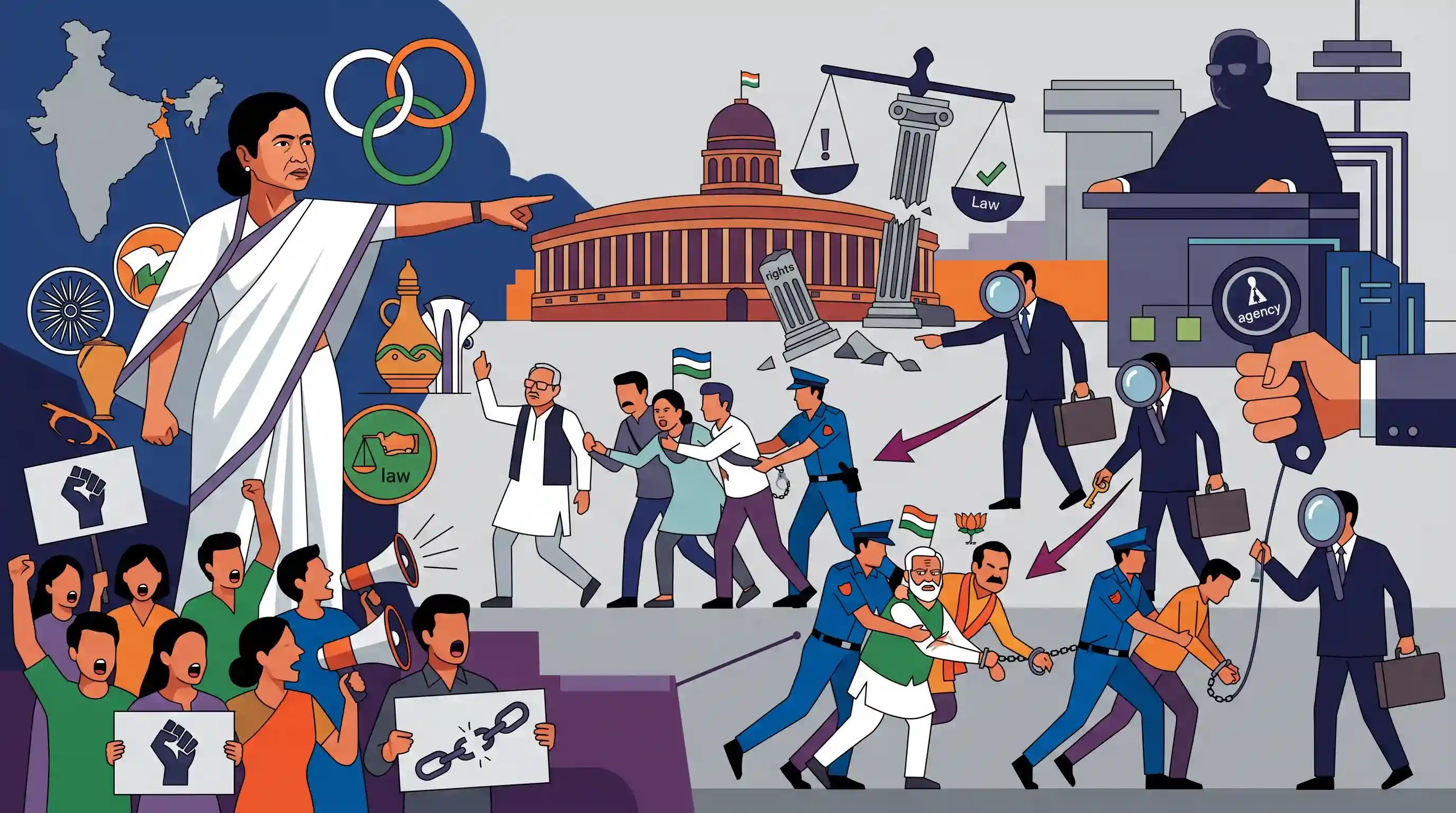
West Bengal Chief Minister Mamata Banerjee strongly condemned the detention of Trinamool Congress (TMC) MPs who were protesting in Delhi against the alleged misuse of Central probe agencies. Following Enforcement Directorate (ED) raids on the I-PAC office and its co-founder Pratik Jain, TMC representatives protested outside the Home Minister's office. Banerjee criticized the Union government for dragging elected representatives on the streets, terming the act an assault on democratic rights, political dissent, and constitutional morality, while accusing the BJP of weaponizing central agencies against the opposition.
Key Points
- Several TMC MPs were detained in Delhi while protesting outside the Home Minister\'s office against the alleged misuse of Central probe agencies.
- West Bengal Chief Minister Mamata Banerjee condemned the police action as an assault on the democratic right to protest and indicative of arrogance in uniform.
- The protests were triggered by recent Enforcement Directorate (ED) raids on the I-PAC office and the residence of its co-founder, Pratik Jain.
- Banerjee accused the ruling BJP of exhibiting double standards regarding political protests and attempting to crush opposition dissent, thereby violating democratic morality.
Important Terms
Enforcement Directorate (ED)

A specialized financial investigation agency under the Ministry of Finance responsible for enforcing the Prevention of Money Laundering Act (PMLA) and Foreign Exchange Management Act (FEMA).
UPSC context
GS Paper II (Statutory Bodies) and Paper III (Money Laundering); essential for understanding executive power and central-state friction.
Parliamentary Privileges
A set of rights and immunities enjoyed by legislators (Article 105 for MPs) to ensure they perform duties without fear of legal action or external interference.
UPSC context
GS Paper II (Parliament and State Legislatures); tests knowledge of legislative independence and constitutional protections for elected members.
Constitutional Morality
The principle of adhering to the core values and spirit of the Constitution—such as justice, liberty, and equality—rather than just its literal text.
UPSC context
GS Paper II (Constitutional Philosophy) and GS Paper IV (Ethics); crucial for questions on judicial interpretations and democratic governance.
Trinamool Congress (TMC)
A political party founded in 1998 by Mamata Banerjee; currently recognized as a State Party following the Election Commission's 2023 status review.
UPSC context
GS Paper II (Elections and Political Parties); relevant for the criteria of National vs. State party status.
Federalism
The constitutional division of power between the Union and States; currently tested by debates over the jurisdiction of central agencies within state territories.
UPSC context
GS Paper II (Centre-State Relations); a core theme involving administrative cooperation and conflicts between different levels of government.
Right to Protest
An implied fundamental right under Article 19(1)(a) and (b), allowing citizens to peacefully assemble and express dissent against government actions.
UPSC context
GS Paper II (Fundamental Rights); focuses on the balance between democratic dissent and "reasonable restrictions" like public order.
Prelims Trap
"Members of Parliament enjoy absolute immunity from any form of arrest or detention while a Parliamentary session is ongoing."
MPs only enjoy immunity from arrest in civil cases (40 days before, during, and after a session). They have no immunity against criminal charges or preventive detention.
Static Concepts Connected
What is the extent of an MP's immunity from arrest?
- Civil cases: Under Section 135A of the Civil Procedure Code, MPs cannot be arrested 40 days before, during, and 40 days after a session.
- Criminal cases: MPs do not enjoy any immunity from arrest in criminal cases and are treated like ordinary citizens.
- Preventive detention: No parliamentary privilege protects an MP from being detained under preventive detention laws or for public order violations.
How does ED's jurisdiction differ from the CBI regarding state powers?
- CBI jurisdiction: Requires 'general consent' from state governments to operate within their territory, governed by the Delhi Special Police Establishment (DSPE) Act, 1946.
- ED jurisdiction: Enforces PMLA and FEMA with nationwide jurisdiction. It can take suo-motu cognizance of scheduled economic offenses without requiring any state consent.
Cross-Topic Patterns
ED, PMLA & Cooperative Federalism
The ED's independent nationwide jurisdiction under PMLA bypasses state consent, emerging as a core contemporary challenge to federalism, often tested alongside the Governor's discretionary powers in Mains.
Fundamental Rights & Public Spaces
Political protests often trigger Article 19(2) and (3) debates. The SC's Shaheen Bagh ruling established that the right to protest is not absolute and public spaces cannot be occupied indefinitely.

Expect a Prelims question contrasting MP arrest immunities (civil vs criminal) with the ED's nationwide jurisdiction under PMLA.
Linked PYQs · 3
Linked PYQs · 3
- 2021MainsGS2
The jurisdiction of the Central Bureau of Investigation (CBI) regarding lodging an FIR and conducting probe within a particular State is being questioned by various States. However, the power of the States to withhold consent to the CBI is not absolute. Explain with special reference to the federal character of India.
- 2014MainsGS2
The 'Powers, Privileges and Immunities of Parliament and its Members' as envisaged in Article 105 of the Constitution leave room for a large number of un-codified and un-enumerated privileges to continue. Assess the reasons for the absence of legal codification of the 'parliamentary privileges'. How can this problem be addressed ?
- 2024MainsGS2
What changes has the Union Government recently introduced in the domain of Centre-State relations ? Suggest measures to be adopted to build the trust between the Centre and the States and for strengthening federalism.
