West Bengal Seeks Extension for Electoral Roll Revision
Source:The Hindu ↗
Why It Matters
The article underscores the monumental scale and challenges of updating electoral rolls, balancing election integrity with the risk of disenfranchising vulnerable voters (due to stringent mapping requirements). This is highly relevant to GS2 topics surrounding the constitutional right to vote, ECI's mandate, and electoral reforms.
Summary
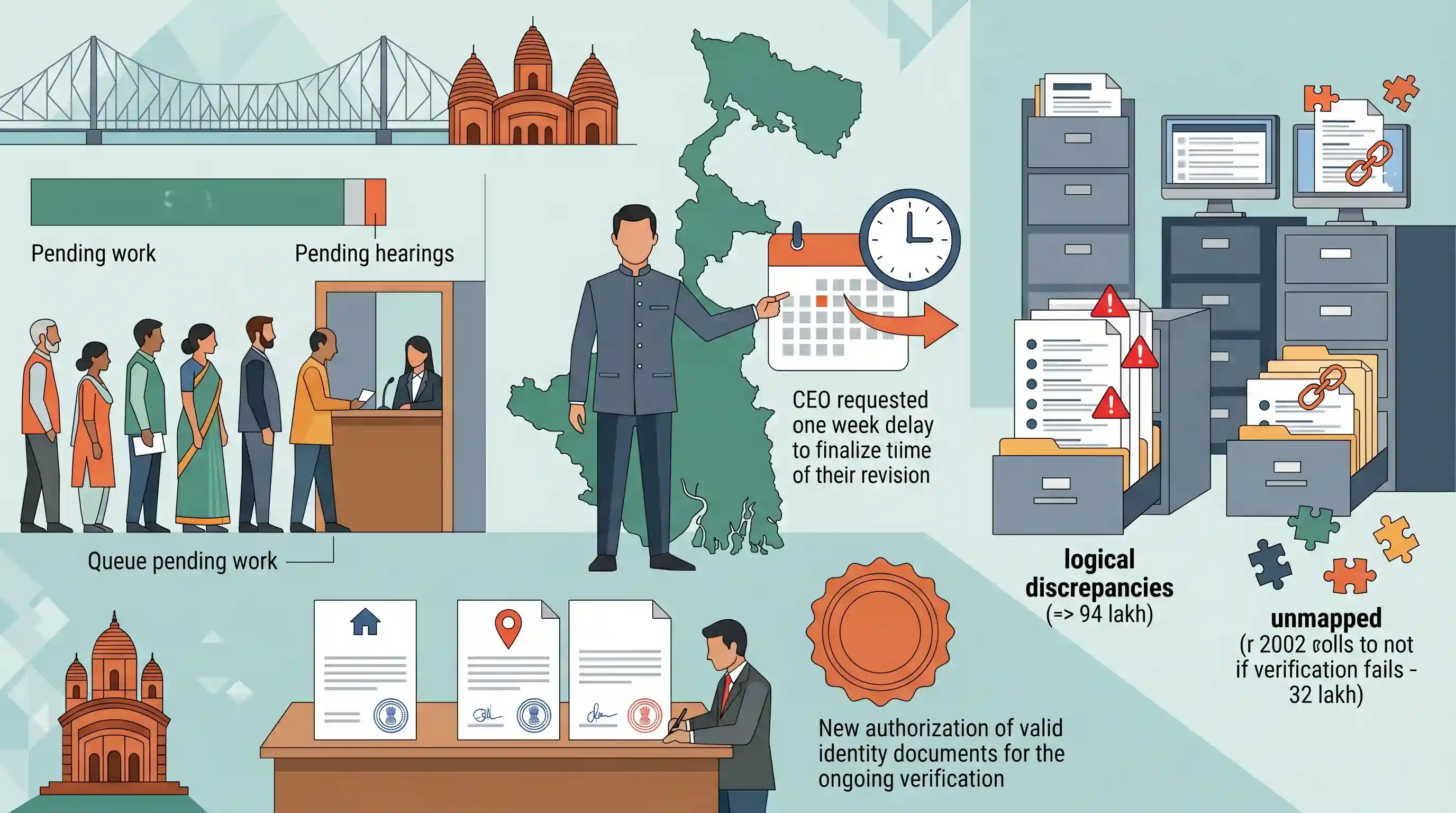
The Chief Electoral Officer of West Bengal, Manoj Kumar Agarwal, has requested a one-week extension from the Election Commission of India to finalize the Special Intensive Revision (SIR) of electoral rolls, with about 5% of voter hearings still pending. The massive exercise has flagged millions of voters—over 94 lakh under 'logical discrepancies' and nearly 32 lakh 'unmapped' to the 2002 electoral rolls—raising concerns of mass deletions if voters fail to attend hearings. Furthermore, the ECI has authorized domicile and permanent resident certificates issued by district magistrates and select officials as valid identity proofs for the ongoing verification.
Key Points
- The Chief Electoral Officer of West Bengal has sought a one-week extension from the ECI to complete the Special Intensive Revision (SIR) of electoral rolls due to 5% pending hearings.
- Voters who miss their scheduled hearings face the risk of deletion from the 2026 final electoral roll.
- Around 94.49 lakh voters were flagged for 'logical discrepancies', while 31.68 lakh are classified as 'unmapped' for lacking links to the 2002 electoral roll through self or progeny mapping.
- The ECI has clarified that domicile or permanent resident certificates issued by specific state authorities (DM, ADM, SDO, Collector) serve as valid identity proofs during SIR hearings.
Important Terms
Special Intensive Revision (SIR)

A comprehensive, house-to-house voter verification drive by the ECI to ensure 'purity' of electoral rolls by fresh enumeration and cross-referencing against benchmark data.
UPSC context
GS Paper II: Electoral Reforms. It tests knowledge of how ECI ensures roll accuracy beyond routine summary revisions.
Election Commission of India (ECI)
A permanent constitutional body (Article 324) responsible for directing and controlling elections to Parliament, State Legislatures, and the offices of President and Vice-President.
UPSC context
GS Paper II: Constitutional Bodies. A core topic regarding institutional independence and electoral management.
Chief Electoral Officer (CEO)
A statutory officer designated by the ECI in each state to supervise the preparation of electoral rolls and election conduct at the state level.
UPSC context
GS Paper II: Election machinery. Tests the distinction between ECI representatives and State Election Commissions for local bodies.
Logical Discrepancies (Electoral Rolls)
Data anomalies in voter records—such as implausible age gaps with parents or excessive progeny mapping—identified during automated cross-verification of current rolls against historical benchmarks.
UPSC context
GS Paper II: Use of technology in electoral processes and challenges in administrative data verification.
Representation of the People Act, 1950
Key legislation governing the allocation of seats, delimitation of constituencies, and the preparation/revision of electoral rolls for Parliamentary and Assembly elections.
UPSC context
GS Paper II: Statutory provisions for elections. Specifically listed in the UPSC syllabus.
Prelims Trap
"The Chief Electoral Officer of a State is appointed by the Governor on the recommendation of the Election Commission of India."
False. Under Section 13A of the Representation of the People Act, 1950, the CEO is an officer designated or nominated directly by the ECI in consultation with the State Government.
Static Concepts Connected
What statutory framework governs the preparation and revision of Electoral Rolls?
- Constitutional Mandate: Article 324 vests the superintendence, direction, and control of electoral rolls preparation directly in the Election Commission of India (ECI).
- Ordinarily Resident: Under Sec 19 of RPA 1950, a person must be ordinarily resident in a constituency. Temporary absence does not break this residency status.
- Special Revision: Sec 21(3) of RPA 1950 empowers the ECI to order a Special Intensive Revision (SIR) of rolls at any time for recorded reasons to correct large-scale discrepancies.
Does a domicile certificate guarantee the right to be registered as a voter?
- Residence Proof: Domicile proves "ordinary residence" in a specific state, which fulfills a key prerequisite for voter registration under the RPA 1950.
- Citizenship Requirement: Article 326 and Sec 16 of RPA 1950 strictly require Indian citizenship. A domicile certificate alone does not confer citizenship or bypass this disqualification.
Cross-Topic Patterns
Electoral Rolls + NRC/Citizenship overlaps
The massive 'unmapped' voter flagging via 2002 electoral roll references echoes the mechanics of Assam's NRC legacy data verification, blending electoral cleanup with broader citizenship and demographic debates.
Federalism + Unified Election Machinery
State bureaucracy executing ECI mandates (DMs issuing domicile certificates, acting as District Election Officers) highlights the unified, centralized election machinery operating within India's federal structure.

Expect a multi-statement question in 2026 on RPA 1950 focusing on 'ordinary resident' criteria, CEO appointment, and ECI revision powers.
Linked PYQs · 4
Linked PYQs · 4
- 2024MainsGS2
Examine the need for electoral reforms as suggested by various committees with particular reference to "one nation one election" principle.
- 2022MainsGS2
Discuss the role of the Election Commission of India in the light of the evolution of the Model Code of Conduct.
- 2017PrelimsGS1
Right to vote and to be elected in India is a
- 2017PrelimsGS1
For election to the Lok Sabha, a nomination paper can be filed by
