Caste Certificate Verification and Welfare Inclusion Errors
Source:Indian Express ↗
Why It Matters
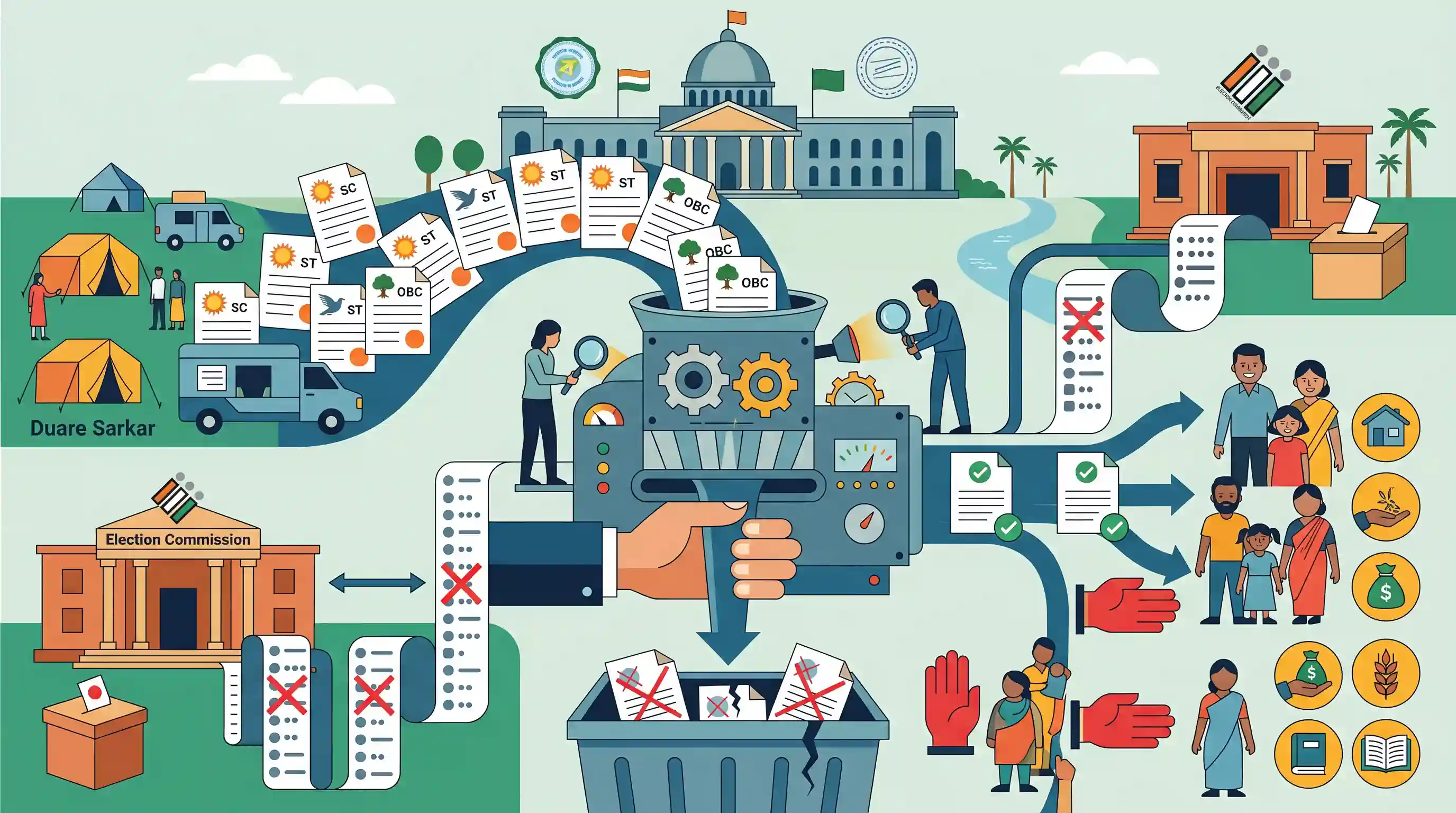
The issue illustrates the critical governance challenge of 'inclusion errors' in welfare delivery, particularly how mass outreach programs can inadvertently enable fake beneficiaries. It also touches upon a significant constitutional and administrative debate: the linkage of electoral roll status (voter registration) to the entitlement and access of government welfare schemes and affirmative action benefits.
Summary
The West Bengal government has ordered a comprehensive re-verification of 1.69 crore SC, ST, and OBC caste certificates issued since 2011, aiming to weed out fake beneficiaries. Almost 48 lakh of these certificates were distributed via the previous administration's 'Duare Sarkar' outreach camps. Crucially, the government is linking this verification to the Election Commission's Special Intensive Revision (SIR) of electoral rolls. Individuals whose names were deleted from the voter lists—amounting to roughly 91 lakh people—face the risk of having their caste certificates canceled and losing access to state welfare schemes, raising important governance questions regarding targeted delivery and beneficiary identification.
Key Points
- The newly formed West Bengal government has initiated a re-verification process for 1.69 crore SC, ST, and OBC caste certificates issued since 2011 over allegations of fake documentation.
- Special scrutiny is being applied to 47.80 lakh certificates issued through the previous administration's 'Duare Sarkar' (government at your doorstep) mass outreach camps.
- The verification process will cross-reference data with the Election Commission's Special Intensive Revision (SIR) of electoral rolls.
- Individuals deleted from the voter list (which saw around 91 lakh deletions recently) may have their caste certificates canceled and be barred from availing government welfare schemes.
- The move underscores the governance challenges of balancing rapid public service delivery with stringent verification to prevent inclusion errors in affirmative action.
Important Terms
Duare Sarkar

A flagship outreach initiative of the West Bengal government designed to deliver public services and social welfare schemes directly to citizens through localized community-level camps.
UPSC context
GS Paper II (Governance). Evaluates decentralized service delivery models and administrative efficiency in implementing social welfare schemes.
Special Intensive Revision (SIR)
A comprehensive voter list verification and purification process conducted by the Election Commission to ensure electoral roll accuracy by adding new voters and removing duplicate or ineligible entries.
UPSC context
GS Paper II (Elections). Crucial for understanding electoral integrity, the Representation of the People Act, and voter database management.
Election Commission of India (ECI)
An autonomous constitutional body established under Article 324, responsible for the superintendence, direction, and control of elections to Parliament, State Legislatures, and the offices of President and Vice-President.
UPSC context
GS Paper II (Constitutional Bodies). Key for topics on electoral reforms, democratic governance, and institutional independence.
Calcutta High Court
The oldest High Court in India, exercising jurisdiction over West Bengal and the Andaman and Nicobar Islands, and performing judicial review over state executive and legislative actions.
UPSC context
GS Paper II (Judiciary). Tests knowledge of judicial review over state reservation policies and the constitutional validity of administrative orders.
Affirmative Action
Policy measures, such as reservations in education and employment, intended to provide equal opportunities and social justice to historically marginalized and backward communities (SCs, STs, and OBCs).
UPSC context
GS Paper II (Social Justice). Fundamental to understanding Articles 15 and 16 and the upliftment of vulnerable sections of society.
Prelims Trap
The Union Government is solely responsible for both notifying SC/ST lists and issuing individual caste certificates.
While the President notifies SC/ST categories under Articles 341/342, issuing and verifying individual caste certificates is exclusively a State administrative function.
Static Concepts Connected
Who has the constitutional authority over SC and ST lists?
- Presidential Notification: The President initially notifies the SC/ST lists for a state under Articles 341 and 342, after consulting the State Governor.
- Parliamentary Modification: Any subsequent inclusion or exclusion from these constitutional lists can only be done by Parliament through legislation.
- State Issuance: Issuing and verifying individual caste certificates remains the administrative responsibility of state revenue authorities.
What are inclusion and exclusion errors in public service delivery?
- Inclusion Errors: Occurs when ineligible individuals wrongly receive welfare benefits, such as through fake caste certificates, leading to resource leakage.
- Exclusion Errors: Occurs when genuine beneficiaries are wrongly denied state support, often caused by strict database mismatches or administrative anomalies.
Cross-Topic Patterns
Database Linkage & Exclusion Errors
Linking welfare eligibility to electoral rolls mirrors past Aadhaar debates. Rigid cross-verification risks severe exclusion errors, denying genuine beneficiaries their constitutionally mandated affirmative action benefits due to administrative anomalies.
Supreme Court on Fake Caste Claims
The 1994 Kumari Madhuri Patil judgement mandated State-Level Scrutiny Committees to verify caste certificates, showing the judiciary's long-standing focus on preventing the usurpation of reserved benefits by ineligible persons.

Expect a 2026 Prelims question contrasting the President's power to notify SC/ST lists with the State's power to issue caste certificates.
Linked PYQs · 2
Linked PYQs · 2
- 2019MainsGS2
Performance of welfare schemes that are implemented for vulnerable sections is not so effective due to absence of their awareness and active involvement at all stages of policy process. Discuss.
- 2023MainsGS2
“Development and welfare schemes for the vulnerable, by its nature, are discriminatory in approach.” Do you agree? Give reasons for your answer.
