West Bengal Integrates Watershed Planning into Gram Sabha Framework
Source:dcdt ↗
Why It Matters
Crucial for understanding grassroots governance, rural development initiatives, and decentralised water resource management in West Bengal.
Summary
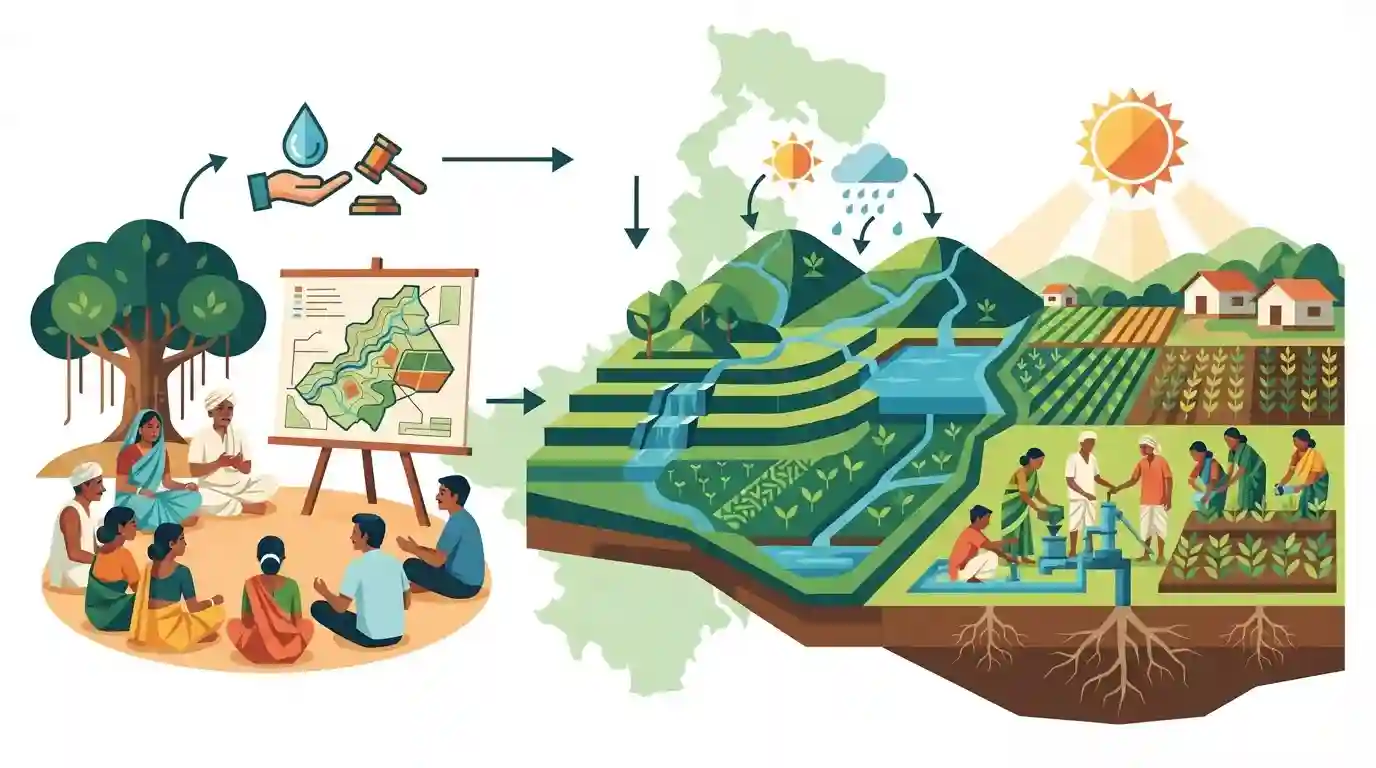
West Bengal has introduced watershed planning into Gram Sabhas, empowering rural communities to manage local water resources, improve soil health, and strengthen climate resilience through participatory local governance.
Key Points
- West Bengal has integrated watershed planning directly into Gram Sabhas to decentralise rural resource management and boost local climate resilience.
- This initiative aims to empower local communities, especially small and marginal farmers, to plan micro-watershed projects, water conservation, and soil management at the grassroots level.
- It strengthens local governance under the Panchayati Raj framework, enhancing public participation in natural resource management and agricultural productivity.
Important Terms
West Bengal Panchayat Act

The foundational statutory framework enacted in 1973 governing rural local self-government in West Bengal, empowering three-tier panchayats with administrative and developmental responsibilities including water management.
UPSC context
Crucial for WBCS Paper IV (Polity, WB Administration, and Decentralization), testing knowledge of state-specific local governance laws and devolved subjects.
Gram Sabha
The constitutional general assembly of all registered voters in a village panchayat area, serving as the foundational platform for direct democracy, social audit, and local resource planning.
UPSC context
Essential for WBCS Indian Polity and Rural Development topics, testing the grassroots machinery of local self-governance and participatory planning.
Panchayati Raj Institutions
The three-tier system of rural local government (Gram Panchayat, Panchayat Samiti, Zilla Parishad) mandated by the 73rd Constitutional Amendment Act to ensure democratic decentralization.
UPSC context
Core topic for WBCS Indian Polity & Governance (Paper IV), frequently tested regarding decentralization, rural welfare, and administrative devolution.
Pradhan Mantri Krishi Sinchayee Yojana (PMKSY)
A flagship national scheme aimed at expanding cultivable area under assured irrigation, improving water use efficiency, and implementing watershed management projects through its WDC component.
UPSC context
Important for WBCS Economy and Agriculture sections, evaluating central schemes for irrigation, water conservation, and climate-resilient farming.
Static Concepts Connected
What are the key constitutional provisions and statutes governing Panchayati Raj institutions in West Bengal?
- WB Act 1973: The West Bengal Panchayati Raj Act, 1973 replaced earlier legislation and established a three-tier panchayat system in the state.
- 73rd Amendment: The 73rd Constitutional Amendment Act of 1992 added Part IX to the Constitution, institutionalising the three-tier system and devolving 29 functional items.
- Three Tiers: Gram Panchayat, Panchayat Samiti, and Zilla Parishad form the three tiers, with Gram Sabhas serving as the foundational deliberative assembly at the village level.
Cross-Topic Patterns
Watershed Planning + Panchayati Raj Decentralisation
The integration of watershed planning with the Panchayati Raj framework directly intersects with rural livelihood security and micro-irrigation funding models like PMKSY.

Expect a statement-based WBCS Prelims question combining the 60:40 funding ratio of WDC-PMKSY with Gram Panchayat statutory powers.
Linked PYQs · 3
Linked PYQs · 3
- 2019WBCS_PRELIMSGS1
West Bengal Land Reform Act came into force in
- 2014WBCS_PRELIMSGS1
Major part of the Indian agriculture is characterised by
- 2013WBCS_PRELIMSGS1
Panchayats in West Bengal are authorised to collect
