West Bengal integrates watershed planning into Gram Sabhas
Source:dcdt ↗
Why It Matters
Important for WBCS aspirants to understand institutional innovations in West Bengal's Panchayati Raj system, particularly regarding grassroots planning, rural resource management, and climate-resilient agriculture.
Summary
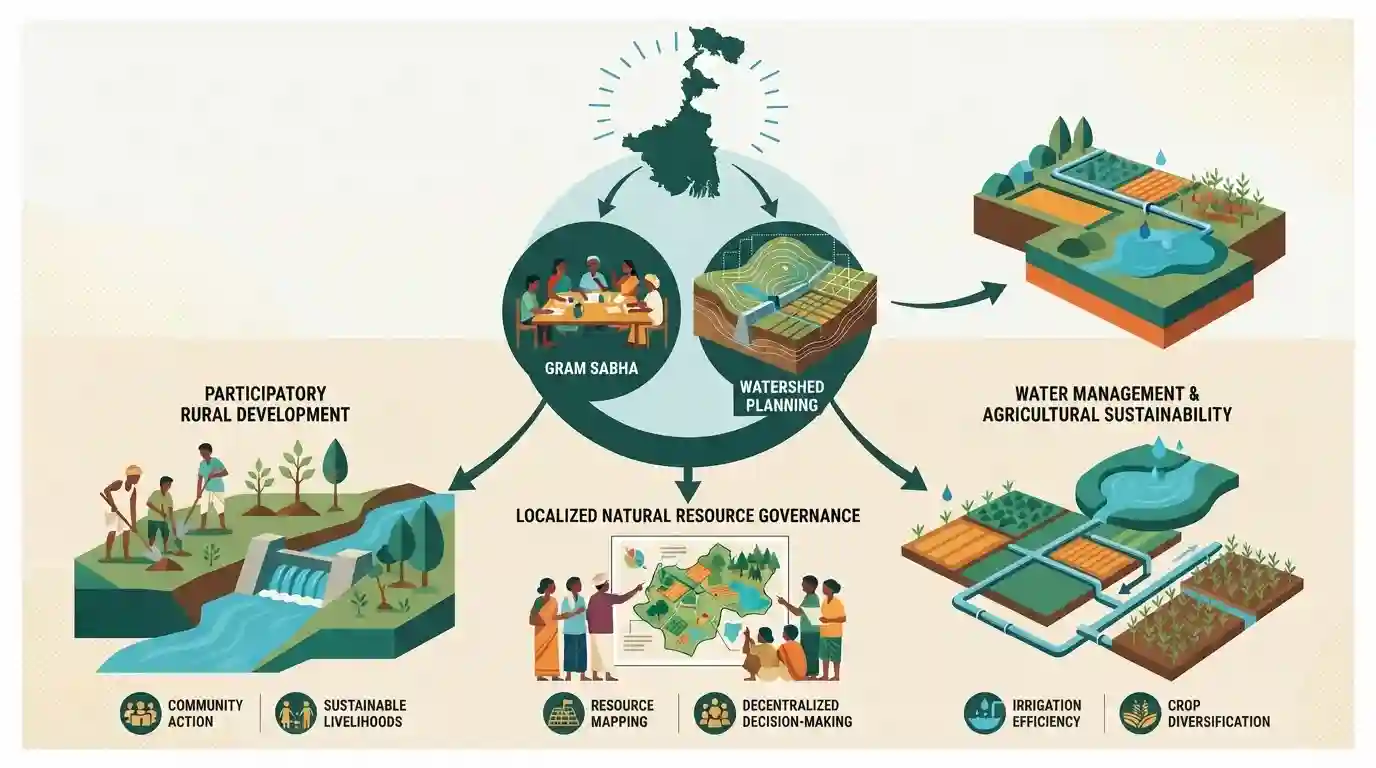
West Bengal's integration of watershed planning into Gram Sabhas marks a significant step towards participatory rural development and localized natural resource governance, empowering local communities to address water management and agricultural sustainability.
Key Points
- West Bengal has integrated watershed planning directly into Gram Sabha deliberations to strengthen decentralized natural resource management.
- This initiative links grassroots planning with rural water security, agricultural resilience, and local governance under Panchayati Raj.
- Enhances community participation in managing soil erosion, water scarcity, and watershed structures, particularly beneficial for drought-prone regions in the state.
Important Terms
West Bengal Panchayat Act

The statutory framework governing rural local self-government in West Bengal, establishing a multi-tiered panchayati raj system and outlining powers for decentralized planning, water management, and rural development.
UPSC context
WBCS Paper V (Indian Economy and WB Polity) — tests local self-government legislation, statutory devolution of powers, and rural administration in West Bengal.
Gram Sabha
A statutory assembly comprising all registered voters within a village or gram area, serving as the primary grassroots forum for participatory democracy and social audit.
UPSC context
WBCS Paper V (Indian Polity) — evaluates grassroots democracy, decentralized governance, and direct community decision-making mechanisms under constitutional provisions.
Panchayati Raj Institutions
A three-tiered system of rural local government established under constitutional amendments and state statutes to promote democratic decentralization, economic development, and social justice.
UPSC context
WBCS Paper V (Indian Polity and Economy) — tests the evolution, structure, and functional devolution of rural local bodies in India and West Bengal.
Prelims Trap
Gram Panchayat executive body alone holds exclusive statutory power to design watershed plans without Gram Sabha consultation.
Aspirants often confuse Gram Sabha (all registered voters of a village) with Gram Panchayat (elected representatives), but watershed planning authority specifically rests with the participatory assembly.
Static Concepts Connected
What are the constitutional provisions and functional domains of Panchayati Raj under the Eleventh Schedule?
- Constitutional Basis: Article 243G empowers Panchayats with powers and responsibilities to prepare plans for economic development and social justice.
- Functional Items: The Eleventh Schedule lists 29 functional items including soil conservation, water management, watershed development, and minor irrigation.
- DPSP Directive: Article 40 (Directive Principles) directs State Governments to organize village panchayats as units of self-government.
Cross-Topic Patterns
Watershed Management + MGNREGS Convergence
Drought-prone western districts like Purulia and Bankura require converging MGNREGS assets with watershed management for climate-resilient rural livelihoods.
Eleventh Schedule Devolution + Local Governance
Article 243G empowers Panchayats on 29 subjects including soil conservation and water management, tested frequently in WBCS polity.

Gram Sabha devolution under Article 243G + Western plateau geography (Purulia/Bankura) is a prime WB-specific polity-geography link.
Linked PYQs · 3
Linked PYQs · 3
- 2013WBCS_PRELIMSGS1
Panchayats in West Bengal are authorised to collect
- 2018WBCS_PRELIMSGS1
Which article of the Constitution of India describes the organisation of village panchayats?
- 2017WBCS_PRELIMSGS1
Drought is occasionally experienced in the plateau region of West Bengal because of
