West Bengal Urged to Bid for Chemical Park Under Central Scheme
Source:newindianexpress ↗
Why It Matters
Industrial revival and specific geographical industrial zones (like Haldia for chemicals/petrochemicals and Durgapur for heavy industries) are highly recurring topics in WBCS Prelims Geography and Economy sections. The BHAVYA Rasayan scheme represents an important union policy context for state-level industrial development.
Summary
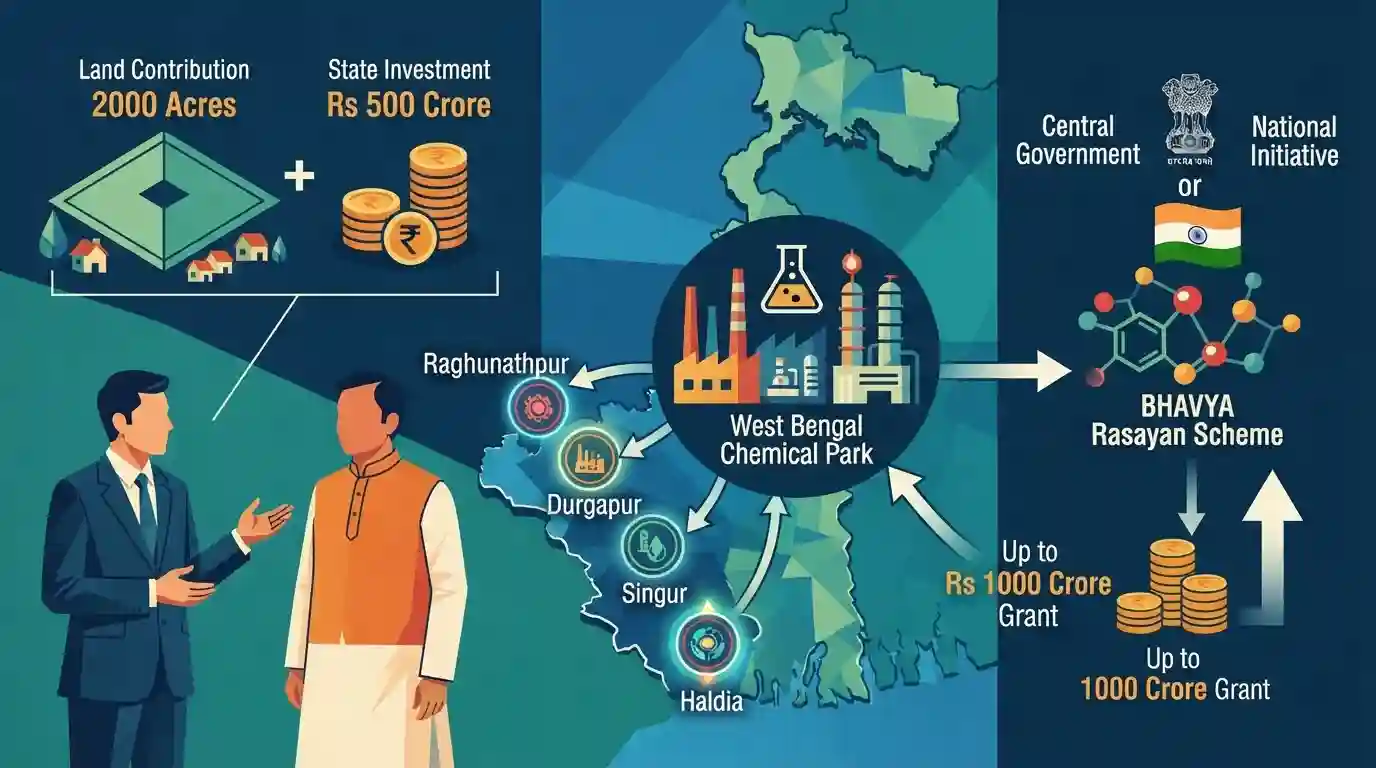
West Bengal BJP president Samik Bhattacharya has urged the state government to aggressively bid for establishing a chemical park under the Centre's newly approved BHAVYA Rasayan scheme. The Rs 3,030-crore central initiative will support the creation of three dedicated chemical parks nationwide, offering up to Rs 1,000 crore in grants for each project provided the host state contributes 2,000 acres of land and at least Rs 500 crore. Bhattacharya suggested potential locations such as Haldia, Durgapur, Singur, or Raghunathpur to boost West Bengal's industrial landscape under the state's new Industries Minister, Tapas Roy.
Key Points
- The Centre approved the Rs 3,030-crore BHAVYA Rasayan scheme on July 24 to establish three dedicated chemical parks in India via a competitive challenge route.
- Under the scheme, the Central government will grant up to Rs 1,000 crore per park, while the state must contribute at least Rs 500 crore and provide a minimum of 2,000 acres of encumbrance-free land.
- West Bengal BJP chief Samik Bhattacharya urged the state government to bid for one of the parks, proposing Singur, Haldia, Raghunathpur, or Durgapur as potential locations.
- The initiative highlights the push for re-industrialization in West Bengal under new state Industries Minister Tapas Roy.
Important Terms
BHAVYA Rasayan scheme

A central sector scheme approved in July 2026 to set up three large-scale chemical parks across India, enhancing manufacturing competitiveness and fostering self-reliance.
UPSC context
GS Paper III (Economy/Infrastructure). Tests awareness of central industrial policies and schemes for core sectors.
Common Effluent Treatment Plant (CETP)
A centralized waste treatment facility that processes industrial effluents from multiple clustered manufacturing units, offering an economical and eco-friendly pollution-control solution.
UPSC context
GS Paper III (Environment/Infrastructure). Tests knowledge of industrial waste management and ecological conservation strategies.
Challenge Route
A competitive project allocation mechanism where states bid and are evaluated based on objective parameters to secure central funding or development projects.
UPSC context
GS Paper II (Polity/Governance). Tests understanding of cooperative and competitive federalism in policy implementation.
Import Substitution
An economic strategy of replacing foreign imports with domestic production to protect local infant industries and promote national self-sufficiency.
UPSC context
GS Paper III (Economy). Tests understanding of trade policies, industrial history, and self-reliance models like Atmanirbhar Bharat.
Haldia
A major industrial port city and petrochemical hub in West Bengal, acting as a key maritime gateway and center for heavy chemicals.
UPSC context
GS Paper I (Geography) / GS Paper III (Infrastructure). Tests knowledge of major industrial regions and port-led development.
Prelims Trap
BHAVYA Rasayan is a 100% centrally-funded scheme with parks allocated automatically to states having the highest chemical output.
It uses a competitive challenge-based model requiring states to co-fund at least ₹500 crore and provide 2,000 acres of land to win grants.
Static Concepts Connected
What is the 'Challenge-Based' allocation model in Indian fiscal federalism?
- Core Mechanism: A competitive allocation method where subnational governments bid for central funds based on predefined benchmark criteria.
- Key Objectives: Fosters competitive federalism, ensures project readiness, and optimizes resource utilization by rewarding states with land and capital commitment.
What are the key structural features of India's chemical and petrochemical sector?
- Economic Contribution: Accounts for nearly 7% of India's GDP and over 8% of the manufacturing Gross Value Added (GVA).
- Location Dynamics: Highly raw-material oriented, clustering near oil refineries, ports, and heavy industrial belts like Gujarat, Maharashtra, and Haldia.
- Environmental Infrastructure: Requires specialized, centralized waste management units such as Common Effluent Treatment Plants (CETPs) to mitigate hazardous ecological footprints.
Cross-Topic Patterns
Competitive federalism vs Regional disparity
Challenge-method schemes like BHAVYA Rasayan favor states with ready land banks and fiscal depth, potentially widening industrial development gaps between wealthier coastal states and poorer landlocked ones.
Industrial geography and environmental compliance
The shift to centralized environmental infrastructure (CETPs/TSDFs) in chemical parks reflects environmental law pressures (GS-3) altering traditional raw-material-based industrial location theories.

BHAVYA Rasayan's strict 2,000-acre land criterion and challenge-route bidding will likely feature as a test of competitive federalism in GS-3.
Linked PYQs · 3
Linked PYQs · 3
- 2023WBCS_PRELIMSGS1
The two main industries in Haldia Industrial Region are
- 2022WBCS_PRELIMSGS1
West Bengal Industrial Development Corporation Ltd. (WBIDC) was established in
- 2018WBCS_PRELIMSGS1
'Dry Port' of West Bengal is located at
