West Bengal Assembly Speaker Admits Condemnation Proposal
Source:The Hindu ↗
Why It Matters
This event illustrates the practical application of the Speaker's powers to expunge remarks and admit condemnation proposals, relevant to GS Paper 2 topics on the functioning of the State Legislature, parliamentary privileges, and maintaining the secular ethos in constitutional bodies.
Summary
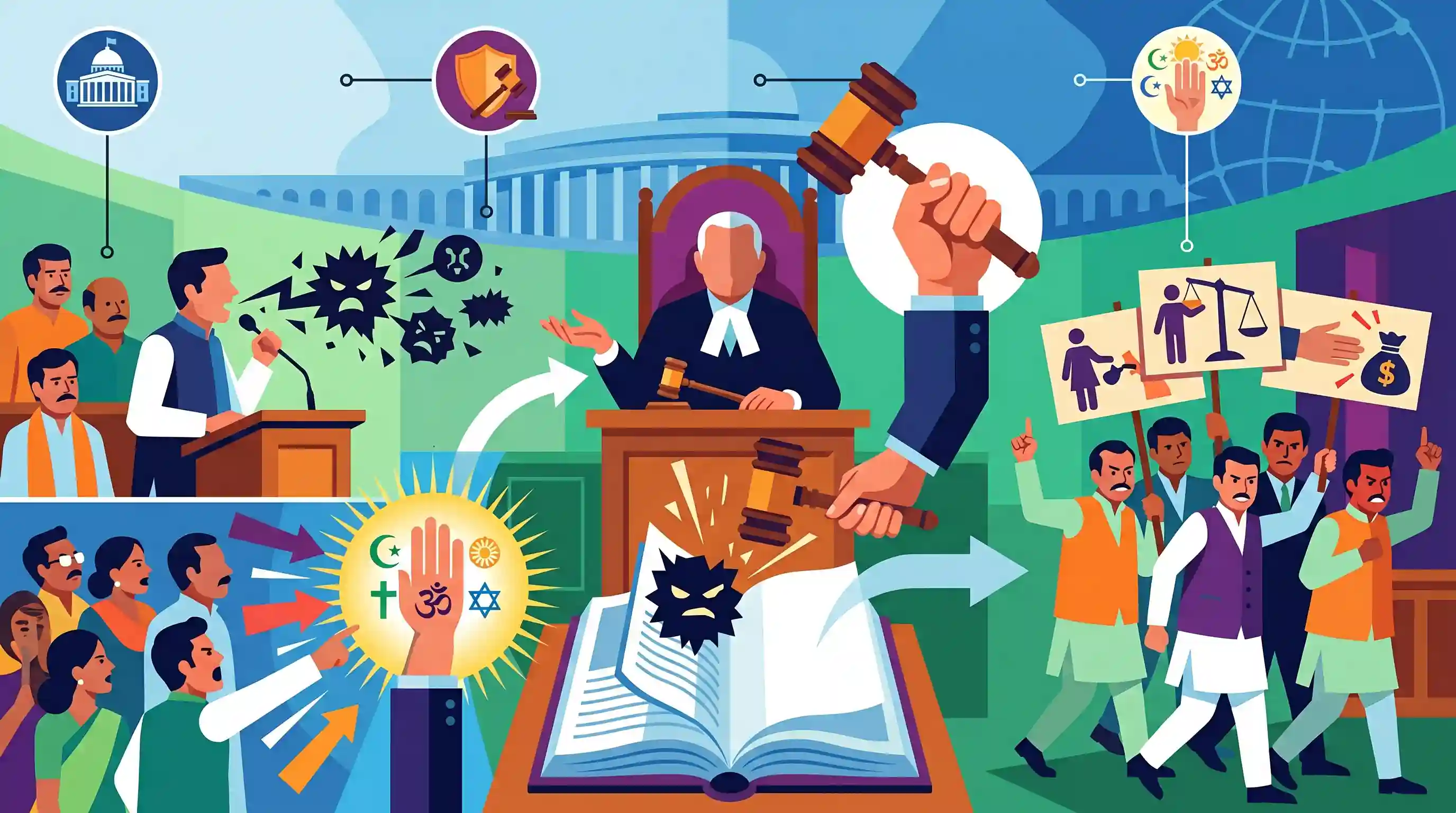
The West Bengal Assembly Speaker permitted a TMC proposal condemning a BJP MLA's remarks about madrasa funding, which were deemed hateful and contrary to India's secular spirit. The Speaker expunged the contentious comments from official records, prompting BJP MLAs to stage a walkout. The protesting MLAs accused the TMC of appeasement politics and alleged the Speaker's decision was influenced by partisan pressure, highlighting ongoing debates around parliamentary privileges, the Speaker's impartiality, and secularism in legislative discourse.
Key Points
- West Bengal Assembly Speaker Biman Banerjee allowed a TMC proposal to condemn BJP MLA Agnimitra Paul's remarks concerning madrasa fund allocations.
- TMC's Parliamentary Affairs Minister Sobhandeb Chattopadhyay argued the MLA's comments violated the secular spirit of India and the Assembly.
- The Speaker exercised his powers to expunge the controversial remarks from the official House records.
- BJP MLAs staged a walkout in protest, accusing the ruling TMC government of minority appeasement and questioning the Speaker's impartiality.
- The episode highlights the crucial role of the Speaker in maintaining parliamentary decorum and utilizing powers like expunction of records to uphold constitutional principles within the legislature.
Important Terms
Speaker of the Legislative Assembly

Constitutional presiding officer (Article 178) of the State Assembly, responsible for maintaining order, interpreting rules, and ensuring the House's dignity through impartial conduct.
UPSC context
GS Paper II (Polity): Powers, functions, and the challenge of maintaining neutrality in a partisan legislative environment.
Parliamentary Privileges
Legal immunities (Article 194) granted to State legislators to ensure freedom of speech and protection from court proceedings for any statement or vote within the House.
UPSC context
GS Paper II (Polity): Balancing legislative freedom of speech with constitutional limits and individual fundamental rights.
Expunction of Remarks
The procedural removal of defamatory, indecent, or undignified remarks from official legislative records (Hansard) by the order of the Presiding Officer.
UPSC context
GS Paper II (Polity): Legislative procedures and the Speaker's discretionary power to regulate House decorum.
Secularism
A fundamental feature of India’s basic structure requiring state neutrality and equal respect for all religions, rather than a strict separation of church and state.
UPSC context
GS Paper I (Social Issues) and GS Paper II (Polity): Constitutional values, Preamble, and religious neutrality in governance.
Substantive Motion
A formal proposal by a member for the House to express an opinion or take action, which must be specific and approved by the Speaker.
UPSC context
GS Paper II (Polity): Parliamentary tools used to discuss matters of public importance or criticize member conduct.
Unparliamentary Language
Words or expressions deemed unfit for legislative discourse; such remarks are subject to withdrawal by the member or expunction by the Speaker.
UPSC context
GS Paper II (Polity): Rules of Procedure and the maintenance of discipline and decorum within the legislature.
Prelims Trap
The freedom of speech in State Legislatures is absolute and overrides the Speaker's rules of procedure.
Under Article 194, legislative free speech is explicitly subject to constitutional provisions and House rules. The Speaker holds final authority over proceedings.
Static Concepts Connected
What governs the expunction of remarks in State Legislatures?
- Discretionary Authority: The Speaker or Presiding Officer has the sole discretion to order the deletion of defamatory, unparliamentary, or undignified words from official records.
- Media Restriction: Reporting or publishing remarks that have been expunged by the Speaker constitutes a breach of parliamentary privilege.
- Judicial Immunity: Article 212 bars courts from inquiring into legislative proceedings based on procedural irregularities, shielding the Speaker's expunction orders from judicial review.
How is legislative freedom of speech distinct from citizen rights?
- Article 194 vs 19: MLAs' free speech derives from Article 194, providing broader immunity from court proceedings for anything said in the House compared to Article 19(1)(a).
- Internal Restrictions: Unlike citizen speech restricted by Article 19(2), legislative speech is specifically constrained by House rules and constitutional limits, such as Article 211 (conduct of judges).
Cross-Topic Patterns
Speaker Impartiality & Tenth Schedule
Disputes over a Speaker's partisan behavior during debates parallel recurring Supreme Court critiques of their biased delays in anti-defection disqualification proceedings.
Article 30 vs Indian Secularism
Debates on madrasa allocations highlight India's 'principled distance' model, which constitutionally permits the State to fund minority educational institutions without violating secularism.

Expect a Prelims question intertwining Article 194 (legislative free speech), the Speaker's expunction powers, and Article 212 (judicial bar).
Linked PYQs · 2
Linked PYQs · 2
- 2020MainsGS2
Once a Speaker, Always a Speaker' ! Do you think this practice should be adopted to impart objectivity to the office of the Speaker of Lok Sabha ? What could be its implications for the robust functioning of parliamentary business in India?
- 2024MainsGS2
Discuss India as a secular state and compare with the secular principles of the US constitution.
