WB Panchayat Amendment Bill curbs financial powers of local pradhans
Source:The Hindu ↗
কেন এটি গুরুত্বপূর্ণ
The amendment marks a significant legislative shift in the balance of power between grassroots elected representatives and the state bureaucracy in West Bengal's three-tier Panchayati Raj system. It directly relates to the constitutional principles of democratic decentralisation (73rd Amendment) and touches upon the debate surrounding bureaucratic overreach versus local self-governance.
সারসংক্ষেপ
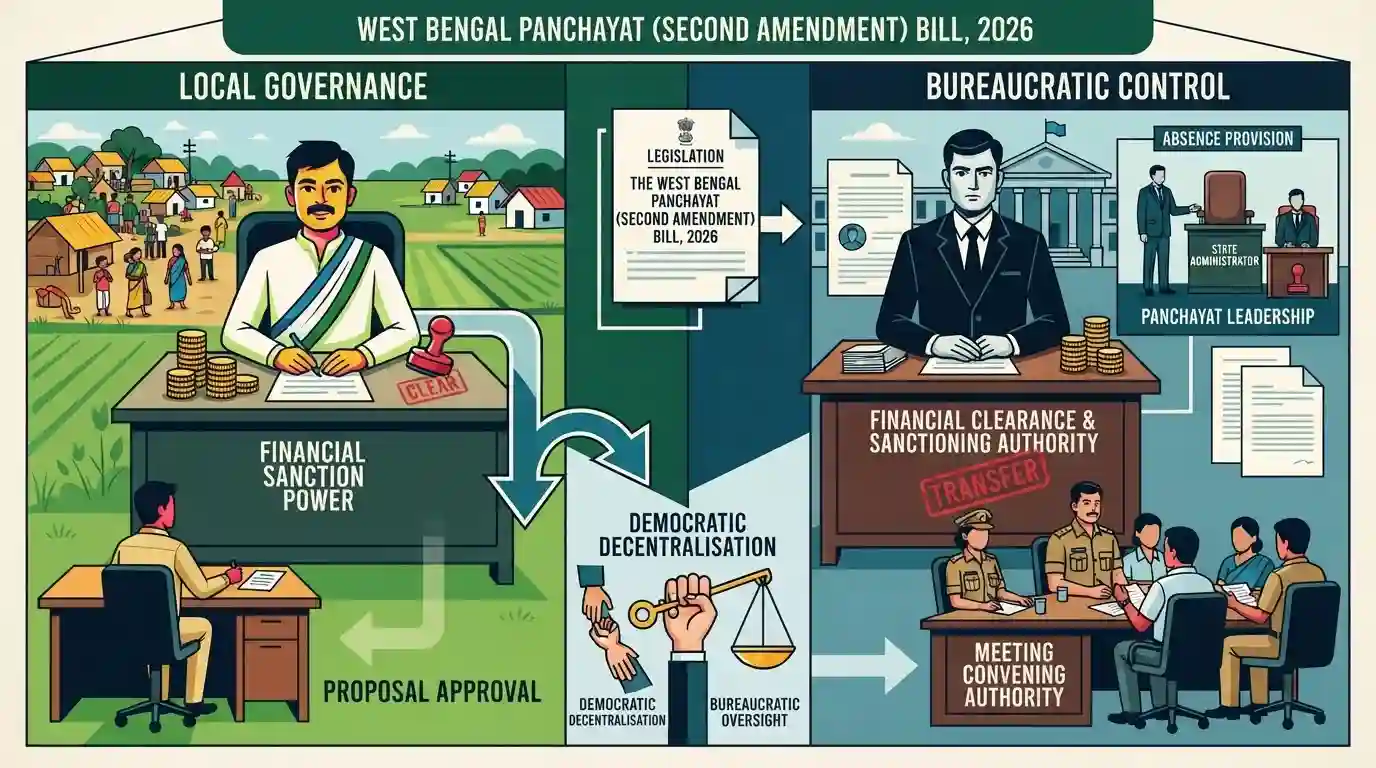
The West Bengal Legislative Assembly passed the West Bengal Panchayat (Second Amendment) Bill, 2026, which amends the West Bengal Panchayat Act, 1973. The primary impact of this legislation is the transfer of financial clearance and sanctioning powers from elected Panchayat Pradhans to state bureaucrats (such as Block Development Officers and Panchayat Secretaries), leaving elected heads with only proposal-approval authority. The bill also introduces provisions to appoint state-appointed administrators during absences of local leaders and allows Panchayat Secretaries to convene meetings under specific conditions. While the state government (under the BJP) states that these steps are meant to curb corruption ('cut-money') and ensure administrative stability, critics and opposition elements view it as a roll-back of democratic decentralisation and devolution of powers to local self-governments.
মূল বিষয়
- The West Bengal Legislative Assembly passed the West Bengal Panchayat (Second Amendment) Bill, 2026, which strips elected panchayat pradhans (village heads) of their financial powers.
- Under the new amendment, bills and financial clearances will be cleared and sanctioned by state bureaucrats (such as Block Development Officers and Panchayat Secretaries), whereas the elected panchayat pradhans will only have the authority to approve proposals.
- The bill allows the prescribed authority to appoint an Extension Officer (or higher-ranking official) as an Administrator for up to 30 days if both the Pradhan and Deputy Pradhan are absent for over 15 days and no other elected member is willing to take charge.
- If no Gram Panchayat meeting is held for two consecutive months due to the absence of the Pradhan and Deputy Pradhan, the Panchayat Secretary (with the approval of the Block Development Officer) is authorised to convene the meeting.
- The West Bengal Panchayat (Second Amendment) Bill, 2026, was passed in the Assembly with 169 votes in favour, 13 votes against, and 32 members abstaining or not participating in the vote.
- State Panchayat Affairs and Rural Development Minister Dilip Ghosh argued that the bill aims to eliminate administrative irregularities, corruption, and commission/'cut-money' practices, rather than curtailing constitutional powers.
- This amendment follows a previous state notification that deprived panchayat pradhans and other elected local representatives of their powers to issue birth and death certificates.
গুরুত্বপূর্ণ শব্দ
West Bengal Panchayat (Second Amendment) Bill, 2026

A 2026 state legislation transferring financial sanctioning powers from elected Gram Panchayat Pradhans to state bureaucrats like Block Development Officers, aiming to curb local corruption.
UPSC context
GS Paper 2 (Local Government). Highlights the tension between state bureaucratic control and local self-governance.
West Bengal Panchayat Act, 1973
The principal state statute establishing and regulating the three-tier Panchayati Raj system in West Bengal, determining the composition, powers, and duties of rural local bodies.
UPSC context
GS Paper 2 (Panchayati Raj). Acts as a state-level case study for legislative frameworks governing rural decentralisation.
West Bengal Legislative Assembly
The unicameral state legislature of West Bengal, possessing the constitutional authority to enact, amend, or repeal state laws, including those relating to local self-government.
UPSC context
GS Paper 2 (State Legislature). Tests the role and powers of state legislatures in modifying the devolution of powers to Panchayats.
Democratic Decentralisation
The transfer of political and administrative decision-making authority from central and state governments to elected local bodies, ensuring direct citizen participation and grassroots governance.
UPSC context
GS Paper 2 (Panchayati Raj). The core philosophy behind the 73rd and 74th Amendments, establishing local self-governance in India.
Devolution of Powers
The constitutional mandate under Article 243G requiring state legislatures to transfer functions, finances, and functionaries (the 3 Fs) to local governments to operate autonomously.
UPSC context
GS Paper 2 (Federalism/Local Governance). Evaluates the extent of actual empowerment of Panchayats versus mere administrative delegation.
প্রিলিমস ফাঁদ
The Constitution mandates strict financial autonomy for Panchayats, preventing states from stripping financial powers.
Article 243G makes the devolution of powers—including financial authority—entirely discretionary for the State Legislature. States can legally grant or withdraw these powers.
সংযুক্ত স্থির ধারণা
What is the constitutional basis for devolving powers to Panchayats?
- Article 243G: Grants state legislatures the discretionary power to endow Panchayats with authority to function as institutions of self-government.
- State List: Local government falls under Entry 5 of the State List, giving states exclusive legislative authority over Panchayat structures and powers.
- Eleventh Schedule: Lists 29 items states may devolve, though actually transferring these functions to Panchayats is not constitutionally mandatory.
What are the '3Fs' required for genuine local self-governance?
- Functions: Clear assignment of functional responsibilities and subjects (like local health and education) to local bodies.
- Funds: Financial autonomy to execute functions, including local taxation powers and untied grants, reducing dependency on the state.
- Functionaries: Administrative staff (like Panchayat Secretaries) must report to and be accountable to elected local leaders, not state bureaucrats.
আন্তঃবিষয় প্যাটার্ন
Bureaucratic control in ULBs
Similar to this rural rollback, Urban Local Bodies suffer from parallel executive control where state-appointed Municipal Commissioners hold actual financial power over elected Mayors.
Corruption vs Decentralisation
The state's rationale of curbing 'cut-money' highlights the classic GS2 governance dilemma: balancing anti-corruption safeguards against the erosion of genuine grassroots democratic devolution.

Expect a GS2 Mains question on states rolling back PRI devolution (3Fs), or a Prelims trap on the discretionary nature of Article 243G.
সংযুক্ত PYQ · 5
সংযুক্ত PYQ · 5
- 2022WBCS_PRELIMSGS1
Which of the following constitutional amendments gives a constitutional status to the Panchayati Raj institutions?
- 2019WBCS_PRELIMSGS1
The fundamental object of 'Panchayati Raj' system is to ensure which among the following?
- 2018WBCS_PRELIMSGS1
Which Amendment of the constitution provided constitutional status to the Panchayats?
- 2014WBCS_PRELIMSGS1
Panchayat system in India was introduced by the
- 2019WBCS_PRELIMSGS1
The Panchayati Raj System of India has
