West Bengal Assembly Elections Phase Two and ECI Controversies
Source:Indian Express ↗
Why It Matters
The controversies surrounding the state elections serve as a critical case study for UPSC aspirants regarding the powers and responsibilities of the Election Commission under Article 324, the enforcement of the Model Code of Conduct, and the federal frictions arising from the deployment of central armed police forces during state polls.
Summary
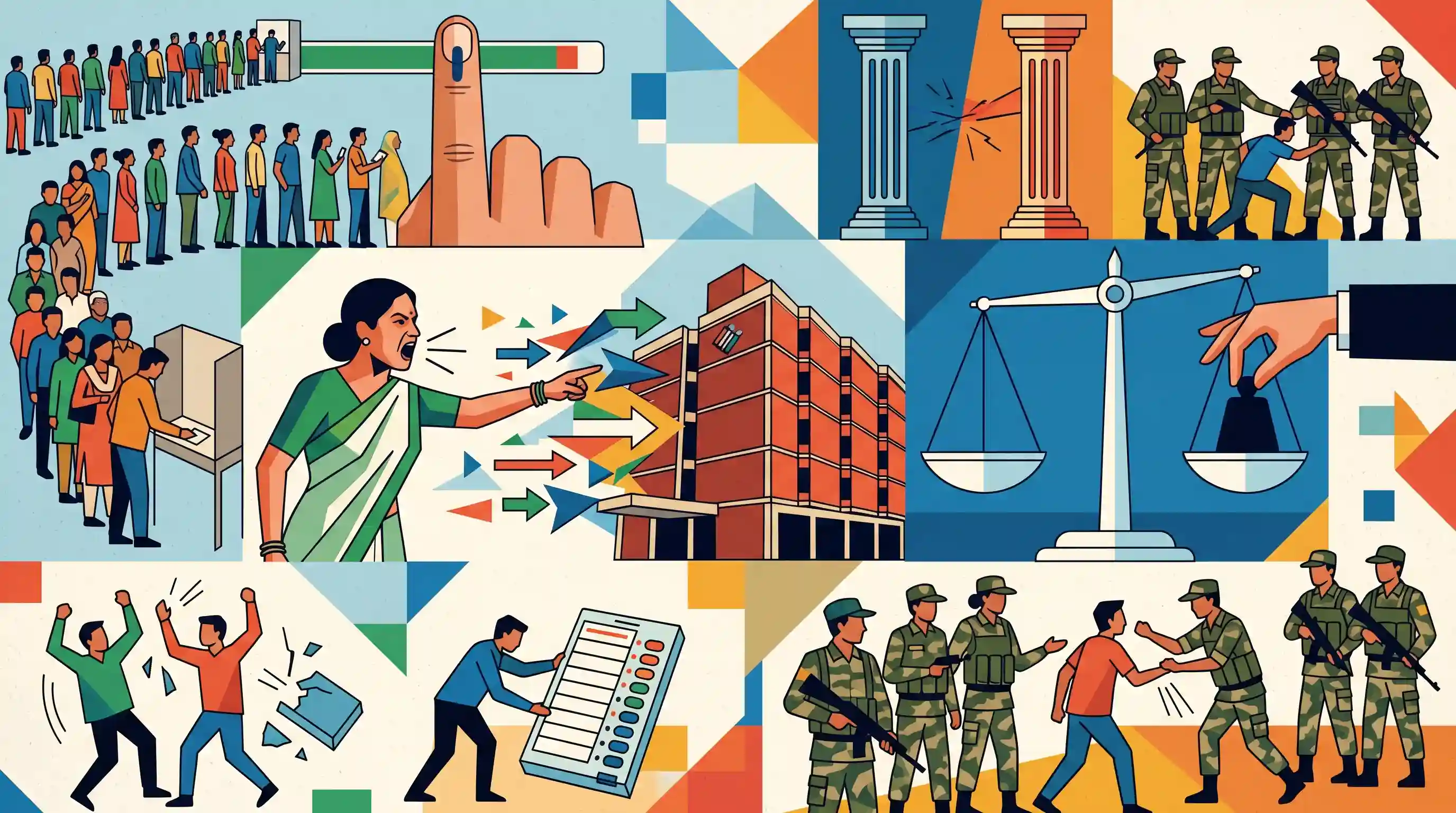
The second phase of the West Bengal Assembly Elections concluded with an exceptionally high voter turnout of nearly 90%, demonstrating strong political participation. However, the polling was accompanied by sporadic violence and allegations of EVM tampering. Chief Minister Mamata Banerjee launched a sharp attack on the Election Commission of India (ECI), accusing the constitutional body of partisan behavior and harassing voters through the disproportionate deployment of central security forces. These developments highlight the enduring challenges of electoral violence, the contentious role of central forces in state law and order, and the critical necessity for the ECI to uphold unquestionable impartiality to ensure free and fair elections.
Key Points
- The second phase of the West Bengal Assembly Elections recorded a massive voter turnout of nearly 90%, reflecting robust democratic participation despite tensions.
- Chief Minister Mamata Banerjee accused the Election Commission of India (ECI) of bias, harassment, and orchestrating midnight raids through central security forces.
- Sporadic incidents of violence and allegations of EVM tampering (such as covering symbols with tape) were reported, highlighting ongoing law and order issues during state polls.
- The events underscore the operational challenges faced by the ECI in maintaining perceived impartiality, managing central forces, and ensuring a free and fair electoral process.
Important Terms
Election Commission of India (ECI)

An autonomous constitutional body established under Article 324 to conduct and oversee elections to Parliament, State Legislatures, and the offices of President and Vice President in India.
UPSC context
GS II (Constitutional Bodies); critical for topics on electoral integrity, institutional autonomy, and the conduct of democratic processes.
Model Code of Conduct (MCC)
A set of non-statutory guidelines issued by the ECI to regulate the conduct of political parties, candidates, and governments during election periods to ensure a level playing field.
UPSC context
GS II (Electoral Reforms); tests understanding of the ECI's regulatory powers and the ethical framework of Indian elections.
Central Armed Police Forces (CAPF)
A group of seven security forces under the Ministry of Home Affairs responsible for internal security, border guarding, and assisting state police during elections to prevent violence.
UPSC context
GS II (Federalism) & GS III (Internal Security); explores the role of central forces in maintaining state law and order during polls.
Electronic Voting Machine (EVM)
An electronic device comprising a Control Unit and a Balloting Unit used to record and count votes, designed to be standalone and tamper-proof to ensure electoral accuracy.
UPSC context
GS II (Electoral Reforms); relevant for discussions on transparency, VVPAT integration, and public trust in the voting process.
Free and Fair Elections
A fundamental democratic principle and part of the Basic Structure of the Constitution, ensuring that every citizen's vote is cast without fear, favor, or external coercion.
UPSC context
GS II (Governance/Polity); tests the conceptual foundation of Article 324 and the Supreme Court’s interpretation of electoral purity.
Bharatiya Janata Party (BJP)
A major Indian political party, currently the ruling party at the Centre, which has significant influence on national policy and the country's legislative direction.
UPSC context
GS II (Political Parties); focuses on the role of national parties in India's representative democracy and federal dynamics.
Trinamool Congress (TMC)
A prominent regional political party primarily based in West Bengal, recognized as a National Party until 2023, representing the interests of regional federalism and state governance.
UPSC context
GS II (Political Parties); significant for studying the role of regional parties in the context of Indian federalism and state politics.
Prelims Trap
"The Election Commission of India adjudicates post-election disputes regarding the validity of a state assembly election."
Once polling concludes, post-election disputes like EVM tampering or improper nominations must be adjudicated exclusively by the relevant High Court, not the ECI.
Static Concepts Connected
How does the ECI bypass state control to deploy central forces?
- Article 324 mandate: Article 324 provides the ECI with broad 'superintendence, direction, and control' to ensure free and fair polls, bypassing routine administrative control.
- Section 28A RPA: It legally mandates that state police and officials on election duty are on temporary deputation to the ECI, not the State Government.
- Federal friction: This often clashes with the 7th Schedule, as 'Public Order' is a State subject, yet the ECI's mandate overrides it temporarily.
Who adjudicates post-election disputes in State Assembly Elections?
- High Court jurisdiction: Election Petitions challenging validity, EVM tampering, or corrupt practices are filed exclusively in the relevant High Court under the RPA, 1951.
- ECI limitation: The Election Commission of India has no authority to adjudicate these disputes once the electoral process is complete and results are declared.
Cross-Topic Patterns
ECI powers vs. Federalism (7th Schedule)
The deployment of CAPFs by ECI blends constitutional mandate with federalism, making it a high-yield area for Mains GS2 questions on Center-State friction over 'Public Order'.
MCC and the 1968 Symbols Order
While MCC lacks statutory backing, the ECI's quasi-judicial power to suspend party recognition under the 1968 Symbols Order indirectly anchors its enforcement.

Prelims 2026 could test a multi-statement question confusing the ECI's Art 324 mandate with the High Court's power over election petitions.
Linked PYQs · 2
Linked PYQs · 2
- 2022MainsGS2
Discuss the role of the Election Commission of India in the light of the evolution of the Model Code of Conduct.
- 2018MainsGS2
In the light of recent controversy regarding the use of Electronic Voting Machines (EVM), what are the challenges before the Election Commission of India to ensure the trustworthiness of elections in India?
