Paschimbanga Loktantra Senani Samman: Pension for Emergency Prisoners
Source:outlookmoney ↗
Why It Matters
The announcement touches upon crucial post-independence political history (the 1975 Emergency) and current state-level welfare initiatives, which are important for WBCS Prelims questions on Polity, Governance, and regional history.
Summary
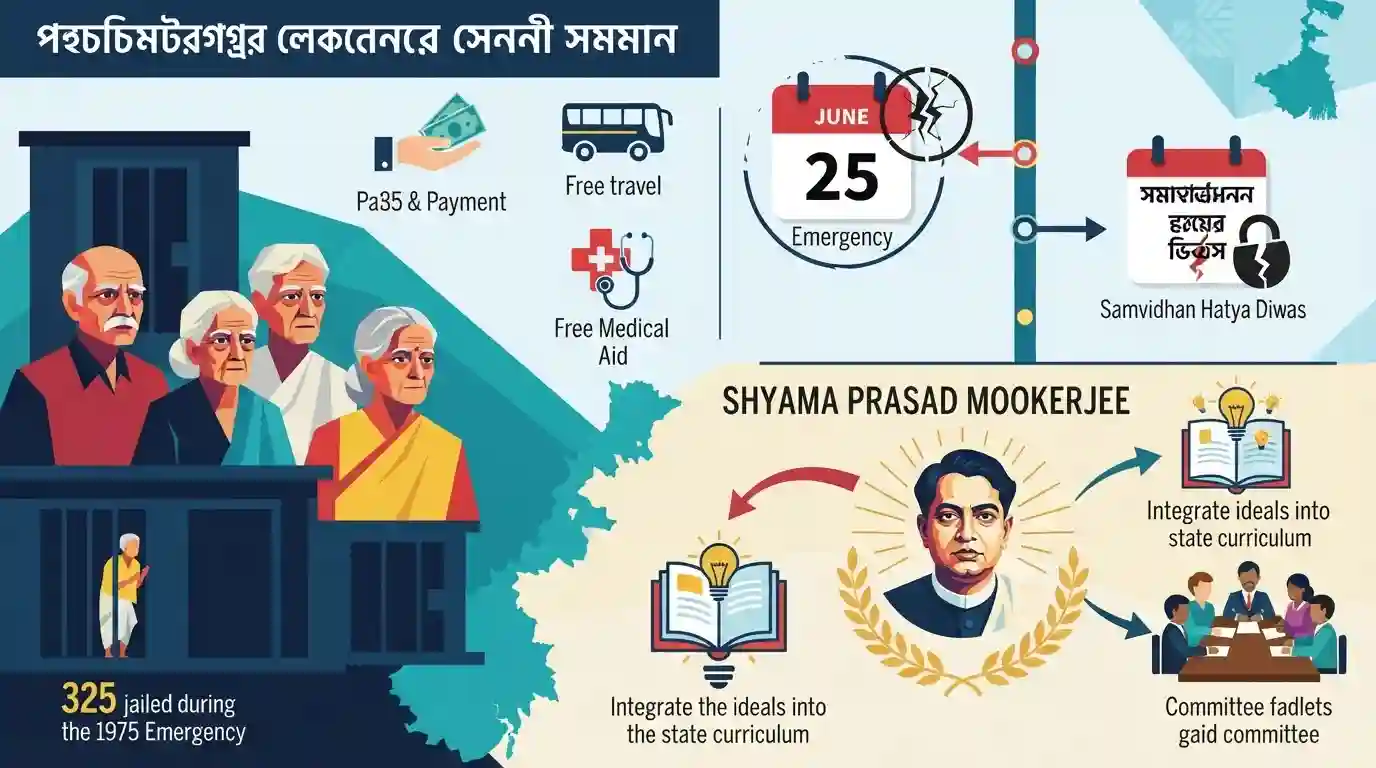
West Bengal has announced the 'Paschimbanga Loktantra Senani Samman', providing a Rs 10,000 monthly pension, free bus travel, and medical aid to 325 individuals jailed during the 1975 Emergency. The government is also setting up a committee to commemorate Shyama Prasad Mookerjee's 125th birth anniversary and integrate his ideals into the state curriculum, alongside observing June 25 as 'Samvidhan Hatya Diwas'.
Key Points
- The West Bengal government introduced the 'Paschimbanga Loktantra Senani Samman' scheme to honor 325 individuals jailed during the 1975 Emergency.
- Beneficiaries will receive a Rs 10,000 monthly pension, free government bus travel, and Rs 1,000 in monthly medical assistance, with benefits extending to surviving spouses.
- The state is preparing to commemorate the 125th birth anniversary of Shyama Prasad Mookerjee, forming a special committee to integrate his ideals into the educational system.
- June 25 is being observed as 'Samvidhan Hatya Diwas' to remember those who protested against the suspension of democratic rights.
Important Terms
National Emergency (1975)

A 21-month period in India (1975–1977) declared under Article 352 by President Fakhruddin Ali Ahmed, which suspended fundamental rights, enforced press censorship, and led to the imprisonment of opposition leaders.
UPSC context
GS Paper II (Indian Constitution / Emergency Provisions), testing the federal structure, civil liberties, and executive powers.
Paschimbanga Loktantra Senani Samman
A West Bengal state welfare scheme launched in 2026 to provide a Rs 10,000 monthly pension, free government bus travel, and medical assistance to 325 individuals jailed during the 1975 Emergency.
UPSC context
GS Paper II (Welfare Schemes), testing state-level social security initiatives, public administration, and political history.
Samvidhan Hatya Diwas
An annual commemoration declared on June 25 in India to honor the struggles of citizens who fought against the authoritarian excesses and suspension of democracy during the 1975 National Emergency.
UPSC context
GS Paper II (Polity & Governance), testing knowledge of constitutional history, civil rights, and democratic values.
Shyama Prasad Mookerjee
An Indian nationalist leader, barrister, academician, and India's first Minister for Industry and Supply, who founded the Bharatiya Jana Sangh in 1951 to oppose Jawaharlal Nehru's policies.
UPSC context
GS Paper I (Modern Indian History / Post-Independence Consolidation), testing major personalities, national integration, and political evolution.
Trinamool Congress
An Indian political party founded by Mamata Banerjee in 1998 as a breakaway from the Indian National Congress, which governed the state of West Bengal from 2011 to 2026.
UPSC context
GS Paper II (Polity), testing political parties, federalism, regionalism, and political dynamics in Indian states.
Left Front
A left-wing political coalition in West Bengal led by the CPI(M), which uninterruptedly governed the state for 34 years from 1977 to 2011, establishing a major democratic communist administration.
UPSC context
GS Paper I & II, testing post-independence political movements, land reforms, and ideological coalitions in state politics.
Prelims Trap
During a National Emergency, the President can suspend the right to move any court for the enforcement of all Fundamental Rights.
The 44th Constitutional Amendment of 1978 permanently barred the suspension of Articles 20 and 21 under Article 359, making this a common false statement in prelims.
Static Concepts Connected
What are the differences between Article 358 and Article 359 during a National Emergency?
- Scope of suspension: Article 358 is confined to Article 19 (Fundamental Rights), whereas Article 359 extends to all those Fundamental Rights whose enforcement is suspended by the Presidential Order.
- Automatic vs Presidential: Article 358 automatically suspends Article 19 rights upon declaration of emergency, whereas Article 359 does not automatically suspend any rights but empowers the President to suspend their enforcement.
- Trigger conditions: Article 358 operates only in cases of External Emergency (war/aggression), whereas Article 359 operates in both External and Internal Emergencies.
What was the Nehru-Liaquat Pact of 1950 and its political significance?
- Objective: An agreement between India and Pakistan to secure the rights of minorities in both countries, allowing refugees to return and recover looted property.
- Mookerjee's Resignation: Dr. Shyama Prasad Mookerjee resigned from the Union Cabinet in protest, arguing the pact failed to hold Pakistan accountable for the exodus of Hindus from East Bengal.
- Ideological Shift: His exit led to the formation of the Bharatiya Jana Sangh in 1951, which became the precursor to the modern Bharatiya Janata Party (BJP).
Cross-Topic Patterns
Federalism + Historical Memorialization
How contemporary state pension schemes for MISA detainees use state fiscal resources to memorialize federal constitutional battles and reshape local political narratives.
Partition Legacies + Citizenship Laws
Connecting Mookerjee’s 1950 cabinet resignation over the Nehru-Liaquat Pact to modern Indian citizenship debates and the constitutional framework for refugee protection.

Expect a multi-statement question on Article 358/359 exceptions alongside the post-independence role and cabinet exits of SP Mookerjee.
Linked PYQs · 5
Linked PYQs · 5
- 2024WBCS_PRELIMSGS1
Which Fundamental Rights cannot be suspended during a National Emergency under Article 359?
- 2022WBCS_PRELIMSGS1
Under which article of the Constitution the President can take over the administration of a State in his own hand?
- 2019WBCS_PRELIMSGS1
West Bengal Land Reform Act came into force in
- 2020WBCS_PRELIMSGS1
Literacy rate in West Bengal census 2011 —
- 2021WBCS_PRELIMSGS1
The Partition of Bengal was annulled in
