Trinamool Congress faces political defections ahead of rally
Source:the-week ↗
কেন এটি গুরুত্বপূর্ণ
The ongoing exodus of Members of Parliament from a major regional party highlights the practical implications and potential loopholes in the Anti-Defection Law (Tenth Schedule). The resignations of Rajya Sabha members specifically touch upon the constitutional provisions regarding the composition and functioning of the Upper House. This political crisis is relevant for understanding state-level political dynamics and their impact on national-level party representations.
সারসংক্ষেপ
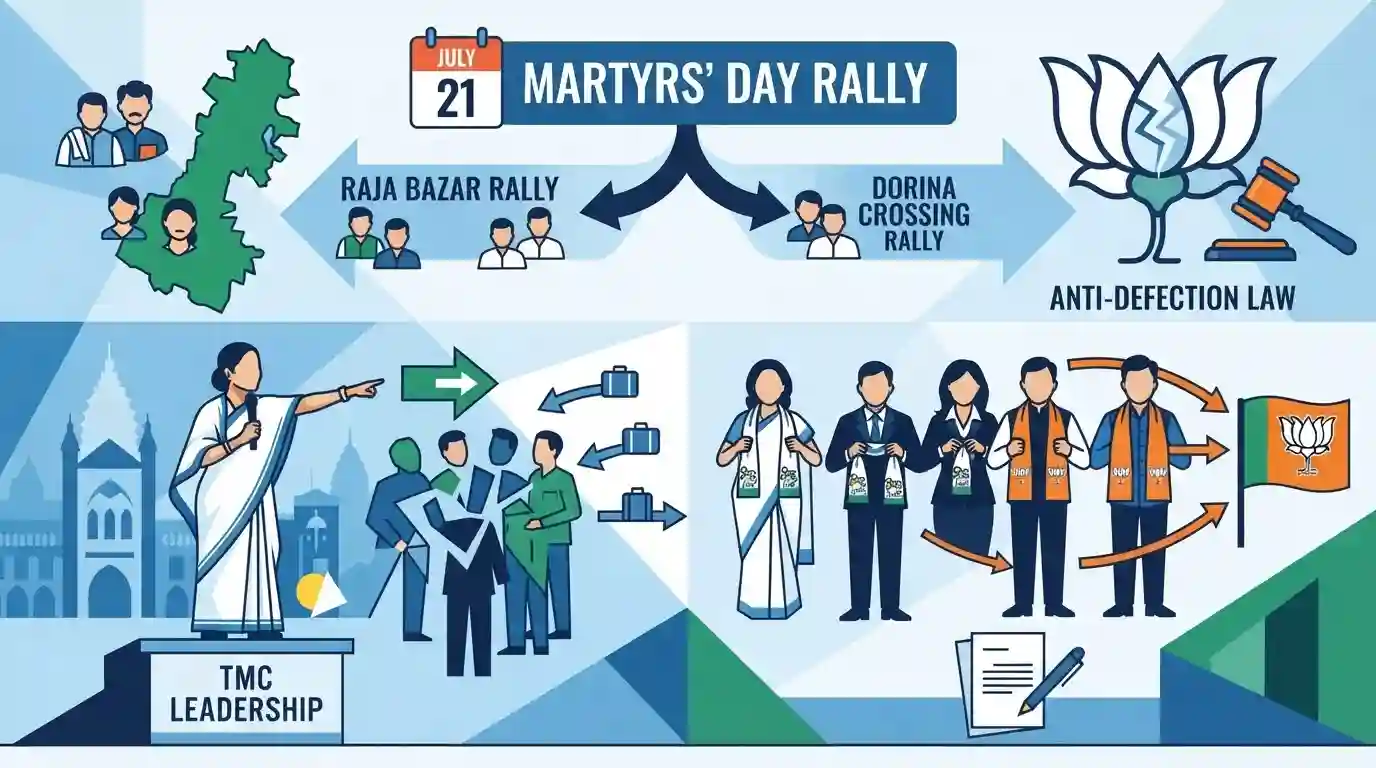
Ahead of the crucial Martyrs' Day rally on July 21, the Trinamool Congress (TMC) faces a significant internal crisis with a fresh wave of defections. Rajya Sabha MP Koel Mallick has resigned, following similar moves by MPs Sushmita Dev and Sukhendu Sekhar Roy, with indications of them joining the BJP. TMC leader Mamata Banerjee has urged those wanting to defect to do so before the rally. The split in the party is evident as both Mamata's faction and a rebel bloc plan separate rallies in Kolkata on July 21, challenging Mamata's traditional show of strength.
মূল বিষয়
- Rajya Sabha MP Koel Mallick resigned from the Trinamool Congress (TMC), becoming the third RS MP to do so recently, following Sushmita Dev and Sukhendu Sekhar Roy.
- The resignations and shifting allegiances towards the BJP come ahead of the TMC's annual Martyrs' Day rally on July 21.
- TMC supremo Mamata Banerjee acknowledged the exodus, suggesting that those feeling pressure from investigative agencies should leave before July 21.
- The Martyrs' Day rally venues have been split between Mamata's faction (near Birla Planetarium) and the rebel faction (less than a kilometre away), highlighting the deep divisions within the party.
গুরুত্বপূর্ণ শব্দ
Anti-Defection Law

A constitutional framework introduced via the 52nd Amendment in 1985 (Tenth Schedule) that disqualifies MPs and MLAs who switch political parties or violate party whips after being elected.
UPSC context
GS Paper II (Polity); tests knowledge of parliamentary stability, legislative discipline, the Speaker's powers, and constitutional amendments.
All India Trinamool Congress (TMC)
A major regional political party in India, founded by Mamata Banerjee in 1998, which governed West Bengal from 2011 to 2026 before losing its national party status.
UPSC context
GS Paper II (Polity); tests dynamics of regional parties, criteria for national party status, and federal-state political relationships.
Bharatiya Janata Party (BJP)
A major right-wing national political party in India, founded in 1980, advocating for cultural nationalism (Hindutva) and currently serving as the ruling party at the Centre.
UPSC context
GS Paper II (Polity); tests the Indian party system, coalition politics, and ideological frameworks of national parties.
Rajya Sabha
The upper house of India's bicameral Parliament, representing states and Union Territories, consisting of indirectly elected members and nominated representatives.
UPSC context
GS Paper II (Polity); tests the federal structure of Parliament, legislative procedures, and the role of the upper chamber.
Left Front
A political coalition of left-wing and communist parties, dominated by the CPI(M), which historically governed West Bengal for 34 consecutive years from 1977 to 2011.
UPSC context
GS Paper II (Polity); tests coalitional politics, political ideologies, and post-independence history of state governance in India.
প্রিলিমস ফাঁদ
"A defection is exempt from disqualification if one-third of the party's elected members decide to split."
The 91st Amendment Act (2003) deleted the 1/3rd split exemption. Currently, only a merger involving at least two-thirds of the legislative party is protected from disqualification.
সংযুক্ত স্থির ধারণা
What is the scope of judicial review in Anti-Defection cases?
- Kihoto Hollohan (1992): Upheld the Tenth Schedule but struck down the clause barring judicial review, making the Presiding Officer's decision subject to High Court and SC scrutiny.
- Intervention Timing: Courts generally cannot intervene prior to the Presiding Officer making a final decision on the disqualification petition.
- Three-month Rule: In Keisham Meghachandra Singh (2020), the SC ruled that disqualification petitions should ordinarily be decided within three months.
How does the Election Commission resolve party symbol disputes during a split?
- Legal Authority: The ECI has exclusive authority to decide under Paragraph 15 of the Election Symbols (Reservation and Allotment) Order, 1968.
- Test of Majority: Upheld in the Sadiq Ali case (1971), the ECI applies this test to evaluate factional strength in both the legislative and organizational wings of the party.
আন্তঃবিষয় প্যাটার্ন
Resignations bypassing the Tenth Schedule
MPs resigning before joining another party bypasses the Tenth Schedule's disqualification mechanism, forcing by-elections instead. This constitutional workaround was previously highlighted during the Karnataka and Madhya Pradesh political crises.
ECI's quasi-judicial role in party splits
Recent splits in regional parties (Shiv Sena, NCP, TMC) repeatedly test the Election Commission's quasi-judicial powers to allocate symbols under the Election Symbols Order of 1968.

Expect a 2026 multi-statement Polity question linking Anti-Defection timeframes (Keisham Meghachandra) with ECI symbol allotment powers.
সংযুক্ত PYQ · 3
সংযুক্ত PYQ · 3
- 2023WBCS_PRELIMSGS1
Which amendment of Indian Constitution is related to the Anti-defection law?
- 2022WBCS_PRELIMSGS1
The quorum requirements in the Rajya Sabha is
- 2020WBCS_PRELIMSGS1
The Chairperson of Rajya Sabha is
