West Bengal Integrates Artificial Intelligence in Urban Services
Source:indianmasterminds ↗
Why It Matters
It highlights the practical application of emerging technologies (AI) in enhancing urban local governance and underscores the importance of central schemes like the Urban Challenge Fund in financing smart city infrastructure.
Summary
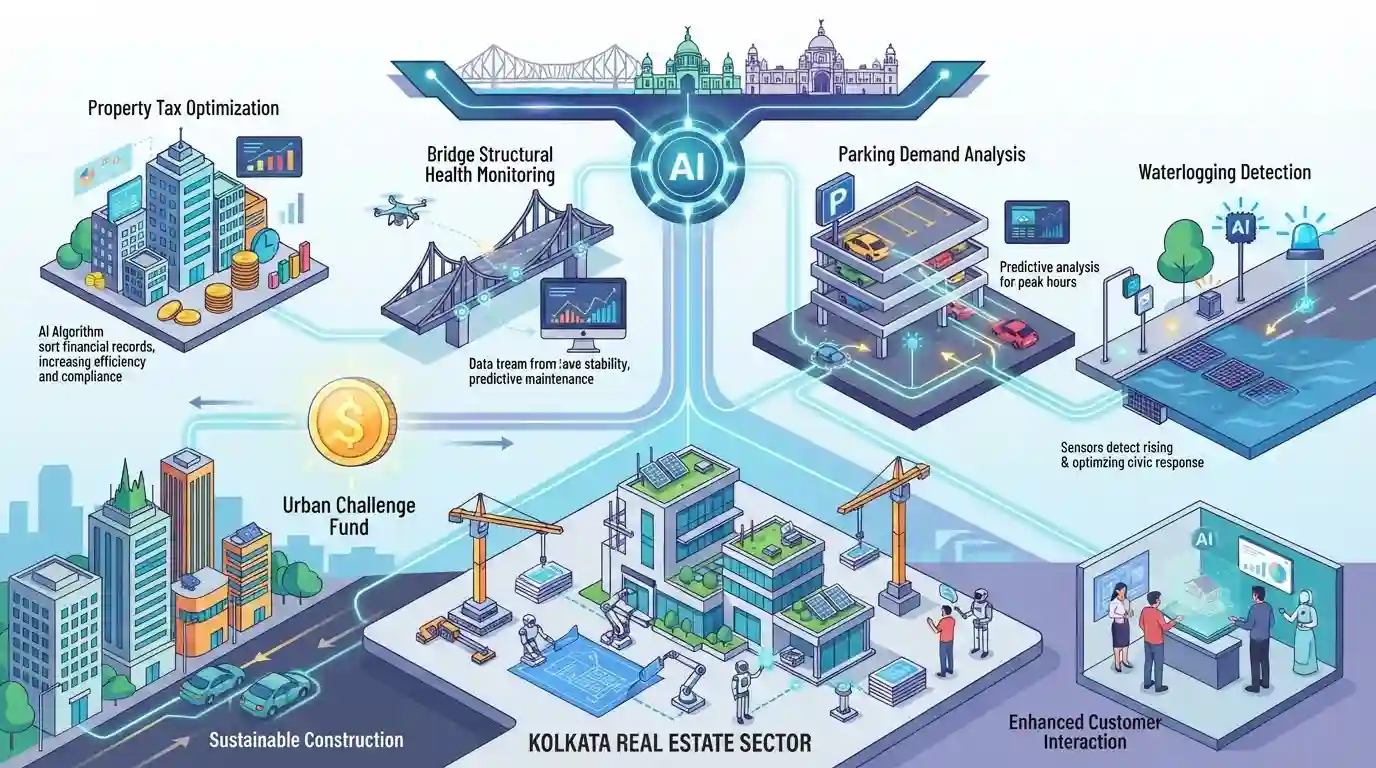
The West Bengal government is planning to integrate Artificial Intelligence (AI) into urban infrastructure and civic services management. Focus areas include optimizing property tax collection, monitoring bridge structural health, analyzing parking demands, and detecting waterlogging. This technology-driven approach in local administration aims to complement existing digitized municipal services. Such modernization efforts could potentially leverage funding from the Centre's ₹1 lakh crore Urban Challenge Fund, which incentivizes market-linked urban projects. Meanwhile, the real estate sector in Kolkata is also increasingly utilizing AI for sustainable construction and enhanced customer interaction.
Key Points
- West Bengal is exploring Artificial Intelligence (AI) to enhance urban infrastructure management, targeting areas like property tax assessment, waterlogging detection, pipeline maintenance, and bridge safety.
- State Minister Agnimitra Paul highlighted the necessity for data-driven tools to transition from digitized municipal services to advanced, real-time civic administration.
- The technological shift aligns with the Centre's recently approved ₹1 lakh crore Urban Challenge Fund, which provides up to 25% central assistance for market-linked urban projects.
- AI adoption is also gaining momentum in Kolkata's real estate sector to improve construction efficiency, marketing, and building sustainability.
Important Terms
Urban Challenge Fund

A ₹1 lakh crore central government fund designed to drive market-led urban infrastructure development. It provides 25% central assistance to cities that mobilize at least 50% of their project costs from market sources like municipal bonds.
UPSC context
Important for WBCS Economy and Urban Governance, highlighting central schemes that finance local municipal modernization and infrastructure.
Kolkata Municipal Corporation
The primary local government body responsible for the civic infrastructure and administration of Kolkata. It oversees essential municipal services, including property tax collection, sanitation, water supply, and overall urban planning.
UPSC context
Highly relevant for WBCS Polity (Paper V), testing knowledge of urban local bodies, their statutory functions, and e-governance initiatives.
CREDAI
The Confederation of Real Estate Developers' Associations of India is the apex representative body for private real estate developers. It engages in policy advocacy, self-regulation, and promotes modern, sustainable construction practices across the market.
UPSC context
Relevant for WBCS Economy (Paper V), illustrating how major industry associations drive technological adoption, like AI, in the real estate sector.
Prelims Trap
"The Urban Challenge Fund fully finances state-level urban infrastructure modernization."
The Centre provides only up to 25% assistance. Cities must mobilize at least 50% of the project cost through market mechanisms like municipal bonds or public-private partnerships (PPPs).
Static Concepts Connected
What are the primary financial resources for Urban Local Bodies (ULBs) in India?
- Tax Revenues: Levied by states or local bodies, primarily consisting of property tax, professional tax, and entertainment tax.
- Non-Tax Revenues: User charges for civic utilities like water and sanitation, alongside administrative fees, royalties, and fines.
- Market Borrowings: Issuance of municipal bonds to raise funds for infrastructure projects, subject to strict SEBI guidelines and credit ratings.
- Devolution & Grants: Statutory funds allocated based on the periodic recommendations of both State and Central Finance Commissions.
How does the 74th Amendment structurally govern urban planning and infrastructure?
- Twelfth Schedule: Introduced Article 243W, detailing 18 functional items including urban planning, roads, bridges, and provision of civic amenities.
- Metropolitan Planning Committees (MPCs): Article 243ZE mandates MPCs for metropolitan areas to consolidate and coordinate development plans prepared by municipalities and panchayats.
- District Planning Committees (DPCs): Article 243ZD requires DPCs to draft development plans, integrating spatial planning, water, and infrastructure across rural and urban zones.
Cross-Topic Patterns
E-Governance boosts Municipal Bonds
AI-driven property tax collection enhances ULB revenue predictability. This improves credit ratings, enabling cities to issue the municipal bonds required by schemes like the Urban Challenge Fund.
AI mapping for Urban Flooding
Using AI for waterlogging detection connects local administration directly with NDMA guidelines on urban flooding, pivoting civic governance from reactive relief to proactive disaster risk reduction.

Questions will likely link the Urban Challenge Fund's market-mobilization criteria (municipal bonds) with e-governance reforms in ULBs.
Linked PYQs · 3
Linked PYQs · 3
- 2024WBCS_PRELIMSGS1
Which one among the following is not a Sunrise Sector in India?
- 2015WBCS_PRELIMSGS1
The local self-government of Kolkata is
- 2023WBCS_PRELIMSGS1
Which sector contributed the most to the real Gross Value Added at basic prices in the last decade?
