West Bengal: New laws planned to target conversion and land jihad
Source:organiser ↗
Why It Matters
State-level implementation of the Uniform Civil Code and anti-conversion laws are major contemporary political issues that highlight the friction between Directive Principles of State Policy and Fundamental Rights, making them highly relevant for questions on Indian polity and constitutional law.
Summary
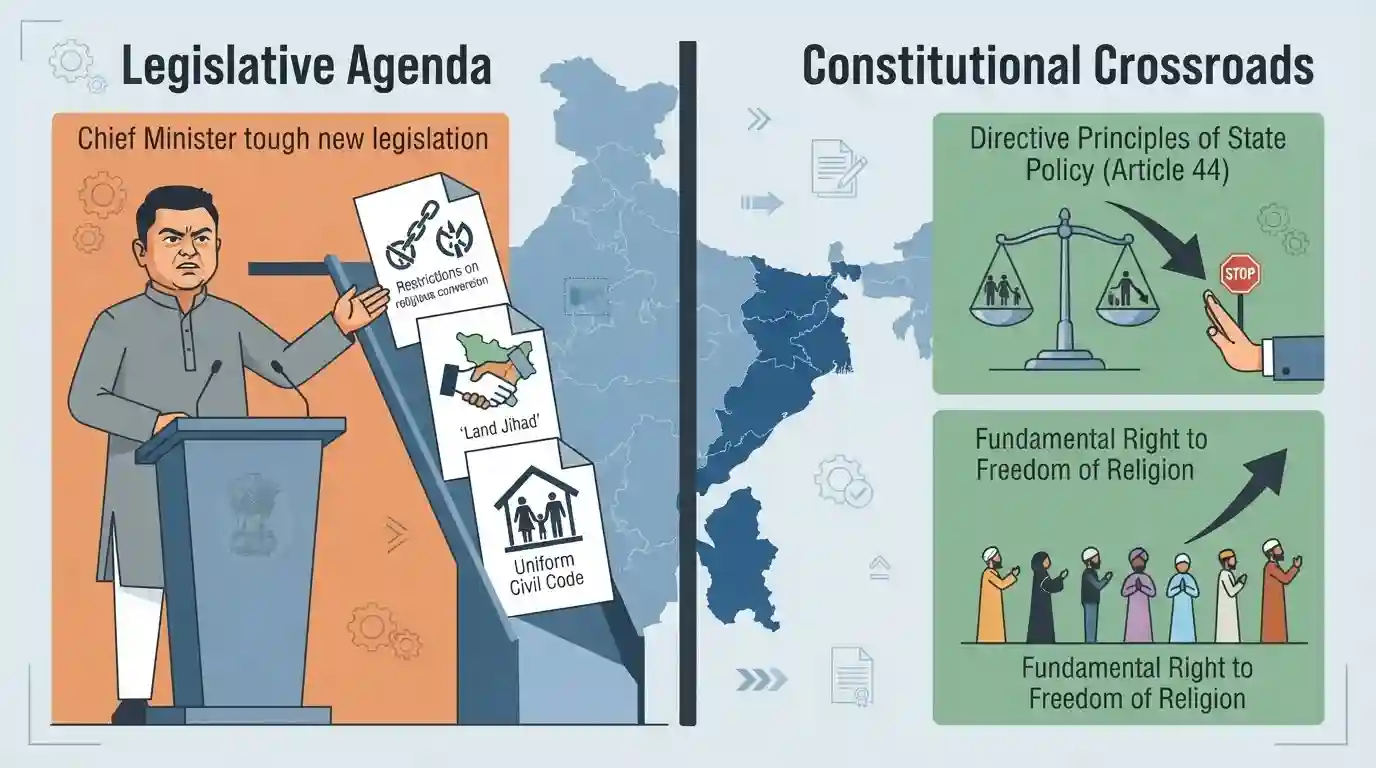
West Bengal's state government, led by CM Suvendu Adhikari, is preparing to introduce tough new legislation targeting religious conversion and 'Land Jihad', following its move toward implementing a Uniform Civil Code. These policy shifts bring critical constitutional concepts—such as the Directive Principles of State Policy (Article 44) and the Fundamental Right to Freedom of Religion—into sharp focus in state politics.
Key Points
- West Bengal CM Suvendu Adhikari is proposing stringent new laws aimed at curbing religious conversion and addressing alleged 'Land Jihad'.
- These measures are being introduced closely following the state government's steps to implement a Uniform Civil Code (UCC).
- The implementation of a UCC relates to Article 44 of the Directive Principles of State Policy, which calls for a common set of personal laws for all citizens regardless of religion.
- Anti-conversion legislation frequently sparks constitutional debates regarding the Right to Freedom of Religion (Articles 25-28) versus state interests in preventing forced conversions.
Important Terms
Uniform Civil Code (UCC)

A proposed common set of personal laws governing marriage, divorce, inheritance, and adoption for all Indian citizens, regardless of their religious identity, as envisioned under Article 44.
UPSC context
GS Paper II (Polity); tests constitutional mandates, personal laws, secularism, and rights versus religious practices.
Anti-conversion laws
State-level legislations in India (formally 'Freedom of Religion Acts') that regulate, restrict, or criminalize religious conversions carried out through force, misrepresentation, coercion, fraud, or monetary inducement.
UPSC context
GS Paper II (Polity); tests the constitutional balance between individual freedom of conscience and state-level public order.
Freedom of Religion
A fundamental right guaranteed under Articles 25–28 of the Constitution, ensuring individuals the freedom of conscience and the right to freely profess, practice, and propagate religion.
UPSC context
GS Paper II (Polity); tests the Indian model of secularism, individual rights, and judicial limits on religious propagation.
Directive Principles of State Policy (DPSP)
Non-justiciable principles enshrined in Part IV (Articles 36–51) of the Indian Constitution that serve as fundamental guidelines for the State to establish socio-economic justice and welfare.
UPSC context
GS Paper II (Polity); tests governance philosophy, welfare policies, and their interface with justiciable Fundamental Rights.
Government of West Bengal
The subnational state government of West Bengal, India, led by the Chief Minister and responsible for the administration and implementation of state-level laws and policies.
UPSC context
GS Paper II (Polity); tests federalism, executive-legislative dynamics at the state level, and the devolution of powers.
Prelims Trap
Article 25 guarantees the fundamental right to convert others to one's own religion.
The Supreme Court explicitly ruled in the Rev. Stanislaus case (1977) that the constitutional right to 'propagate' religion does not include a fundamental right to convert another person.
Static Concepts Connected
Under what constitutional provisions do states enact anti-conversion laws?
- Public Order: Enacted under Entry 1 of the State List (Seventh Schedule), giving states legislative competence over law and order.
- Article 25 Limits: The right to freedom of religion is explicitly subject to reasonable restrictions, namely public order, morality, and health.
- Stanislaus Case: The 1977 Supreme Court judgment clarified that the constitutional right to propagate a religion does not entail a right to convert others.
Can a State government independently enact a Uniform Civil Code (UCC)?
- Concurrent List: Personal laws like marriage, divorce, and succession fall under Entry 5 of the Concurrent List, allowing both Centre and States to legislate.
- Presidential Assent: Under Article 254(2), a state UCC requires the President's assent to prevail over existing, contradictory central laws on personal matters.
- Definition of State: Article 44 directs the "State" to secure a UCC. Under Article 12, "State" includes both the Government of India and the State governments.
Cross-Topic Patterns
Fundamental Rights vs. State List
State-level anti-conversion laws create friction between Article 25 guarantees and state police powers (Public Order). UPSC frequently tests this overlap between fundamental rights and federal legislative lists.
UCC + Concurrent List overlap
The trend of individual states passing UCCs highlights Concurrent List dynamics (Entry 5 - Personal Laws), making Article 254(2) Presidential assent a prime testing area for upcoming Prelims.

Expect a multi-statement question on Article 25 restrictions, the Stanislaus judgment, and States' power to legislate personal laws (UCC).
Linked PYQs · 3
Linked PYQs · 3
- 2019WBCS_PRELIMSGS1
The ideal of 'Welfare State' in the Indian Constitution in enshrined in its
- 2021WBCS_PRELIMSGS1
Article 21 of the Indian Constitution ensues
- 2021WBCS_PRELIMSGS1
Article 18 of the Indian Constitution guarantees the right to
