West Bengal Adopts Deportation Policy for Undocumented Immigrants
Source:tbsnews ↗
Why It Matters
This development is highly relevant for understanding Centre-State relations, internal security dynamics in border states, and the practical implementation of citizenship laws (Part II of the Constitution) and the CAA, 2019.
Summary
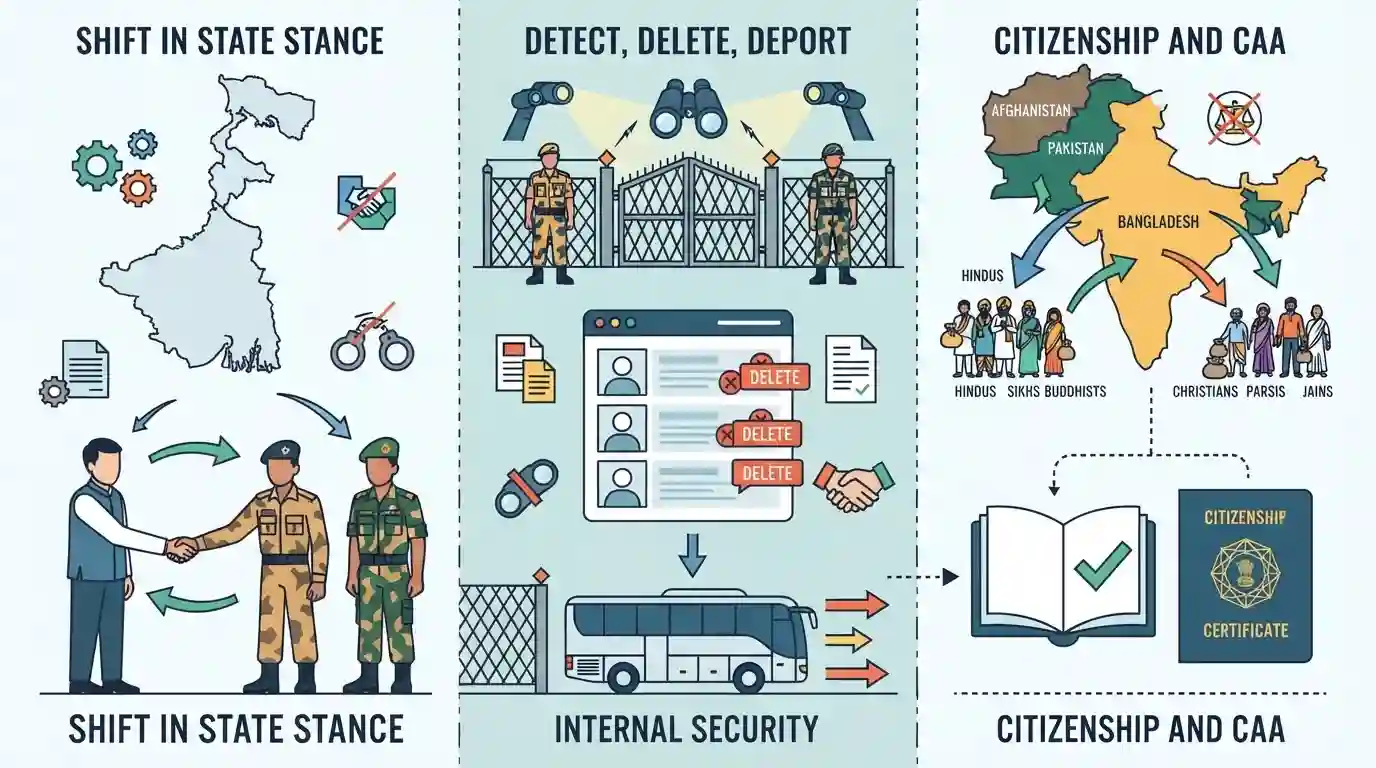
The West Bengal government has launched a 'Detect, Delete and Deport' policy targeting undocumented immigrants, signaling a major shift in its stance on border management and citizenship. In a departure from its earlier opposition to the central government's Citizenship Amendment Act (CAA) of 2019, the state administration is now coordinating with the Border Security Force (BSF) and Border Guard Bangladesh (BGB) to identify and deport illegal infiltrators. However, in line with the CAA, religious minorities (such as Hindus, Sikhs, Buddhists, Christians, Parsis, and Jains) fleeing persecution from countries like Bangladesh, Pakistan, and Afghanistan will be offered protection and a pathway to Indian citizenship, distinguishing them from those classified as illegal immigrants.
Key Points
- The West Bengal government has introduced a 'Detect, Delete and Deport' policy to identify and expel undocumented immigrants, primarily from Bangladesh and Myanmar.
- This strategy marks a significant policy alignment with the Central government, indicating a shift from the ruling TMC's previous strong opposition to the Citizenship Amendment Act (CAA).
- Deportation efforts will be coordinated between the state administration, the Border Security Force (BSF), and Border Guard Bangladesh (BGB).
- Under the policy, non-Muslim minorities facing religious persecution in neighboring countries (covered under the CAA) will be eligible for protection and citizenship, while others will be treated as illegal infiltrators.
Important Terms
Detect, Delete and Deport Policy

A state policy aimed at identifying undocumented immigrants, removing them from electoral and citizen rolls, and deporting them to their country of origin.
UPSC context
Relevant for Paper III (Polity) and internal security, highlighting state-level demographic management and border policy shifts.
Citizenship Amendment Act (CAA) 2019
A 2019 law expediting Indian citizenship for non-Muslim religious minorities fleeing persecution in Pakistan, Bangladesh, and Afghanistan who entered India before December 31, 2014.
UPSC context
Crucial for Paper III (Indian Constitution) regarding citizenship provisions (Part II) and the politics of centre-state relations.
Border Security Force (BSF)
A Central Armed Police Force of India responsible for guarding the country's land borders with Pakistan and Bangladesh and preventing transnational crimes like smuggling and infiltration.
UPSC context
Important for internal security and Centre-State relations, given its role in guarding West Bengal's porous international borders.
Border Guard Bangladesh (BGB)
The paramilitary force of Bangladesh responsible for securing the country's borders and managing cross-border issues, often operating in coordination with India's BSF.
UPSC context
Relevant for India-Bangladesh bilateral relations and cooperative border management strategies against infiltration and smuggling.
Prelims Trap
The West Bengal government's new policy allows the State to grant citizenship to persecuted minorities.
Citizenship is exclusively a Union Subject (Article 11). States can identify and deport infiltrators, but they cannot grant citizenship; they only facilitate the Union's CAA process.
Static Concepts Connected
What are the Constitutional provisions governing citizenship in India?
- Part II: Articles 5 to 11 of the Constitution deal with citizenship at the commencement of the Republic.
- Article 11: Empowers Parliament to regulate the right of citizenship by law, leading to the Citizenship Act of 1955.
- Single Citizenship: India recognizes only a single national citizenship; there is no separate state citizenship, irrespective of domicile.
Which Central Armed Police Forces (CAPFs) guard India's specific international borders?
- BSF: Secures the borders with Pakistan and Bangladesh under the Ministry of Home Affairs.
- SSB: Sashastra Seema Bal (SSB) guards borders with Nepal and Bhutan.
- ITBP & Assam Rifles: Indo-Tibetan Border Police (ITBP) secures the China border, while Assam Rifles guards the Myanmar border.
Cross-Topic Patterns
CAA implementation and cooperative federalism
State opposition to Central laws (like CAA) often creates federal friction under Article 256. This shift demonstrates eventual state-level administrative compliance in enforcing Union mandates on naturalization and border security.
Border management in Eastern India
Undocumented immigration from Bangladesh and Myanmar links to internal security threats, resource strain, and demographic shifts, frequently tested alongside border management and the role of CAPFs.

Expect a multi-statement question mixing CAA 2019's exact beneficiary criteria with the Union's exclusive citizenship powers (Article 11).
Linked PYQs · 3
Linked PYQs · 3
- 2016WBCS_PRELIMSGS1
Which part of the Constitution deals with citizenship ?
- 2024WBCS_PRELIMSGS1
Which one of the following is included in acquiring foreign citizenship?
- 2021WBCS_PRELIMSGS1
India is a
