West Asia Multi Front Military Conflict and UN Resolution 1701
Source:The Hindu ↗
Why It Matters
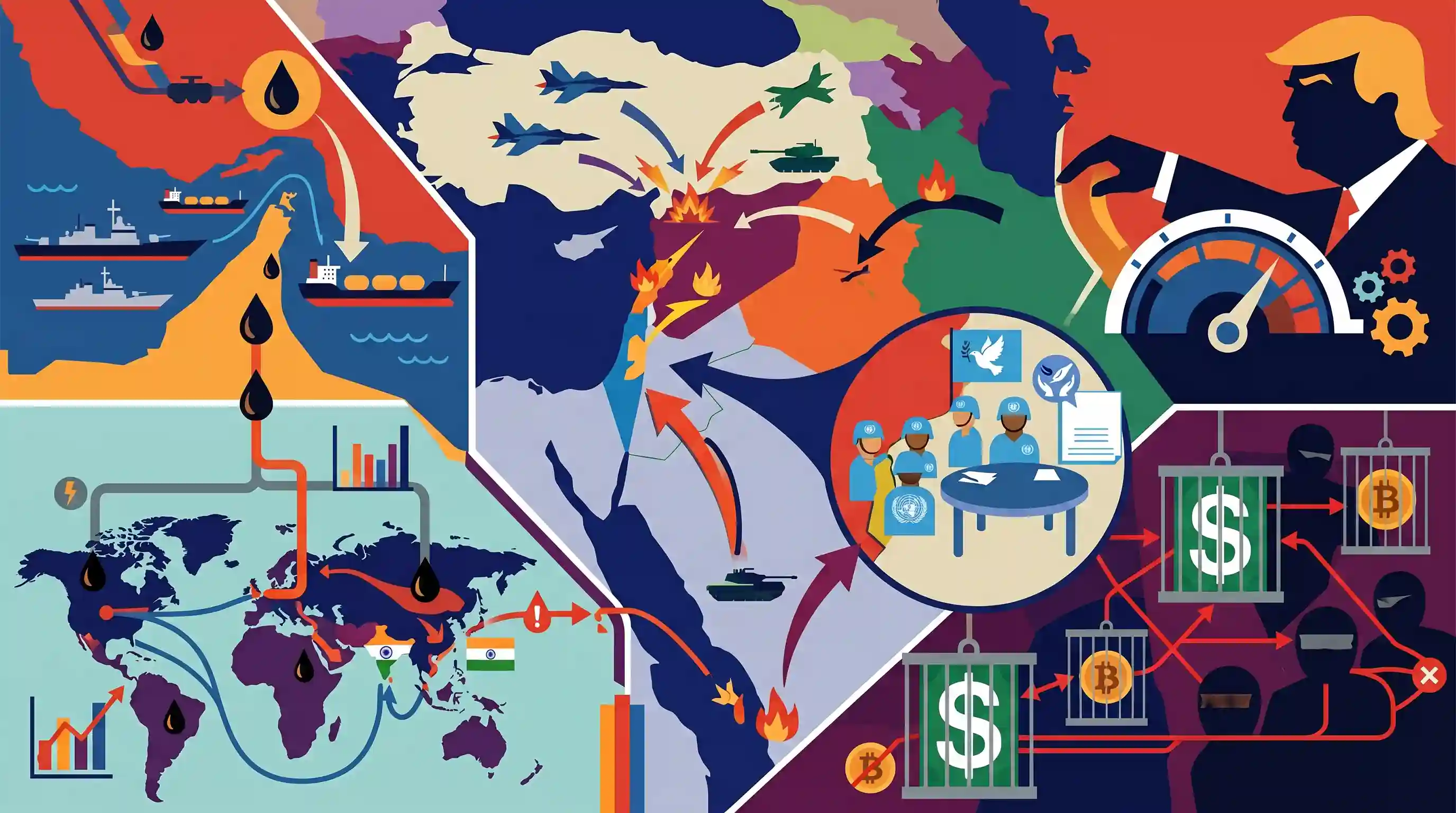
The multifaceted West Asia conflict directly threatens global oil supply chains through the Strait of Hormuz, making it highly relevant for India's energy security calculus. It also provides contemporary context for UPSC questions on UN peacekeeping effectiveness (UNIFIL/Resolution 1701), US-Israel-Iran relations, and emerging mechanisms of terror financing like cryptocurrency.
Summary
Escalating multi-front conflicts in West Asia involve direct U.S. and Israeli military engagements against Iran and its proxy Hezbollah. While the U.S. neutralized Iranian threats to energy shipping lanes near the Strait of Hormuz, Israel intensified its offensive in Lebanon, prompting U.S. diplomatic efforts for a ceasefire based on UN Resolution 1701. The crisis is compounded by unprecedented U.S. sanctions on Iranian crypto exchanges and shifting U.S.-Israel political dynamics under the incoming Trump administration, posing severe risks to global energy security and regional stability.
Key Points
- The U.S. military intercepted Iranian drone and missile attacks in the Persian Gulf, preventing disruptions to shipping lanes and oil facilities near the strategic Strait of Hormuz.
- Israel escalated military strikes against Hezbollah infrastructure along the Litani River in Lebanon, complicating ongoing UNIFIL peacekeeping efforts near the Blue Line.
- U.S. envoy Amos Hochstein proposed a 60-day ceasefire framework anchored in enforcing UN Security Council Resolution 1701 to stabilize the Israel-Lebanon border.
- U.S. President-elect Donald Trump publicly criticized Israeli PM Benjamin Netanyahu's war management, signaling potential shifts in U.S. diplomatic posture towards the conflict.
- The U.S. Treasury Department imposed sanctions on Nobitex, Iran's largest cryptocurrency exchange, aiming to choke off illicit funding streams for the IRGC.
Important Terms
UN Security Council Resolution 1701

A 2006 UN resolution aimed at ending the Israel-Hezbollah war by establishing a permanent ceasefire and a buffer zone free of armed personnel (except UNIFIL and Lebanese army) in southern Lebanon.
UPSC context
GS Paper 2 (IR); tests understanding of international peace frameworks and their effectiveness in resolving regional West Asian conflicts.
UNIFIL (United Nations Interim Force in Lebanon)
A UN peacekeeping force established in 1978 to oversee Israeli withdrawal from Lebanon. Its mandate was expanded in 2006 to monitor hostilities and assist the Lebanese army in southern Lebanon.
UPSC context
GS Paper 2 (Peacekeeping); highly relevant due to India's status as a top troop contributor and security risks to Indian personnel.
Hezbollah
A Lebanon-based Shia Islamist political and militant group founded in 1982. Backed by Iran, it operates as a powerful non-state actor with significant political influence and military capabilities.
UPSC context
GS Paper 2 & 3 (Security/IR); critical for understanding proxy warfare, regional instability, and threats to global energy security.
Islamic Revolutionary Guard Corps (IRGC)
An elite branch of Iran's Armed Forces formed after the 1979 Revolution. It manages Iran's ballistic missile program and the Quds Force, which coordinates regional proxy groups.
UPSC context
GS Paper 2 (IR); central to analyzing Iran's regional influence and its impact on India's strategic balancing in West Asia.
Strait of Hormuz
A strategic maritime chokepoint between Iran and Oman. It is the world’s most critical oil transit route, through which approximately 20% of global oil and 35% of LNG pass daily.
UPSC context
GS Paper 1 (Geography) & 3 (Energy Security); vital as India imports nearly 40-84% of its oil requirements through this passage.
United Nations Security Council (UNSC)
The principal UN organ responsible for international peace and security. It is empowered to issue binding resolutions, impose sanctions, and authorize military intervention.
UPSC context
GS Paper 2 (International Institutions); tests knowledge of global governance, the P5 veto power, and institutional reform debates.
Prelims Trap
UN Security Council Resolution 1701 mandates a demilitarized zone and ceasefire along the Israel-Gaza border.
Resolution 1701 exclusively addresses the 2006 Israel-Lebanon war, establishing a buffer zone between the Blue Line and the Litani River. It has no jurisdiction over Gaza.
Static Concepts Connected
What are the critical maritime chokepoints in the West Asian region?
- Strait of Hormuz: Connects the Persian Gulf to the Gulf of Oman and Arabian Sea. It is the world's most critical transit chokepoint for crude oil.
- Bab-el-Mandeb: Connects the Red Sea to the Gulf of Aden and Arabian Sea. Critical for all maritime traffic heading toward the Suez Canal.
- Strait of Tiran: Narrow sea passages connecting the Gulf of Aqaba to the Red Sea, bordered by Egypt's Sinai Peninsula and Saudi Arabia.
How does FATF regulate the risks of virtual assets and cryptocurrency?
- The Travel Rule: The FATF introduced the 'Travel Rule', requiring Virtual Asset Service Providers (VASPs) to collect and share originator and beneficiary data during crypto transactions.
- VASP Registration: Mandates member countries to ensure that VASPs are licensed or registered and subject to strict anti-money laundering (AML) and counter-terror financing (CFT) oversight.
Cross-Topic Patterns
UNIFIL diplomacy & India's strategic autonomy
India's historic role as a major troop-contributing country to UNIFIL highlights its delicate diplomatic balancing act between strengthening strategic ties with Israel and maintaining its traditional peacekeeping footprint in Arab states.
FATF vs. the Crypto-Hawala Nexus
The US sanctioning of Iranian crypto exchange Nobitex illustrates how terror financing bypasses traditional SWIFT restrictions, making FATF's 'Travel Rule' for Virtual Asset Service Providers (VASPs) crucial for internal security.

Map-based matching questions on West Asian borders (Blue Line, Golan Heights) and rivers (Litani, Jordan) are highly probable in 2026.
Linked PYQs · 4
Linked PYQs · 4
- 2024PrelimsGS1
Consider the following statements : Statement-I : Sumed pipeline is a strategic route for Persian Gulf oil and natural gas shipments to Europe. Statement-II : Sumed pipeline connects the Red Sea with the Mediterranean Sea. Which one of the following is correct in respect of the above statements?
- 2022PrelimsGS1
The term "Levant" often heard in the news roughly corresponds to which of the following regions?
- 2025MainsGS2
"Energy security constitutes the dominant kingpin of India's foreign policy, and is linked with India's overarching influence in Middle Eastern countries.” How would you integrate energy security with India's foreign policy trajectories in the coming years?
- 2018MainsGS2
“India’s relations with Israel have, of late, acquired a depth and diversity, which cannot be rolled back.” Discuss.
