US Iran Ceasefire Pause and Diplomatic Challenges in West Asia
Source:The Hindu ↗
Why It Matters
The geopolitical dynamic between the U.S. and Iran directly affects the stability of West Asia, a region crucial for global energy security. Conflicts near the Strait of Hormuz or disruptions from sanctions impact global oil prices and trade routes, directly influencing India's economy, diaspora safety, and strategic foreign policy maneuvers.
Summary
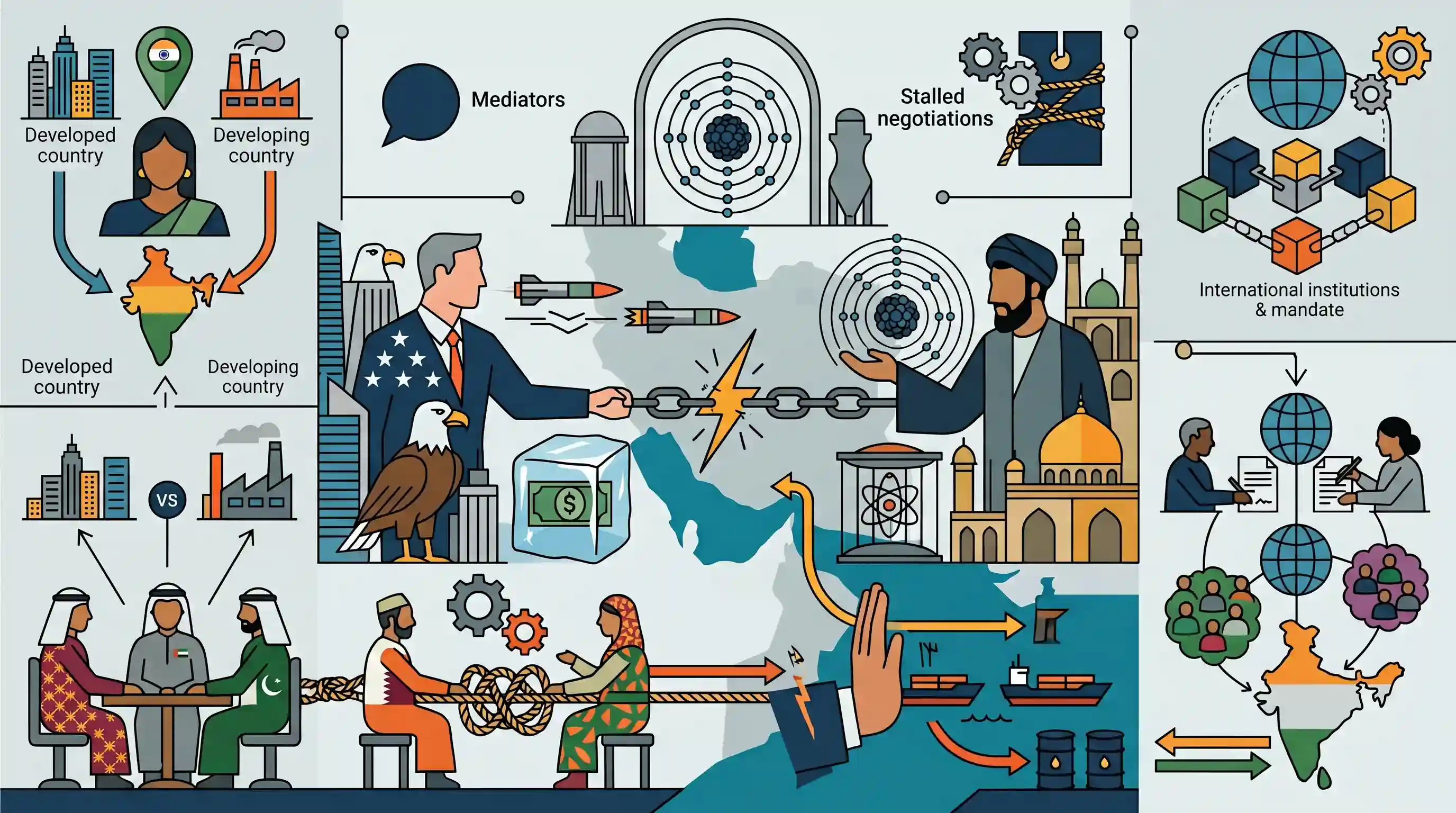
The U.S. and Iran have reached an informal pause in direct strikes amid the broader West Asia conflict, but negotiations remain stalled over subsequent steps. Mediators like Qatar, Oman, and Pakistan are involved in brokering issues such as unfreezing $6 billion in Iranian assets and capping Iran's uranium enrichment. Further complicating the talks is Iran's push for increased maritime access in Oman's territorial waters near the strategic Strait of Hormuz, raising concerns for the U.S. administration under Donald Trump over regional energy security.
Key Points
- The U.S. and Iran have achieved a fragile pause in direct hostilities but are deadlocked on the next steps in their negotiations regarding the West Asia war.
- Mediation efforts are being facilitated by Qatar, Oman, and Pakistan to bridge the gap between the two nations.
- A key point of contention includes a $6 billion unfreeze of Iranian assets facilitated by Qatar, tied to an informal agreement that limits Iran's uranium enrichment.
- Iran is seeking greater access to Oman's territorial waters near the strategic Strait of Hormuz, a move that the U.S. views with caution.
- The broader diplomatic landscape remains complex, with uncertainty surrounding long-term agreements under a Donald Trump administration.
Important Terms
Strait of Hormuz

A strategic maritime chokepoint between the Persian Gulf and Gulf of Oman, handling roughly 20% of the world's total oil consumption.
UPSC context
GS Paper I (Geography) & II (IR); critical for India’s energy security and navigating West Asian geopolitical volatility.
Joint Comprehensive Plan of Action (JCPOA)
A 2015 agreement between Iran and the P5+1 powers to restrict Iran's nuclear program in exchange for international sanctions relief.
UPSC context
GS Paper II (International Relations); tests knowledge of nuclear non-proliferation frameworks and multilateral diplomacy.
Interim deal
A temporary diplomatic arrangement intended to provide immediate de-escalation and partial relief (e.g., asset unfreezing) without a permanent, comprehensive treaty.
UPSC context
GS Paper II (International Relations); relevant for conflict resolution, tactical diplomacy, and managing regional stability.
Uranium Enrichment
The technical process of increasing the concentration of the Uranium-235 isotope for use in nuclear reactors or weapons.
UPSC context
GS Paper III (Science & Tech); fundamental to nuclear security, energy policy, and international safeguards.
Frozen assets
Sovereign capital (often oil revenues) held in foreign accounts and restricted from access by the owner nation due to international sanctions.
UPSC context
GS Paper II (IR); concerns economic diplomacy, sanctions as a policy tool, and the role of neutral third-party mediators.
Territorial waters
Maritime zones extending up to 12 nautical miles from a state's baseline, over which it exercises full sovereign authority under UNCLOS.
UPSC context
GS Paper II (International Law/Maritime Security); relates to freedom of navigation and the UN Convention on the Law of the Sea.
Prelims Trap
The Strait of Hormuz lies entirely between Iran and the United Arab Emirates.
It lies between Iran and Oman (specifically Oman's Musandam Peninsula exclave), not the UAE. UPSC frequently tests exact bordering nations of critical West Asian chokepoints.
Static Concepts Connected
What are the primary strategic maritime chokepoints in West Asia?
- Strait of Hormuz: Connects the Persian Gulf to the Gulf of Oman and the Arabian Sea. Crucial for global petroleum transit.
- Bab el-Mandeb: Connects the Red Sea to the Gulf of Aden and the Arabian Sea. A major flashpoint for Houthi attacks.
- Suez Canal: An artificial sea-level waterway in Egypt connecting the Red Sea to the Mediterranean Sea.
What is the significance of the JCPOA and Uranium Enrichment?
- JCPOA limits: The 2015 agreement that lifted economic sanctions in exchange for Iran capping its uranium enrichment at 3.67% and dismantling much of its nuclear infrastructure.
- Enrichment threshold: While low-enriched uranium (LEU) is used for commercial nuclear power, highly enriched uranium (90%+) is required for nuclear weapons.
- IAEA monitoring: The UN watchdog responsible for monitoring Iran's nuclear facilities to ensure compliance with Non-Proliferation Treaty (NPT) safeguards.
Cross-Topic Patterns
Chabahar Port + INSTC bypass
Chabahar lies outside the Strait of Hormuz on the Gulf of Oman, offering India a strategic bypass around the volatile Hormuz chokepoint and Pakistan for the INSTC.
Middle-power mediation in West Asia
Oman and Qatar's roles highlight a shift towards regional middle-power mediation in West Asia, effectively balancing their US security partnerships with their geographic proximity to Iran.

West Asian geography (Hormuz, Gulf of Oman) paired with INSTC nodes like Chabahar is highly probable for a 2026 map-based question.
Linked PYQs · 3
Linked PYQs · 3
- 2026PrelimsGS1
Ships from which of the following countries have to cross the Strait of Hormuz to reach out to the Indian Ocean ? 1. Bahrain 2. Syria 3. Qatar 4. Egypt Select the answer using the code given below :
- 2018MainsGS2
In what ways would the ongoing US-Iran Nuclear Pact Controversy affect the national interest of India? How should India respond to this situation?
- 2012MainsGS2
How have the US sanctions against Iran affected India's bilateral relations with Iran?
