West Asia Conflict Disrupts India Manufacturing and Supply Chains
Source:Indian Express ↗
Why It Matters
Geopolitical tensions in West Asia directly threaten India's economic stability by increasing crude oil import costs and disrupting maritime trade. This highlights the vulnerabilities of domestic manufacturing to external shocks and underscores the need for supply chain diversification and resilient energy security policies.
Summary
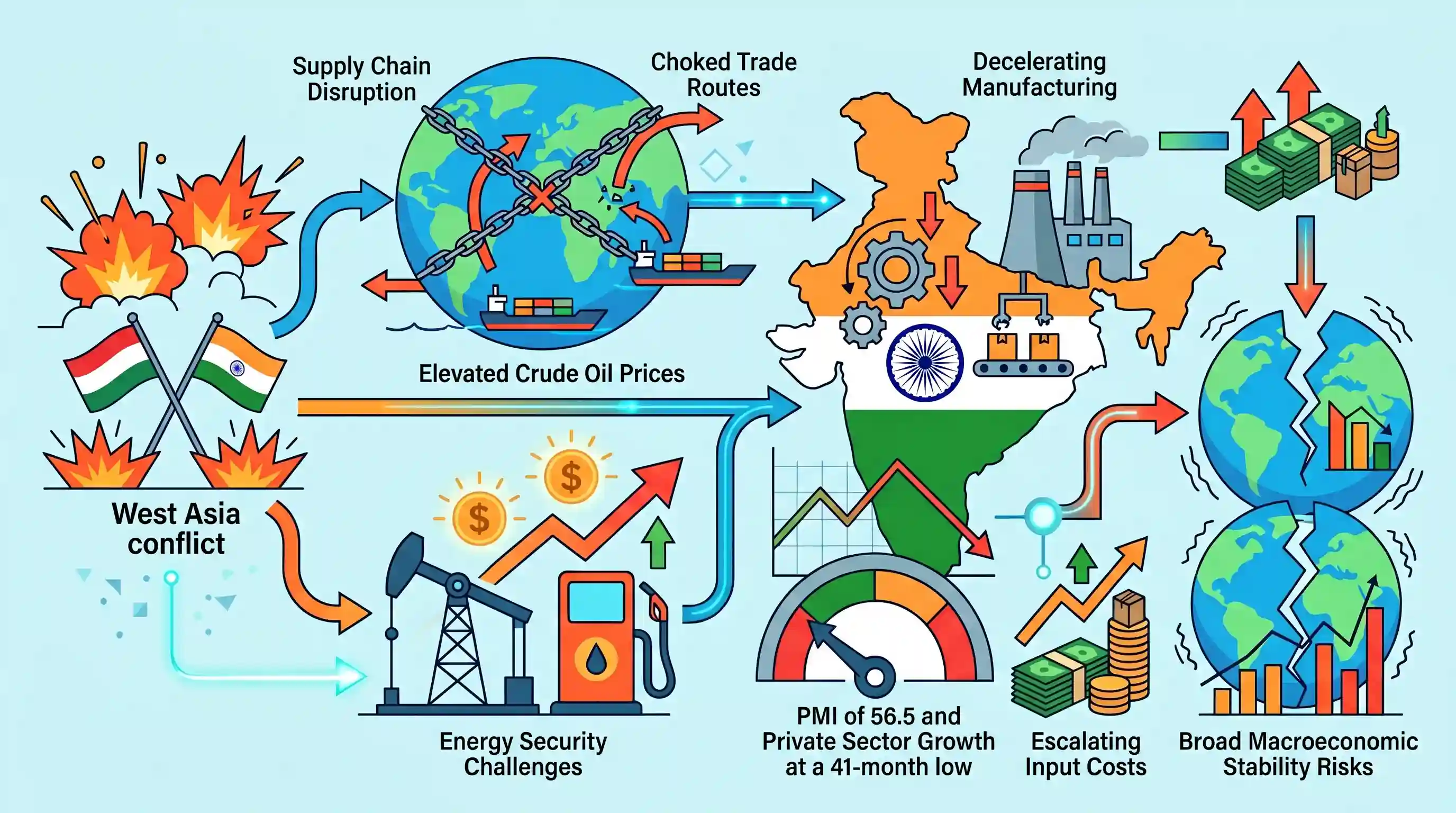
The ongoing conflict in West Asia is significantly impacting India's economy, primarily by disrupting critical global supply chains and trade routes. This geopolitical instability has led to a noticeable deceleration in India's manufacturing and service activities, with private sector growth hitting a 41-month low (a PMI of 56.5). The choked supply lines, combined with the risk of elevated crude oil prices stemming from the Middle East crisis, are escalating input costs and posing broader challenges to India's energy security and macroeconomic stability.
Key Points
- The ongoing conflict in West Asia is causing severe disruptions to global supply chains and trade routes.
- India's private sector growth has decelerated to a 41-month low, as reflected by a PMI (Purchasing Managers' Index) reading of 56.5.
- The manufacturing slowdown is directly linked to the choking of supply lines and escalating input costs driven by the geopolitical crisis.
- Fluctuations in crude oil prices due to the Middle East war threaten to inflate import bills and create broader macroeconomic challenges for energy security.
Prelims Trap
A PMI reading of 56.5, being a multi-month low, indicates a contraction in India's private sector.
PMI above 50 always indicates expansion. A 'multi-month low' of 56.5 simply means the rate of growth has slowed down, not that the sector is shrinking.
Static Concepts Connected
How is the Purchasing Managers' Index (PMI) interpreted for the Indian economy?
- Survey-based: It is a private, survey-based indicator of business activity and sentiment across the manufacturing and service sectors.
- The 50 threshold: A reading above 50 denotes expansion, while below 50 denotes contraction compared to the previous month.
- Compilation: Compiled by S&P Global for India, making it distinct from the government-released Index of Industrial Production (IIP).
How does a crude oil price shock affect India's twin deficits?
- Current Account: Since India imports ~90% of its crude oil, higher prices inflate the import bill, significantly widening the Current Account Deficit (CAD).
- Fiscal Deficit: Government efforts to absorb price shocks and control inflation via excise duty cuts or fuel subsidies increase the fiscal deficit.
- Currency depreciation: The combined widening of CAD and fiscal deficit exerts severe downward pressure on the Rupee's exchange rate.
Cross-Topic Patterns
Supply shocks vs. IMEC resilience
Choking of Red Sea and West Asian routes accelerates the strategic push for the India-Middle East-Europe Economic Corridor (IMEC) to bypass traditional maritime chokepoints.
Imported inflation vs. RBI Policy
Supply-side imported inflation limits the RBI's ability to cut interest rates, forcing a tight monetary stance even when domestic growth indicators like the PMI decelerate.

Expect a 2026 Prelims question linking PMI interpretation thresholds with the cascading macroeconomic effects of imported inflation.
Linked PYQs · 3
Linked PYQs · 3
- 2025MainsGS2
"Energy security constitutes the dominant kingpin of India's foreign policy, and is linked with India's overarching influence in Middle Eastern countries.” How would you integrate energy security with India's foreign policy trajectories in the coming years?
- 2024MainsGS2
‘The West is fostering India as an alternative to reduce dependence on China's supply chain and as a strategic ally to counter China's political and economic dominance.’ Explain this statement with examples.
- 2023MainsGS3
Faster economic growth requires increased share of the manufacturing sector in GDP, particularly of MSMEs. Comment on the present policies of the Government in this regard.
