Stock market tumble due to Middle East geopolitical conflict
Source:The Hindu ↗
Why It Matters
Demonstrates the real-time vulnerability of India's economy and energy supply chains to geopolitical shocks in the Middle East. Understanding this linkage is crucial for analyzing India's foreign policy imperatives and domestic macroeconomic management, frequent topics in both Prelims and Mains.
Summary
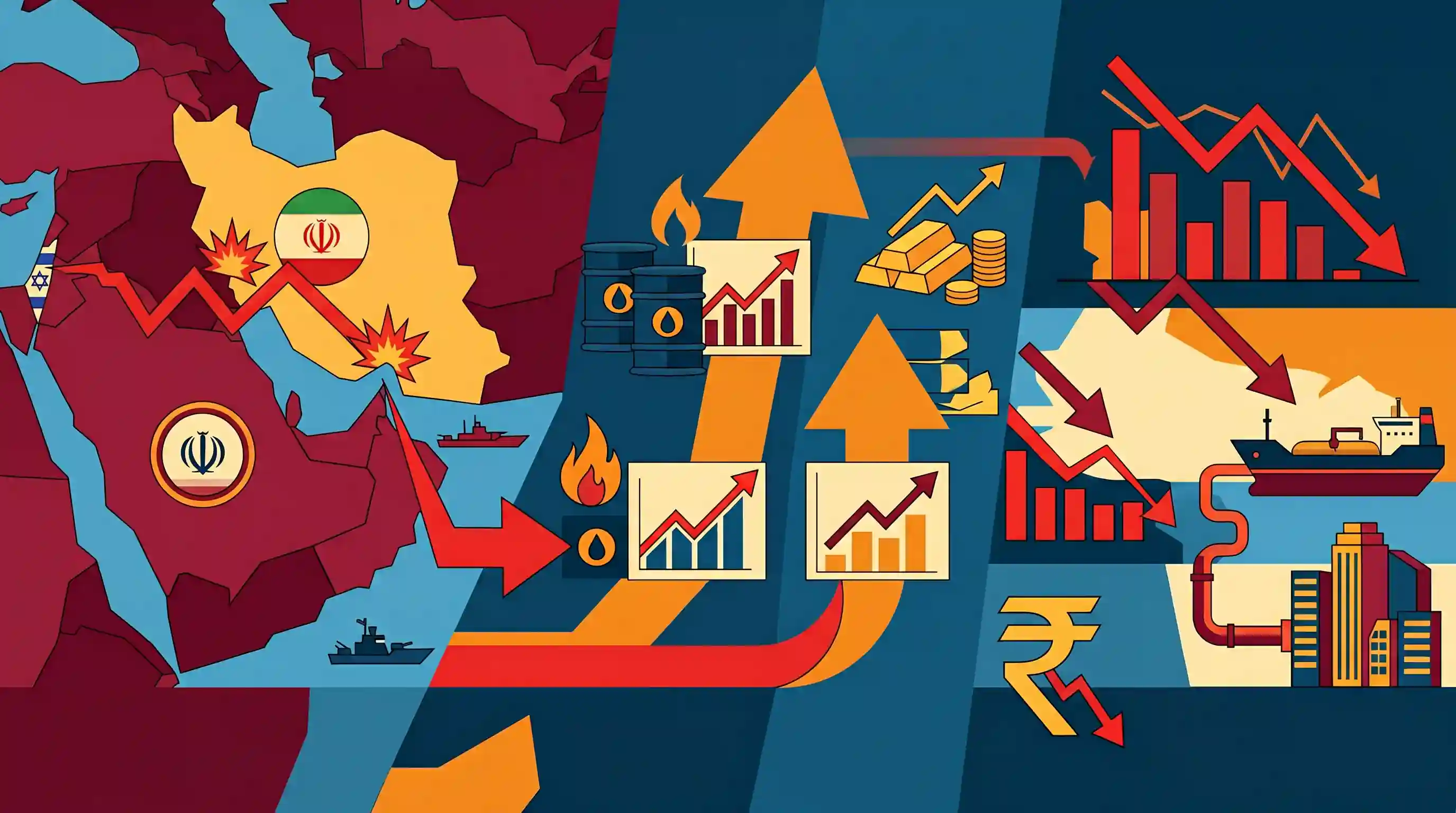
Escalating tensions between Iran and Israel have triggered a severe downturn in Indian stock markets, with the Sensex and Nifty tumbling as investors brace for economic fallout. The conflict threatens critical global oil supplies via the Strait of Hormuz, causing Brent crude prices to spike and driving up the value of safe-haven assets like gold. The crisis underscores India's vulnerability to West Asian instability, particularly concerning energy security and macroeconomic stability.
Key Points
- The escalating geopolitical conflict between Iran and Israel caused a sharp sell-off in Indian equity markets, leading to significant drops in the Sensex and Nifty.
- Global Brent crude prices surged due to fears of supply chain disruptions, particularly regarding the strategic Strait of Hormuz, which handles around 20% of global oil transit.
- India remains highly vulnerable to the crisis, as over 40% of its crude oil imports pass through the Strait of Hormuz.
- Market uncertainty drove investors toward safe-haven assets, sharply increasing gold prices, while aviation and tour operator stocks plummeted due to West Asian airspace closures.
Important Terms
Sensex

The benchmark index of the Bombay Stock Exchange (BSE) tracking 30 of the largest and most actively traded stocks in India.
UPSC context
GS-III Indian Economy; tests knowledge of financial market indicators and their role as barometers for economic health.
Nifty
The flagship index of the National Stock Exchange (NSE), representing the weighted average of 50 major Indian company stocks across various sectors.
UPSC context
GS-III Indian Economy; relevant for understanding capital markets, sectoral representation, and benchmarking investment portfolios.
Strait of Hormuz
A vital maritime chokepoint between Iran and Oman connecting the Persian Gulf to the Arabian Sea; it facilitates ~20% of global oil transit.
UPSC context
GS-I Geography & GS-II IR; crucial for questions on maritime security, energy transit, and West Asian geopolitics.
Brent Crude
A global benchmark for light, sweet crude oil sourced from the North Sea, used to price two-thirds of the world's internationally traded oil.
UPSC context
GS-III Indian Economy; critical for analyzing India's energy security, import bill, and its impact on the Current Account Deficit.
Safe-haven Assets
Investments like gold or US Treasuries expected to retain or increase in value during periods of market volatility or geopolitical turmoil.
UPSC context
GS-III Indian Economy; tests understanding of risk management, inflation hedging, and the economic significance of gold in India.
Energy Security
The condition where a country ensures reliable and affordable access to energy sources to sustain its economic growth and national functions.
UPSC context
GS-III Indian Economy; a core theme involving strategic reserves, import diversification, and vulnerability to global supply chain disruptions.
Prelims Trap
A widening Current Account Deficit due to soaring crude oil import bills leads to the appreciation of the Indian Rupee.
Increased import bills widen the CAD, meaning India demands more dollars to pay for imports. This excess dollar demand causes the Rupee to depreciate, not appreciate.
Static Concepts Connected
What is Imported Inflation and how does crude oil trigger it?
- Definition: A general and sustainable price increase in a country's domestic economy due to an increase in the costs of imported raw materials and products.
- Cost-Push Effect: Expensive crude oil raises domestic fuel prices, which cascades into higher transportation, logistics, and manufacturing costs across virtually all sectors of the economy.
- Currency Factor: If the Rupee depreciates concurrently due to dollar demand, imports become even costlier in local currency terms, severely exacerbating the inflationary pressure.
What is a "flight to safety" in financial markets?
- Definition: A market phenomenon where investors sell higher-risk assets (like equities) and purchase lower-risk assets during periods of geopolitical or economic uncertainty.
- Safe-Haven Assets: Instruments like Gold, US Treasury bonds, and the US Dollar that are historically expected to retain or increase in value during macroeconomic shocks.
- Impact on India: It typically triggers Foreign Portfolio Investment (FPI) outflows from emerging markets, causing indices like Sensex/Nifty to tumble and weakening domestic currencies.
Cross-Topic Patterns
Chokepoints + India's Energy Security
Frequent disruptions in West Asian straits (Hormuz, Bab el-Mandeb) highlight the urgency of expanding India's Strategic Petroleum Reserves (SPR) and diversifying crude sources to non-OPEC regions like Latin America.
Imported Inflation + RBI Monetary Policy
Supply-driven imported inflation caused by global oil shocks limits the RBI's ability to cut interest rates, forcing a delicate monetary policy balance between maintaining price stability and stimulating growth.

Expect a linked question in 2026 testing the geography of West Asian straits alongside their direct macroeconomic impact on India's CAD.
Linked PYQs · 4
Linked PYQs · 4
- 2025MainsGS2
"Energy security constitutes the dominant kingpin of India's foreign policy, and is linked with India's overarching influence in Middle Eastern countries.” How would you integrate energy security with India's foreign policy trajectories in the coming years?
- 2017MainsGS2
The question of India's Energy Security constitutes the most important part of India's economic progress. Analyze India's energy policy cooperation with West Asian countries.
- 2018MainsGS2
“India’s relations with Israel have, of late, acquired a depth and diversity, which cannot be rolled back.” Discuss.
- 2024PrelimsGS1
Consider the following statements : Statement-I : Sumed pipeline is a strategic route for Persian Gulf oil and natural gas shipments to Europe. Statement-II : Sumed pipeline connects the Red Sea with the Mediterranean Sea. Which one of the following is correct in respect of the above statements?
