India Evaluates West Asia Crisis Impact on Energy and Supply Chains
Source:The Hindu ↗
Why It Matters
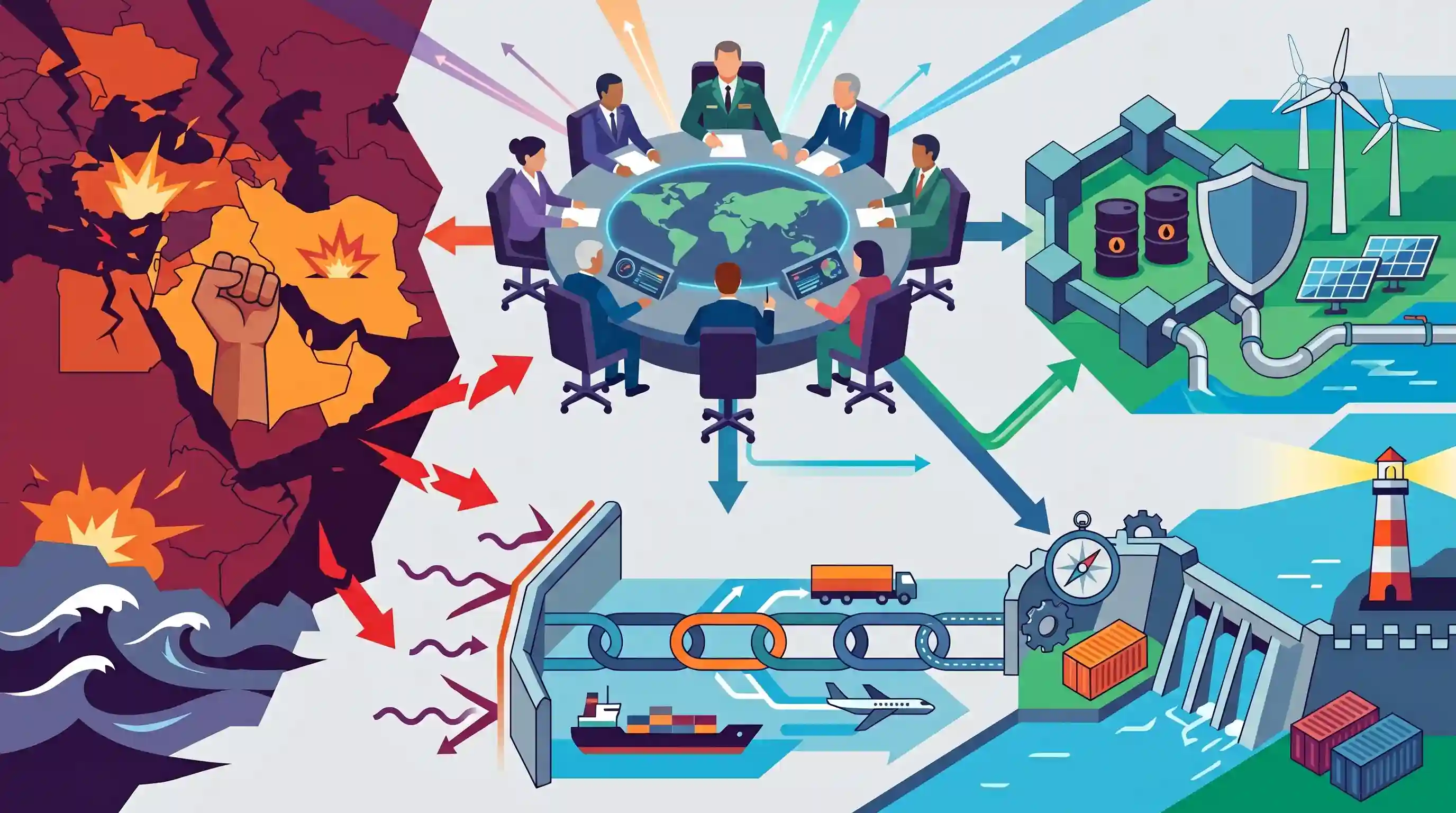
Escalating conflicts in West Asia pose a direct threat to India's energy security, supply chains, and macroeconomic stability through potential crude oil price shocks. The activation of an Informal Group of Ministers (IGoM) highlights the executive's proactive approach to crisis management and cross-ministerial coordination.
Summary
Defence Minister Rajnath Singh convened an Informal Group of Ministers (IGoM) to evaluate the strategic and economic repercussions of the escalating West Asia crisis on India. The high-level meeting focused on proactively safeguarding India's energy security, ensuring supply chain resilience, and maintaining the availability of essential commodities amid geopolitical uncertainties. The IGoM underscored the critical need for swift policy decisions and long-term preparedness to insulate the domestic economy from external shocks arising out of the volatile situation in the Middle East.
Key Points
- Defence Minister Rajnath Singh chaired an Informal Group of Ministers (IGoM) to assess the impact of the ongoing West Asia crisis on India's strategic and economic interests.
- The high-level meeting prioritized uninterrupted energy supplies and the domestic availability of essential commodities amidst global volatility.
- Key discussions revolved around ensuring the resilience of critical infrastructure and maintaining robust supply chains.
- The IGoM emphasized the necessity for swift decision-making and long-term strategic readiness to insulate the Indian economy from external geopolitical shocks.
Important Terms
Informal Group of Ministers (IGoM)

An ad-hoc committee of senior ministers formed by the Prime Minister to examine specific, urgent issues and provide recommendations to the Cabinet for streamlined decision-making.
UPSC context
GS Paper II (Governance/Executive). Tests understanding of cabinet working, inter-ministerial coordination, and the executive's response to emergent crises.
Strategic Petroleum Reserves (SPR)
Emergency underground crude oil stockpiles maintained to ensure supply continuity during global disruptions. India currently holds 5.33 MMT at Visakhapatnam, Mangaluru, and Padur.
UPSC context
GS Paper III (Energy/Infrastructure). Crucial for questions on energy self-reliance and mitigating geopolitical risks to the economy.
Strait of Hormuz
A critical maritime chokepoint between the Persian Gulf and the Gulf of Oman through which nearly 50% of India's crude oil imports transit.
UPSC context
GS Paper II (International Relations). Tests knowledge of maritime geography and its impact on India's strategic and economic interests.
Gulf Plus One Strategy
India's energy diversification approach aimed at reducing heavy reliance on Middle Eastern crude by increasing imports from non-Arab nations like Russia, Angola, and the US.
UPSC context
GS Paper II (Foreign Policy). A strategic term reflecting India's shift toward multi-vector energy diplomacy.
Sea Lines of Communication (SLOCs)
Primary maritime routes used for trade, logistics, and naval passage. In the West Asia context, these link India to essential energy suppliers and European markets.
UPSC context
GS Paper III (Internal Security/Security Challenges). Relevant for maritime security and protecting economic interests in volatile regions.
Energy Security
Uninterrupted availability of energy sources at an affordable price. For India, it involves balancing import dependency with domestic production, renewables, and strategic reserves.
UPSC context
GS Paper III (Economy/Environment). Central to discussions on sustainable growth and the impact of global conflicts on domestic inflation.
Prelims Trap
Groups of Ministers (GoMs) are constitutional mechanisms mentioned under Article 77 for inter-ministerial coordination.
GoMs and Cabinet Committees are not constitutional bodies. They are extra-constitutional, created under the Government of India (Transaction of Business) Rules, 1961.
Static Concepts Connected
What is India's Strategic Petroleum Reserve (SPR) framework?
- Nodal agency: Managed by the Indian Strategic Petroleum Reserve Limited (ISPRL), a special purpose vehicle under the Ministry of Petroleum & Natural Gas.
- Locations: Phase I includes underground rock caverns at Visakhapatnam, Mangaluru, and Padur, holding 5.33 MMT (million metric tonnes).
- Coverage capacity: The SPR provides ~9.5 days of crude oil coverage, which supplements commercial storage by oil marketing companies (OMCs) to mitigate supply disruptions.
How do Groups of Ministers (GoMs) differ from Cabinet Committees?
- Cabinet Committees: Institutionalized bodies established under the Transaction of Business Rules (e.g., Cabinet Committee on Security). They have a permanent mandate.
- Groups of Ministers: Ad-hoc bodies formed by the PM or Cabinet to resolve specific, immediate inter-ministerial issues or crises.
- EGoMs vs IGoMs: Formal EGoMs could take binding decisions on behalf of the Cabinet. They were abolished in 2014 to speed up executive decision-making.
Cross-Topic Patterns
Imported inflation via supply chain shocks
West Asia instability spikes crude freight costs, leading to a widening current account deficit (CAD) and imported inflation. This forces the RBI into tight monetary balancing acts to defend the Rupee.
Green Hydrogen as a geopolitical shield
Sustained volatility in fossil fuel markets acts as a catalyst for India's National Green Hydrogen Mission, shifting the domestic narrative from pure climate commitments to urgent national security imperatives.
SCRI and minilateral economic frameworks
Geopolitical shocks reinforce the utility of frameworks like the Supply Chain Resilience Initiative (SCRI) between India, Japan, and Australia to reduce single-geography reliance and diversify critical imports.

A linked Prelims question mapping West Asian conflict zones to energy supply choke points (Strait of Hormuz, Bab-el-Mandeb) is highly likely in 2026.
Linked PYQs · 4
Linked PYQs · 4
- 2025MainsGS2
"Energy security constitutes the dominant kingpin of India's foreign policy, and is linked with India's overarching influence in Middle Eastern countries.” How would you integrate energy security with India's foreign policy trajectories in the coming years?
- 2017MainsGS2
The question of India's Energy Security constitutes the most important part of India's economic progress. Analyze India's energy policy cooperation with West Asian countries.
- 2018MainsGS2
“India’s relations with Israel have, of late, acquired a depth and diversity, which cannot be rolled back.” Discuss.
- 2025MainsGS3
What are the challenges before the Indian economy when the world is moving away from free trade and multilateralism to protectionism and bilateralism? How can these challenges be met?
