Global Economic Volatility and India Macroeconomic Resilience
Source:Indian Express ↗
Why It Matters
Understanding how geopolitical conflicts affect macroeconomic stability is crucial for GS3. The article provides highly relevant data points (import cover, debt-to-GDP ratio, forex reserves) and conceptual keywords (counter-cyclical fiscal policy, fiscal space) that are vital for writing mains answers on the resilience of the Indian economy.
Summary
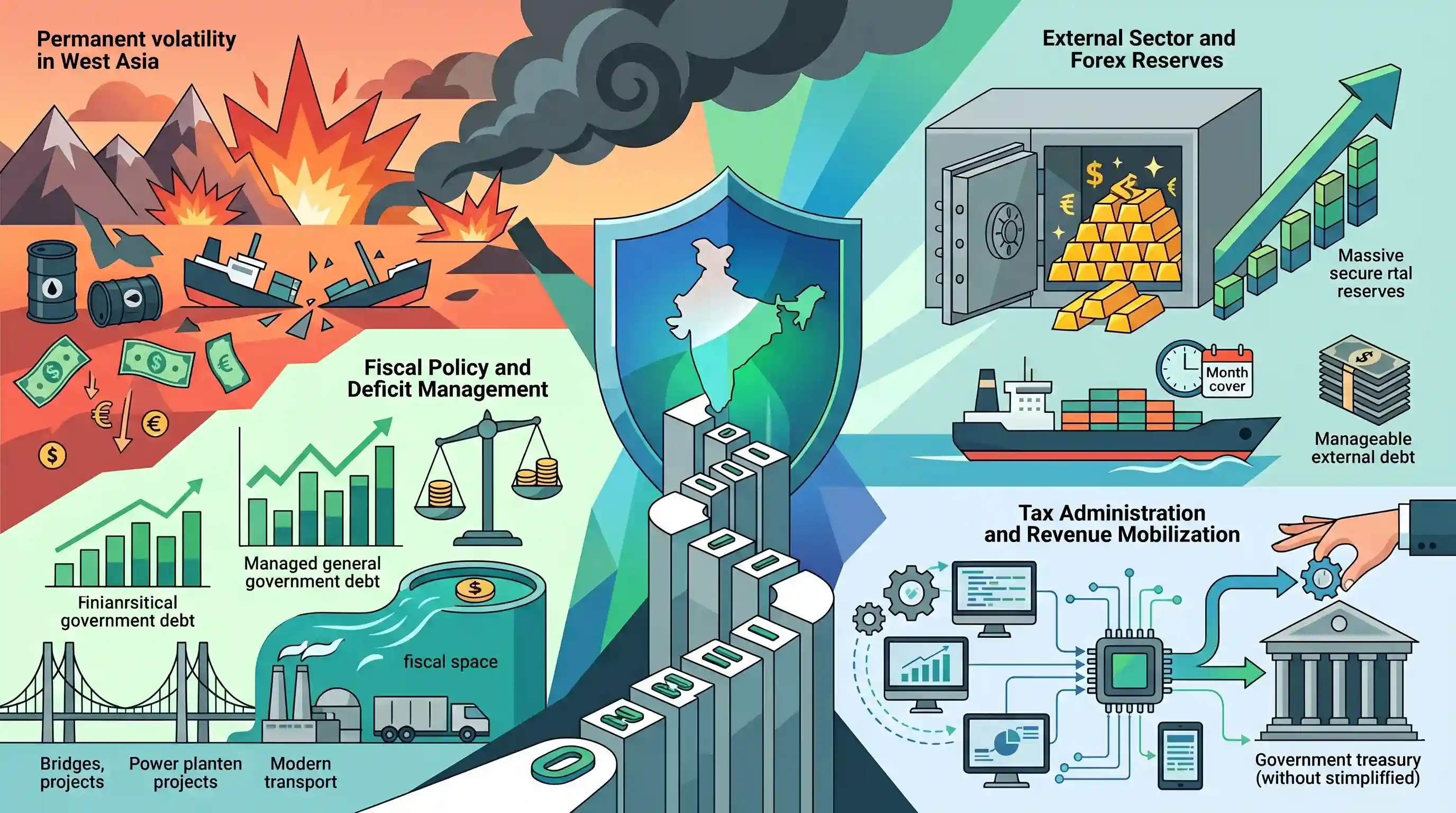
Finance Minister Nirmala Sitharaman emphasized that the ongoing conflict in West Asia is causing permanent volatility in the global economy rather than temporary shocks. Despite these geopolitical headwinds, India remains insulated due to its strong macroeconomic fundamentals built on a decade of fiscal discipline. This discipline has provided the government with the necessary fiscal space to implement counter-cyclical policies and support capital expenditure. India's general government debt is manageable at 81% of GDP, with external debt at just 19.1%. Additionally, the RBI's substantial foreign exchange reserves of over $688 billion ensure 11 months of import cover. On the domestic front, the Finance Minister highlighted a shift towards technology-driven, simplified tax administration by the CBDT to improve revenue mobilization without resorting to aggressive tax enforcement.
Key Points
- The West Asia conflict has evolved from a regional security issue into a source of permanent volatility and systemic tremors for the global economy.
- India's disciplined fiscal policy over the past decade has created robust 'fiscal space,' enabling counter-cyclical measures (leaning against the wind) without resorting to excessive borrowing.
- India maintains a strong external buffer with foreign exchange reserves exceeding $688 billion, equivalent to 11 months of import cover.
- The country's general government debt-to-GDP ratio stands at 81%, while external debt is low at 19.1% of GDP.
- Revenue mobilization is being enhanced through simplified tax administration, emphasizing trust, transparency, and the use of technology (like AI and TDS matching by CBDT) over coercive tactics.
Important Terms
Counter-cyclical Fiscal Policy

A strategy where the government increases spending and reduces taxes during economic downturns, or vice versa, to stabilize fluctuations. It aims to 'lean against' prevailing economic trends.
UPSC context
GS Paper III (Indian Economy). Tests understanding of tools for macroeconomic stability and managing business cycles.
General Government Debt-to-GDP Ratio
The total amount of debt owed by both central and state governments as a percentage of the nation's GDP; a key indicator of fiscal health.
UPSC context
GS Paper III (Fiscal Policy). Essential for debt sustainability analysis and evaluating government borrowing patterns.
Foreign Exchange Reserves
Assets held by the central bank (RBI) in foreign currencies, gold, and Special Drawing Rights (SDRs) to support the national currency and ensure external stability.
UPSC context
GS Paper III (External Sector). Tests knowledge of Balance of Payments (BoP) and currency management strategies.
Import Cover
An indicator measuring how many months a country can pay for its imports using its current foreign exchange reserves. It reflects external economic resilience.
UPSC context
GS Paper III (Economic Development). A vital metric for assessing vulnerability to global trade shocks and energy price hikes.
Central Board of Direct Taxes (CBDT)
A statutory body under the Ministry of Finance's Department of Revenue that manages and collects direct taxes, such as income and corporate tax.
UPSC context
GS Paper III (Resource Mobilization). Relevant for institutional frameworks in tax administration and technology-driven revenue reforms.
Fiscal Space
The flexibility in a government's budget that allows it to provide resources for specific purposes without jeopardizing its financial sustainability or creditworthiness.
UPSC context
GS Paper III (Government Budgeting). Tests the ability to analyze constraints and enablers of public expenditure and capital investment.
Prelims Trap
India's robust macroeconomic fundamentals mean its general government debt-to-GDP ratio has fallen below the 60% FRBM mandate.
While external debt is impressively low (19.1%), India's total general government debt (Centre + States) remains elevated at 81%, well above the N.K. Singh Committee's 60% target.
Static Concepts Connected
What is 'counter-cyclical fiscal policy' and how does 'fiscal space' enable it?
- Counter-cyclical policy: The government increases spending and cuts taxes during an economic downturn, and does the opposite during a boom, leaning against the wind.
- Pro-cyclical policy: The government cuts spending during a recession and increases it during a boom, which exacerbates economic volatility and deepens crises.
- Fiscal Space: The financial room a government possesses to undertake stimulus spending without jeopardizing its debt sustainability or sovereign credit ratings.
What constitutes India's Foreign Exchange Reserves and the 'Import Cover' metric?
- Import Cover: A traditional trade-based indicator measuring the number of months a country can sustain its current level of imports using solely its foreign exchange reserves.
- Forex Components: Managed by the RBI, the reserves comprise Foreign Currency Assets (FCA) - the largest component, Gold, Special Drawing Rights (SDRs), and the Reserve Tranche Position (RTP) in the IMF.
Cross-Topic Patterns
West Asia & Imported Inflation
Permanent volatility in West Asia threatens chokepoints like the Strait of Hormuz, directly linking regional security (GS-2) to India's Current Account Deficit and imported inflation (GS-3).
Algorithmic Tax Governance
CBDT's use of AI and TDS matching connects GS-3 revenue mobilization with GS-2 e-governance, shifting focus from coercive 'inspector raj' to non-intrusive, data-driven compliance.

A multi-statement Prelims question combining counter-cyclical fiscal policy, FRBM debt targets, and import cover metrics is highly likely.
Linked PYQs · 4
Linked PYQs · 4
- 2019MainsGS3
The public expenditure management is a challenge to the Government of India in the context of budget making during the post-liberalization period. Clarify it.
- 2016PrelimsGS1
Which of the following best describes the term 'import cover', sometimes seen in the news?
- 2013PrelimsGS1
Which one of the following groups of items is included in India's foreign-exchange reserves?
- 2025PrelimsGS1
A country's fiscal deficit stands at ₹50,000 crores. It is receiving ₹10,000 crores through non-debt creating capital receipts. The country's interest liabilities are ₹1,500 crores. What is the gross primary deficit?
