West Asia Conflict Impacts Indian Economy and RBI Policy Stance
Source:The Hindu ↗
Why It Matters
This article perfectly illustrates the intersection of global geopolitics and domestic macroeconomic stability. For UPSC aspirants, it provides a real-world example of how external shocks (West Asia conflict, Strait of Hormuz blockage) directly influence RBI's monetary policy decisions (repo rate status quo) and highlight India's critical need for energy security.
Summary
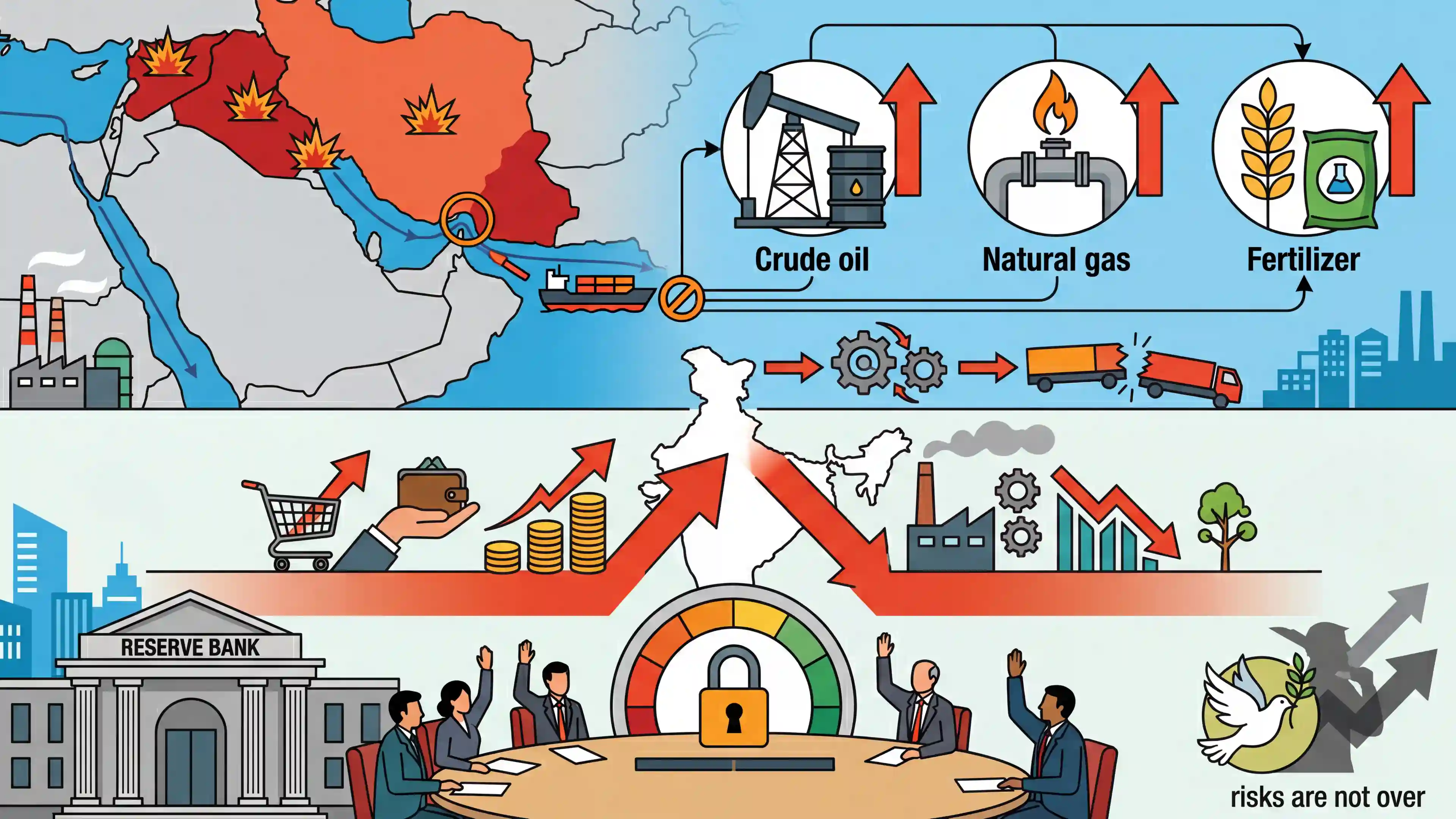
The article outlines concerns raised by RBI Governor Sanjay Malhotra and other Monetary Policy Committee (MPC) members regarding the economic fallout of the West Asia conflict. According to the MPC minutes, the conflict threatens the Indian economy through potential disruptions in crude oil, natural gas, and fertilizer supplies, particularly if key chokepoints like the Strait of Hormuz are affected. These supply chain dislocations pose downside risks to growth and upside risks to inflation, which prompted the MPC's unanimous decision to maintain a status quo on the policy repo rate despite a temporary ceasefire announcement.
Key Points
- RBI Governor Sanjay Malhotra highlighted that the West Asia conflict poses significant risks to the Indian economy through supply chain disruptions, elevated energy prices, and subdued global demand.
- The Monetary Policy Committee (MPC) voted unanimously to maintain the status quo on the policy repo rate, citing uncertainties surrounding the geopolitical situation and its impact on inflation.
- External MPC member Nagesh Kumar emphasized India's structural vulnerability due to its heavy reliance on Middle Eastern imports for crude oil, natural gas, and fertilizers.
- The potential blockage of the Strait of Hormuz was specifically identified as a critical chokepoint that could severely disrupt supplies and trigger a spike in crude oil prices.
Important Terms
Monetary Policy Committee (MPC)

A statutory six-member body under the RBI Act, 1934, responsible for determining the benchmark interest rate (repo rate) to meet India's inflation target.
UPSC context
GS-III: Indian Economy. Key for understanding institutional frameworks, statutory bodies, and monetary policy formulation.
Repo Rate
The benchmark interest rate at which the RBI lends short-term funds to commercial banks against government securities to regulate liquidity and control inflation.
UPSC context
GS-III: Monetary Policy tools. Frequently tested in Prelims (direct impacts) and Mains (macroeconomic stability).
Inflation Targeting
A policy framework (FIT) where the RBI targets a 4% CPI inflation rate with a +/- 2% tolerance band to maintain price stability.
UPSC context
GS-III: Economy. Tests knowledge of price stability vs. growth trade-offs and the Urjit Patel Committee recommendations.
Strait of Hormuz
A strategic maritime chokepoint between Iran and Oman; it is the primary conduit for global oil and gas from the Persian Gulf.
UPSC context
GS-I: Geography; GS-II: International Relations. Critical for mapping and understanding West Asian geopolitical risks to India.
Energy Security
The uninterrupted availability of energy sources at affordable prices; for India, this relies heavily on diversifying imports and regional stability.
UPSC context
GS-III: Infrastructure/Energy. Relevant for discussions on strategic reserves and economic vulnerability to external shocks.
Status Quo (Monetary Stance)
A policy stance of maintaining the current repo rate, often used when the central bank is monitoring inflation or external geopolitical risks.
UPSC context
GS-III: Indian Economy. Tests ability to analyze RBI's "wait-and-watch" approach amidst global uncertainties.
Prelims Trap
"The Strait of Hormuz connects the Red Sea to the Arabian Sea and is critical for India's oil imports."
UPSC frequently swaps Middle Eastern maritime chokepoints. The Strait of Hormuz links the Persian Gulf to the Gulf of Oman, not the Red Sea.
Static Concepts Connected
What is the Monetary Policy Committee (MPC) and its core mandate?
- Statutory Body: It is a statutory body constituted under the amended Reserve Bank of India Act, 1934.
- Composition: It has 6 members (3 from RBI, including the Governor who has a casting vote, and 3 external experts appointed by the Central Government).
- Objective: To determine the policy interest rate (repo rate) required to achieve the inflation target (4% +/- 2%) while keeping growth in mind.
How does imported cost-push inflation limit monetary policy effectiveness?
- Cost-Push Nature: It is driven by supply-side shocks (e.g., global oil or fertilizer price spikes) rather than excess domestic demand.
- Policy Limitation: Hiking repo rates subdues domestic demand but cannot fix external supply disruptions, risking an economic slowdown without cooling prices (stagflation).
- Imported Inflation: India's heavy reliance on imported energy directly passes global geopolitical price shocks to domestic consumers, widening the Current Account Deficit.
Cross-Topic Patterns
Energy Security + Agri-inflation
Disruptions in West Asia do not just spike oil prices; they directly impact critical fertilizer imports (urea, DAP), leading to cost-push food inflation within the Indian agricultural sector.
Map Locations + Trade Chokepoints
The Strait of Hormuz, Bab-el-Mandeb, and the Suez Canal are increasingly tested in mapping questions alongside their cascading macroeconomic impacts on global supply chains and India's Current Account Deficit.

Expect a 2026 Prelims question pairing the geographic mapping of West Asian chokepoints with their macroeconomic impact on India's CAD.
Linked PYQs · 2
Linked PYQs · 2
- 2025MainsGS2
"Energy security constitutes the dominant kingpin of India's foreign policy, and is linked with India's overarching influence in Middle Eastern countries.” How would you integrate energy security with India's foreign policy trajectories in the coming years?
- 2024MainsGS3
What are the causes of persistent high food inflation in India? Comment on the effectiveness of the monetary policy of the RBI to control this type of inflation.
