BRICS Summit Chair Summary on West Asia Security Crisis
Source:Indian Express ↗
Why It Matters
The expansion of BRICS has complicated its internal consensus-building, as clearly demonstrated by the lack of a joint statement on the West Asia conflict. Understanding how regional dynamics (such as Iran vs. US/Israel/Arab states) affect multilateral forums is crucial for analyzing India\'s diplomatic balancing act and the future effectiveness of global groupings.
Summary
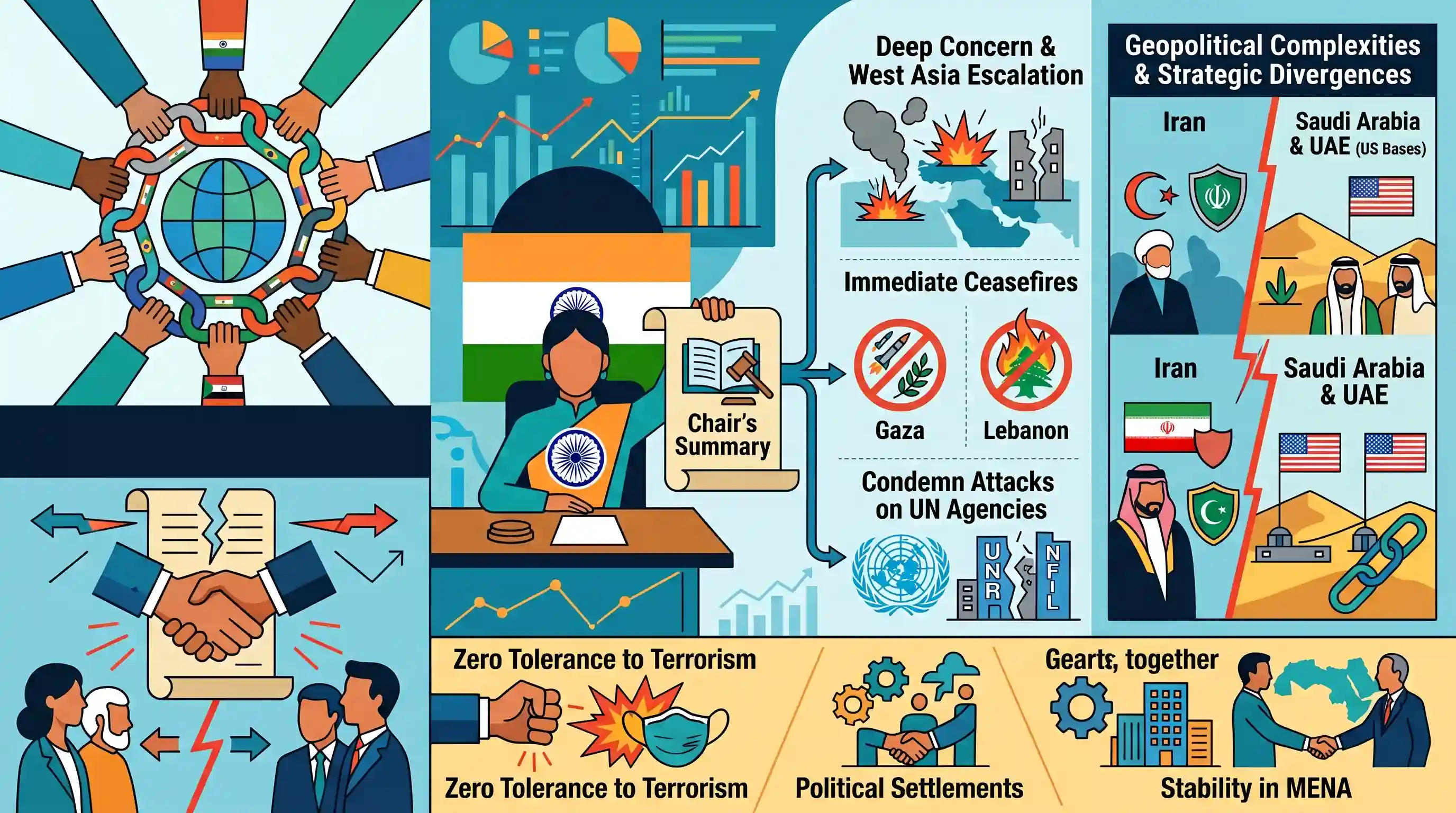
The expanded BRICS group was unable to reach a consensus for a joint statement regarding the ongoing US-Israel conflict with Iran, prompting India—the 2026 BRICS Chair—to issue a "Chair’s summary." The summary noted "deep concern" over the escalation in West Asia, called for immediate ceasefires in Gaza and Lebanon, and condemned attacks on UN agencies like UNRWA and UNIFIL. The inability to forge a joint statement highlights the geopolitical complexities and strategic divergences within the 11-member BRICS, especially between nations hosting US military bases (like Saudi Arabia and the UAE) and Iran. The meeting emphasized a zero-tolerance approach to terrorism while advocating for political settlements and stability across the broader MENA region.
Key Points
- BRICS nations failed to issue a joint statement on the West Asia conflict (specifically the US-Israel war on Iran) due to internal strategic divisions.
- India, as the 2026 BRICS Chair, issued a "Chair\'s summary" expressing deep concern over the deteriorating security situation in the Middle East and North Africa (MENA) region.
- The diplomatic rift underscores the complexities of the recently expanded 11-member BRICS grouping, which now includes geopolitical rivals or nations with diverging alliances (e.g., Iran vs. Saudi Arabia/UAE hosting US bases).
- The Chair\'s summary emphasized a zero-tolerance approach to terrorism, called for immediate ceasefires in Gaza and Lebanon, and condemned attacks on UN personnel and premises, specifically defending UNIFIL and UNRWA.
- The summary also reaffirmed support for Palestine\'s full UN membership and advocated for political stability across Syria, Yemen, Iraq, Libya, and Sudan.
Important Terms
BRICS

A grouping of major emerging economies (Brazil, Russia, India, China, South Africa) recently expanded to include nations like Iran and the UAE.
UPSC context
GS Paper 2: International Relations. Tests understanding of Global South leadership and India's role in a multipolar world.
UNRWA
A UN agency created in 1949 to provide relief, health, and education services specifically to Palestine refugees.
UPSC context
GS Paper 2: International Institutions. Relevant for humanitarian issues in West Asia and India's Palestine policy.
UNIFIL
A UN peacekeeping mission in Lebanon established in 1978 to maintain security along the Israel-Lebanon border (Blue Line).
UPSC context
GS Paper 2: Peacekeeping. Important due to India's status as a top troop contributor and regional stability concerns.
Chair’s Summary
A summary issued by the presiding chair when consensus for a joint declaration cannot be reached among all member states.
UPSC context
GS Paper 2: Diplomacy. Tests understanding of multilateral negotiation challenges and the concept of "agreeing to disagree."
MENA Region
The Middle East and North Africa; a strategic region vital for global energy security and international trade routes.
UPSC context
GS Paper 2: Global Geopolitics. Critical for India's energy security and "Link West" foreign policy.
Prelims Trap
"UNRWA operations are strictly financed through assessed contributions mandated by the UN regular budget."
UNRWA is funded almost entirely by voluntary contributions from member states, making its operations highly vulnerable to diplomatic leverage and funding pauses during regional conflicts.
Static Concepts Connected
What are the core mandates and funding mechanisms of UNIFIL and UNRWA?
- UNIFIL (Lebanon): Established in 1978 to monitor hostilities in southern Lebanon. India is traditionally one of the largest troop-contributing nations to this UN peacekeeping mission.
- UNRWA (Palestine): Created in 1949 to provide relief and human development services specifically to Palestinian refugees. It relies almost entirely on voluntary funding.
How does a 'Chair's Summary' differ from a 'Joint Statement' in multilateral forums?
- Joint Statement: A formal outcome document issued only when absolute, unanimous consensus is achieved by all member states in a grouping like BRICS or G20.
- Chair's Summary: A document issued by the host nation when internal strategic divisions prevent consensus. It records the prevailing views but lacks unanimous geopolitical weight.
Cross-Topic Patterns
Consensus gridlock in expanded groups
Adding geopolitical rivals (Iran/Saudi) to BRICS mirrors the SCO's India-Pakistan paralysis, highlighting why India increasingly favors agile, interest-based minilaterals like the Quad or I2U2.
UNIFIL and India's Peacekeeping footprint
Condemning attacks on UN agencies in West Asia goes beyond diplomatic rhetoric; it is a direct national interest issue, as India is a top troop contributor to UNIFIL.

Expect a 2026 Prelims pairing question on UN agencies in West Asia (UNIFIL/Lebanon, UNRWA/Palestine, UNDOF/Golan Heights).
Linked PYQs · 4
Linked PYQs · 4
- 2012MainsGS2
Compare the significance of IBSA and BRICS in the context of India's multilateral diplomacy.
- 2022MainsGS2
How will I2U2 (India, Israel, UAE and USA) grouping transform India's position in global politics?
- 2025MainsGS2
"Energy security constitutes the dominant kingpin of India's foreign policy, and is linked with India's overarching influence in Middle Eastern countries.” How would you integrate energy security with India's foreign policy trajectories in the coming years?
- 2017MainsGS2
The question of India's Energy Security constitutes the most important part of India's economic progress. Analyze India's energy policy cooperation with West Asian countries.
