West Asia Crisis Impacts Maharashtra Agricultural Exports
Source:Indian Express ↗
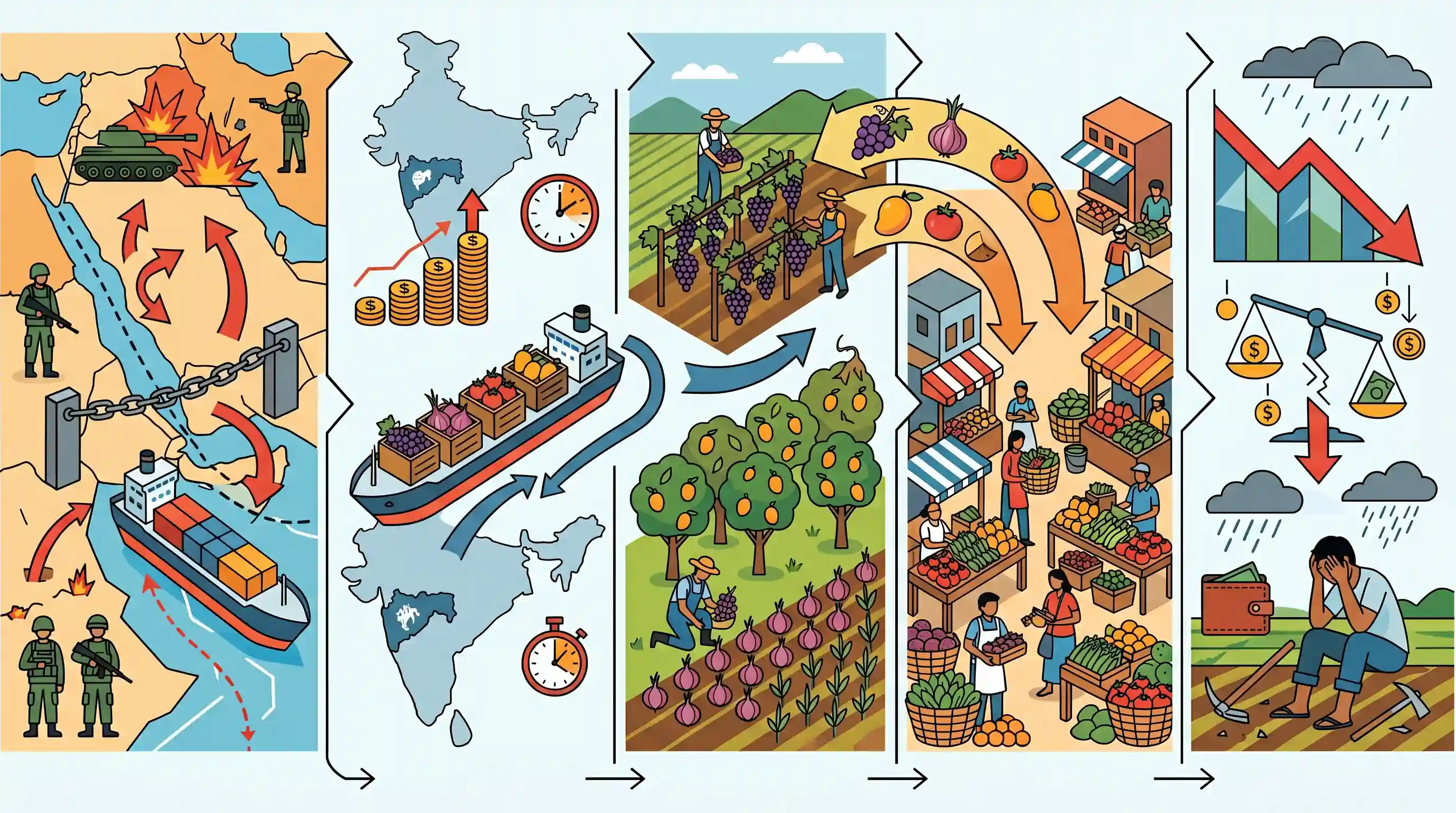
Why It Matters
It illustrates the direct link between international geopolitical crises (West Asia conflict) and domestic economic issues (farmer distress), which is highly relevant for GS-2 (IR) and GS-3 (Agriculture and Economy). It highlights the fragility of agricultural supply chains for perishable goods.
Summary
The ongoing conflict in West Asia and the resulting disruptions in the Red Sea shipping routes have severely impacted agricultural exports from Maharashtra. Escalating freight costs and prolonged transit times have made it unviable to export perishable goods such as fruits and vegetables to lucrative markets in the Middle East and Europe. Consequently, these export-bound commodities are being diverted to the domestic market, causing a massive supply glut. This oversupply has triggered a sharp crash in prices, leading to severe financial distress for farmers and highlighting the vulnerability of agricultural supply chains to global geopolitical conflicts.
Key Points
- Escalating geopolitical tensions in West Asia and the Red Sea crisis have severely disrupted maritime shipping routes.
- The conflict has led to a sharp increase in freight costs and extended transit times, crippling the export of perishable agricultural commodities from Maharashtra to the Middle East and Europe.
- Unable to reach international markets, export-bound fruits and vegetables are flooding the domestic market, creating a severe supply glut.
- This oversupply has triggered a sharp slump in domestic prices, causing significant financial distress for farmers in Maharashtra.
- The situation underscores the vulnerability of India's agricultural supply chains and rural economy to global geopolitical shocks and trade disruptions.
Prelims Trap
"India formally joined the US-led Operation Prosperity Guardian to protect its maritime agricultural exports."
India deployed its own naval assets independently in the region and did not formally join the US-led Operation Prosperity Guardian.
Static Concepts Connected
What is the strategic geography of the Bab-el-Mandeb Strait?
- Connectivity: It serves as a critical maritime chokepoint connecting the Red Sea to the Gulf of Aden and the Indian Ocean.
- Asian Border: It is bordered by Yemen on the Asian side (Arabian Peninsula).
- African Border: It is bordered by Djibouti and Eritrea on the African side (Horn of Africa).
How does Food Processing act as a buffer against agricultural supply gluts?
- Shelf-life Extension: Converts highly perishable surpluses like fruits and vegetables into value-added products with extended longevity.
- Price Stabilization: Absorbs excess domestic supply during export disruptions, preventing distress sales and stabilizing farmer incomes.
- Export Diversification: Reduces dependence on volatile fresh-produce export routes by establishing alternate, durable market linkages.
Cross-Topic Patterns
Geopolitics and localized deflation
Global chokepoint disruptions typically cause imported inflation, but for net-exporters of perishables, they trigger devastating localized price crashes due to forced domestic dumping.
Operation Prosperity Guardian vs India
UPSC often tests India's independent security posture. Despite the trade hit, India deployed independent naval assets rather than joining the US-led Operation Prosperity Guardian.

A GS3 multi-statement question linking global maritime chokepoints (Red Sea) directly to domestic agricultural price crashes is expected.
Linked PYQs · 4
Linked PYQs · 4
- 2025MainsGS3
Elaborate the scope and significance of supply chain management of agricultural commodities in India.
- 2020MainsGS3
What are the main constraints in transport and marketing of agricultural produce in India?
- 2024MainsGS2
Discuss the geopolitical and geostrategic importance of Maldives for India with a focus on global trade and energy flows. Further also discuss how this relationship affects India's maritime security and regional stability amidst international competition ?
- 2020MainsGS3
What are the challenges and opportunities of food processing sector in the country? How can income of the farmers be substantially increased by encouraging food processing?
