External Affairs Minister Discusses West Asia Crisis with Iran
Source:The Hindu ↗
Why It Matters
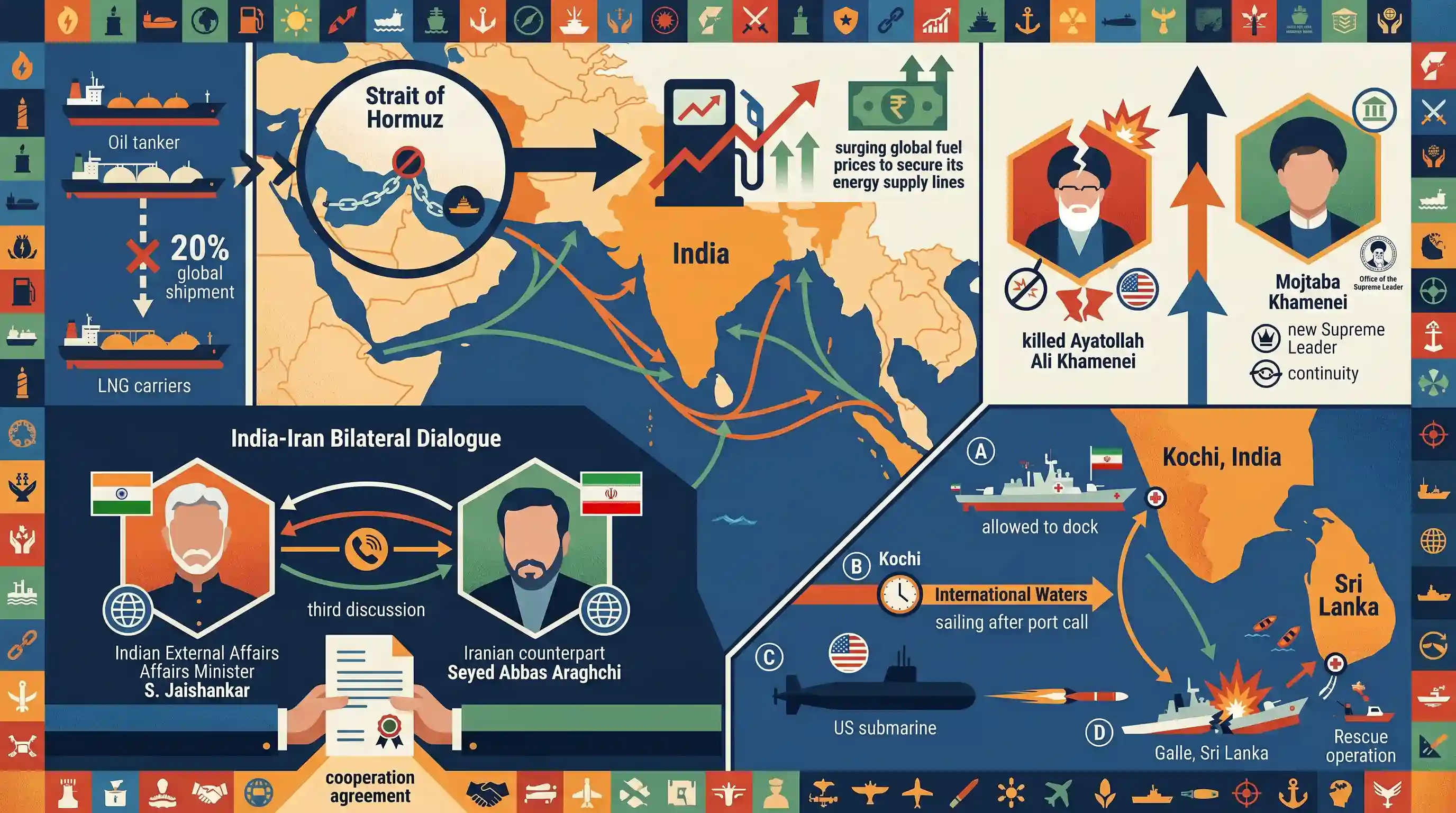
The ongoing conflict in West Asia directly impacts India's vital strategic interests on multiple fronts. The blockade of the Strait of Hormuz exposes the vulnerabilities of India's energy security, heavily reliant on imported crude oil, while escalating geopolitical tensions require a delicate diplomatic balancing act between Iran, the US, and Israel. Furthermore, maritime incidents extending into the Indian Ocean (near Sri Lanka and Kochi) highlight the spillover risks to India's immediate maritime neighborhood.
Summary
External Affairs Minister S. Jaishankar held a detailed conversation with his Iranian counterpart Seyed Abbas Araghchi, marking their third discussion since the current West Asia crisis escalated. The dialogue occurred against the backdrop of Iran's virtual blockade of the Strait of Hormuz—a crucial maritime chokepoint that handles roughly 20% of global oil and LNG shipments—prompting India to actively secure its energy supply lines amidst surging global fuel prices. It was also the first bilateral interaction following Iran's appointment of Mojtaba Khamenei as the new Supreme Leader, succeeding Ayatollah Ali Khamenei who was killed in a joint US-Israel strike. Further complicating the regional security matrix is a recent maritime incident in which a US strike sank an Iranian warship off the coast of Sri Lanka shortly after India allowed the vessel to dock in Kochi on humanitarian grounds.
Key Points
- External Affairs Minister S. Jaishankar held his third conversation with Iranian FM Seyed Abbas Araghchi since the recent escalation of the West Asian crisis.
- The talks were heavily focused on ensuring India's energy security as global oil and gas prices surge due to Iran's virtual blockade of the Strait of Hormuz, a critical transit route for 20% of global oil and LNG.
- This was the first high-level contact since Mojtaba Khamenei was named Iran's new Supreme Leader, succeeding Ayatollah Ali Khamenei who died in a joint US-Israel military strike.
- Jaishankar also held discussions on the crisis with counterparts from Germany and South Korea.
- The strategic backdrop includes a recent incident where an Iranian warship was sunk by the US near Sri Lanka, shortly after India permitted it to dock in Kochi on humanitarian grounds.
Important Terms
Strait of Hormuz

A strategic waterway connecting the Persian Gulf to the Gulf of Oman, handling roughly 20% of global oil and LNG shipments. It is the world's most critical energy chokepoint.
UPSC context
GS II (International Relations) & GS I (Geography). Tests knowledge of maritime trade routes and India’s energy vulnerability in West Asia.
Supreme Leader (Iran)
The highest religious and political authority in Iran's theocratic system, holding ultimate control over the military, foreign policy, and state institutions under the principle of Velayat-e Faqih.
UPSC context
GS II (Comparison of Constitutions/IR). Crucial for understanding Iran's strategic decision-making and bilateral relations with India.
Energy Security
The uninterrupted availability of energy sources at an affordable price. It includes availability, affordability, and accessibility, ensuring national growth is not derailed by global supply disruptions.
UPSC context
GS III (Economic Development/Infrastructure). Tests ability to analyze India’s import dependency and strategies like Strategic Petroleum Reserves (SPR).
Maritime Security
The protection of territorial waters, sea lanes of communication (SLOCs), and maritime resources from threats like piracy, terrorism, and geopolitical blockades to ensure freedom of navigation.
UPSC context
GS III (Security) & GS II (IR). Focuses on India's role as a net security provider in the Indian Ocean.
Maritime Chokepoint
Narrow geographical passages (straits or canals) that connect larger bodies of water. They act as global trade bottlenecks, where disruptions can significantly inflate shipping costs and fuel prices.
UPSC context
GS I (Geography) & GS II (IR). Tests understanding of the "jugular veins" of global commerce and strategic geography.
Indian Ocean Region (IOR)
The maritime theater spanning from the African coast to the Indonesian archipelago, vital for over 90% of India's trade and the primary zone of its naval influence.
UPSC context
GS II (IR). Central to India’s "Neighborhood First" policy and SAGAR (Security and Growth for All in the Region) initiative.
Prelims Trap
"Providing port access to belligerent warships during active conflict violates a host nation's neutrality."
Customary international law and UNCLOS permit granting temporary port facilities to foreign naval vessels in distress on humanitarian grounds without breaching neutrality.
Static Concepts Connected
What is the geographical and economic significance of the Strait of Hormuz?
- Geographical Location: It serves as a critical maritime chokepoint connecting the Persian Gulf to the Gulf of Oman and the Arabian Sea.
- Bordering Nations: It is bounded by Iran to the north and Oman (Musandam Peninsula) and the United Arab Emirates to the south.
- Trade Chokepoint: It handles approximately 20% of global oil consumption and over a third of global LNG trade, directly impacting global macroeconomic stability.
How does international law view port access for belligerent warships?
- UNCLOS Framework: Warships enjoy sovereign immunity, but host states retain the right to regulate their entry into internal waters and ports.
- Humanitarian Exception: Offering temporary refuge or port facilities to naval vessels in distress (weather or humanitarian reasons) is a recognized obligation that does not breach neutral duties.
Cross-Topic Patterns
Energy Security + Strategic Reserves
A sustained blockade of the Strait of Hormuz directly tests the adequacy of India's Strategic Petroleum Reserves (SPR) and accelerates the mandate for diversified LNG sourcing.
UNCLOS + Humanitarian Neutrality
India’s docking of the Iranian ship connects to broader UNCLOS debates on transit passage, sovereign immunity of warships, and the limits of humanitarian neutrality in active conflict zones.
West Asian Instability + Chabahar/INSTC
Instability and blockades under Iran's new Supreme Leader directly threaten the viability of India's investments in Chabahar Port and the International North-South Transport Corridor (INSTC).

Expect a 2026 Prelims map question pairing West Asian maritime chokepoints (Hormuz) with UNCLOS provisions on warship transit/distress.
Linked PYQs · 4
Linked PYQs · 4
- 2018MainsGS2
In what ways would the ongoing US-Iran Nuclear Pact Controversy affect the national interest of India? How should India respond to this situation?
- 2025MainsGS3
Why is maritime security vital to protect India's sea trade? Discuss maritime and coastal security challenges and the way forward.
- 2022MainsGS3
What are the maritime security challenges in India ? Discuss the organisational, technical and procedural initiatives taken to improve the maritime security.
- 2024PrelimsGS1
Consider the following statements : Statement-I : Sumed pipeline is a strategic route for Persian Gulf oil and natural gas shipments to Europe. Statement-II : Sumed pipeline connects the Red Sea with the Mediterranean Sea. Which one of the following is correct in respect of the above statements?
