West Asia Conflict Disrupts India LNG Supplies and Petronet
Source:Indian Express ↗
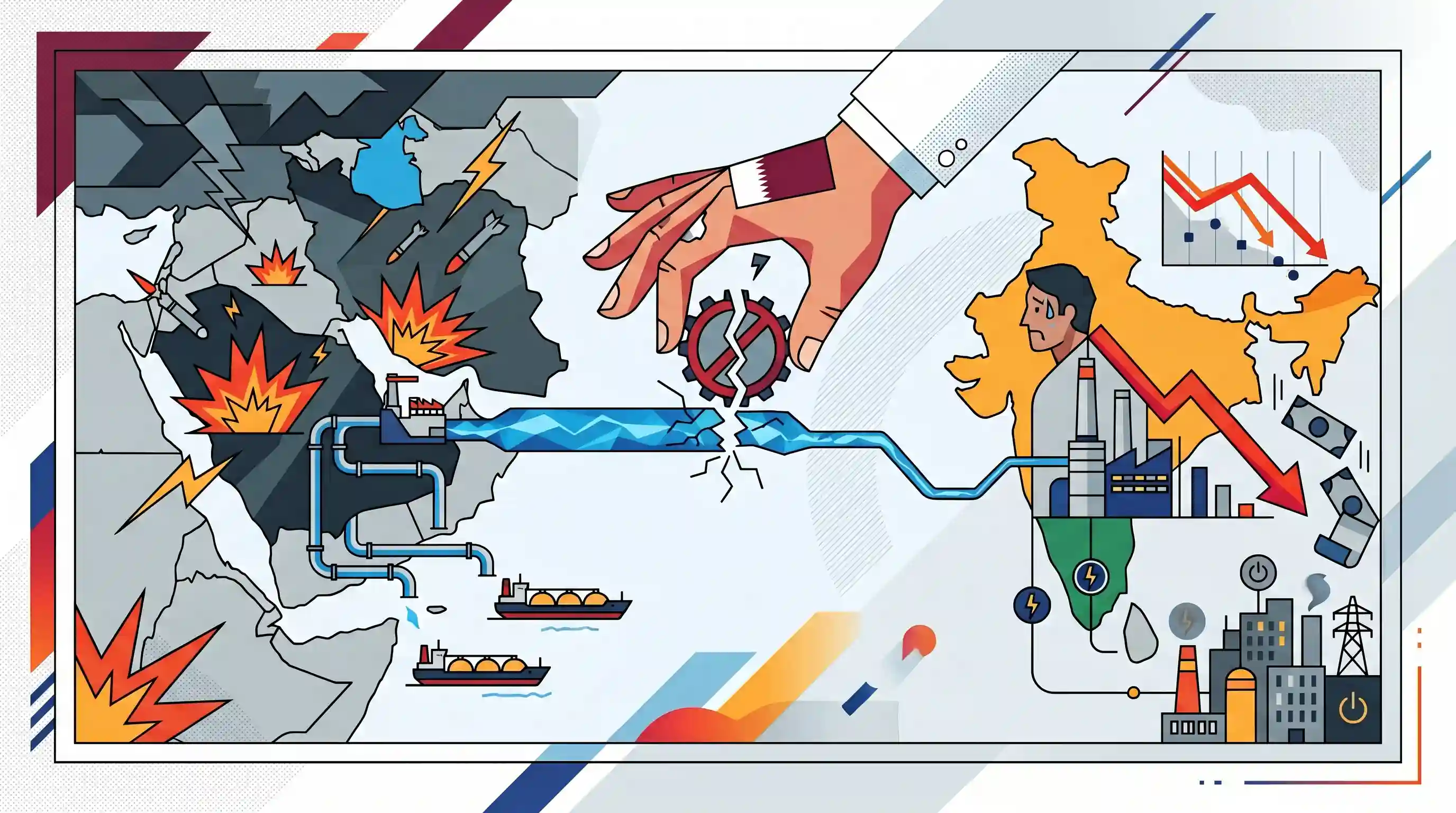
Why It Matters
Demonstrates the tangible economic consequences of geopolitical conflicts on India's energy imports. The invocation of 'force majeure' provides a practical case study for GS2/GS3 topics linking international relations to domestic corporate and macroeconomic stability.
Summary
The escalating conflict in West Asia has severely impacted India's energy imports, leading QatarEnergy and India's Petronet to issue 'force majeure' notices over Liquefied Natural Gas (LNG) supplies. The invocation of this legal clause, which shields parties from liability due to unavoidable disruptions, triggered a sharp decline in Petronet's stock. This development underscores India's heavy reliance on the Middle East for natural gas and highlights the critical vulnerability of its energy security to geopolitical instability and global supply chain shocks.
Key Points
- The ongoing conflict in West Asia has disrupted India's Liquefied Natural Gas (LNG) imports, exposing vulnerabilities in global energy supply chains.
- Major players Petronet (India) and QatarEnergy (Qatar) have issued 'force majeure' notices, legally shielding themselves from liability for failing to meet contractual obligations due to unavoidable geopolitical circumstances.
- Following the supply disruption and the invocation of the force majeure clauses, Petronet's stock price plummeted, reflecting market anxiety over energy availability and corporate financial health.
- The incident underscores India's heavy reliance on Middle Eastern natural gas and the direct impact of regional instability on national energy security and macroeconomic stability.
Important Terms
Force Majeure clause

A legal provision excusing parties from contractual obligations due to extraordinary, unavoidable events like war or natural disasters beyond their control.
UPSC context
GS II (Law/Contracts) and GS III (Economy). Tests risk allocation mechanisms and Indian Contract Act (Section 56) applications.
Petronet LNG
India's leading LNG importer and a joint venture of state-owned firms (GAIL, ONGC, IOCL, BPCL), managing the Dahej and Kochi terminals.
UPSC context
GS III (Energy/Infrastructure). Critical for understanding India's gas-based economy goals and public sector energy management.
QatarEnergy
Qatar's state-owned energy giant and India's single-largest supplier of Liquefied Natural Gas, providing nearly 40-45% of India's imports.
UPSC context
GS II (International Relations). Examines India-West Asia strategic partnerships and the impact of regional instability on trade.
Strait of Hormuz
A critical maritime chokepoint between the Persian Gulf and Gulf of Oman through which approximately 20% of global oil flows.
UPSC context
GS I (Geography) and GS II (Geopolitics). High importance for maritime security and vulnerability of energy supply chains.
Energy Security
The uninterrupted availability of energy sources at an affordable price, vital for national economic stability and industrial growth.
UPSC context
GS III (Energy/Environment). Evaluates India’s import dependency risks and the necessity for energy source diversification.
Prelims Trap
Petronet LNG is a wholly-owned PSU of the Government of India.
Petronet is not a standard, fully state-owned PSU. It is a Joint Venture (JV) formed by four Maharatna PSUs: ONGC, IOCL, GAIL, and BPCL.
Static Concepts Connected
How is 'Force Majeure' legally treated in India?
- Governing Law: Regulated under the Doctrine of Frustration (Section 56 of the Indian Contract Act, 1872).
- Core Conditions: The disrupting event must be unforeseeable, unavoidable, and make contract performance physically or legally impossible.
- Exemption: Legally exempts parties from financial or legal liability for non-performance during the specified disruption.
What are India's targets for a 'gas-based economy'?
- 15% Target: The government aims to increase natural gas share in the primary energy mix from ~6.2% to 15% by 2030.
- Import Dependency: India imports roughly 70% of its LNG, predominantly from Qatar, exposing it heavily to Middle Eastern geopolitics.
- Hormuz Chokepoint: Supplies are vulnerable to disruptions in the Strait of Hormuz, a chokepoint handling ~20% of global oil/gas trade.
Cross-Topic Patterns
Energy chokepoints & Imported Inflation
Disruptions in West Asia widen India's Current Account Deficit and trigger imported inflation, linking regional geopolitics directly to RBI's monetary policy challenges.
Transition fuel vs. Supply risks
India's climate strategy relies on natural gas as a transition fuel, making strategic gas reserves and supply diversification crucial for meeting long-term decarbonization targets.

Expect a 2026 multi-statement question linking 'Force Majeure' (Contract Act) with India's natural gas import reliance and energy mix goals.
Linked PYQs · 2
Linked PYQs · 2
- 2025MainsGS2
"Energy security constitutes the dominant kingpin of India's foreign policy, and is linked with India's overarching influence in Middle Eastern countries.” How would you integrate energy security with India's foreign policy trajectories in the coming years?
- 2017MainsGS2
The question of India's Energy Security constitutes the most important part of India's economic progress. Analyze India's energy policy cooperation with West Asian countries.
