West Asia Conflict Disrupts Uttarakhand Public Bus Procurement
Source:the-statesman ↗
Why It Matters
It highlights how global geopolitical instability directly impacts regional infrastructure development in Indian states, and demonstrates the practical fiscal effect of Central GST rate changes on ongoing public-private procurement contracts.
Summary
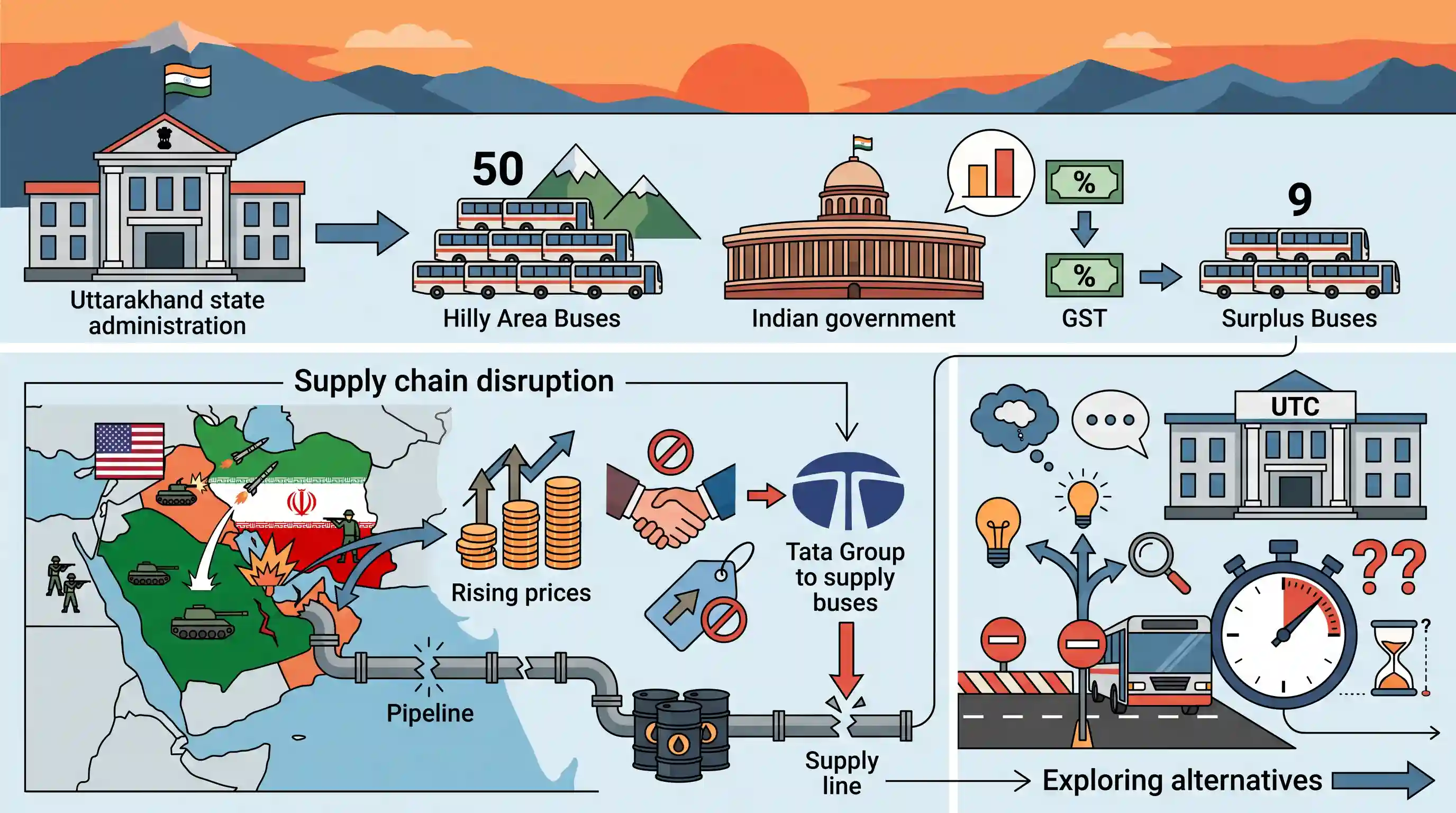
The ongoing geopolitical conflict in West Asia, specifically the war between the US and Iran, has stalled the Uttarakhand government's procurement of 59 buses. Citing a rise in raw material prices due to the war in the Gulf countries, the Tata Group has refused to supply the vehicles at previously finalized rates and hiked the quote to ₹36 lakh per vehicle. The procurement includes 50 buses approved by the state cabinet for hilly areas and 9 surplus buses obtained from a previous 100-bus deal after the Centre reduced the GST on buses from 28% to 18% in September 2025. The Uttarakhand Transport Corporation (UTC) is currently seeking a resolution or exploring alternatives to meet its October deadline.
Key Points
- The geopolitical conflict in West Asia (US-Iran war) has disrupted the procurement of 59 public transport buses for the Uttarakhand government due to rising raw material costs.
- Tata Group has refused to supply the buses at old rates, escalating the price to ₹36 lakh per vehicle instead of the previously agreed rates.
- The 59 buses consist of 50 buses approved by the Pushkar Singh Dhami Cabinet for hill areas (initially priced at ₹32.58 lakh each) and 9 additional buses.
- The 9 additional buses were negotiated under a July 2025 contract for 100 buses, made possible because the Centre reduced GST from 28% to 18% in September 2025, which lowered the cost per bus by ₹2.77 lakh and created a surplus.
- The Uttarakhand Transport Corporation, represented by GM Operations Kranti Singh, is looking at alternative options to meet its October procurement deadline if the dispute with Tata Group is not resolved.
Important Terms
Goods and Services Tax (GST)

A comprehensive, multi-stage, destination-based indirect tax levied on the supply of goods and services in India, designed to eliminate the cascading tax-on-tax effect of the previous regime.
UPSC context
GS Paper III (Indian Economy); tests knowledge of indirect taxation, mobilization of resources, and fiscal federalism.
GST Council
A constitutional joint forum of the Centre and States, established under Article 279A, tasked with making recommendations on GST rates, tax exemptions, and administrative frameworks.
UPSC context
GS Paper II (Constitutional Bodies) and Paper III (Indian Economy); tests understanding of cooperative fiscal federalism.
Indirect Tax
A consumption tax levied on goods and services rather than income, where the initial tax incidence is on the supplier, who subsequently shifts the burden to the end consumer.
UPSC context
GS Paper III (Indian Economy); tests comprehension of taxation structures, fiscal policy, and its regressive consumption impacts.
Public Procurement
The process by which government bodies and state-owned enterprises acquire goods, services, and works from the private sector to execute public welfare and development projects.
UPSC context
GS Paper III (Indian Economy); tests policies concerning public expenditure, infrastructure building, and the Ease of Doing Business.
Centre (Union Government)
The federal governing authority of India, established by the Constitution, with legislative, executive, and judicial powers over the entire country.
UPSC context
GS Paper II (Indian Polity); tests understanding of constitutional provisions, federal structures, and Centre-State relations.
Uttarakhand Transport Corporation (UTC)
The state-owned public transport enterprise of Uttarakhand, responsible for operating and managing passenger bus services across the state's hilly and plain terrains.
UPSC context
GS Paper II (State Governance); tests the administrative functioning of state public utilities and regional transport connectivity.
Prelims Trap
State road transport corporations are exempt from paying Goods and Services Tax (GST) on procurement of commercial passenger buses.
Public transport undertakings (STUs) are subject to GST on bus acquisitions (reduced from 28% to 18% in 2025). They do not enjoy a blanket exemption despite providing public utility services.
Static Concepts Connected
What is the constitutional structure and voting mechanism of the GST Council under Article 279A?
- Constitutional Origin: Inserted via the 101st Amendment Act, 2016, to establish a joint forum of the Centre and the States.
- Weighted Voting: The Centre's vote has a weightage of 1/3rd, while all State Governments combined have 2/3rds of the total votes cast.
- Decision Threshold: Decisions require a 75% (three-fourths) majority of weighted votes of members present and voting, forcing consensus between Centre and States.
Why are mountainous states uniquely dependent on road transport networks for public mobility?
- Topographic Barriers: Steep gradients, seismic vulnerability, and ecological sensitivity severely restrict the feasibility and cost-effectiveness of rail and metro networks.
- Socio-Economic Lifeline: Dispersed Himalayan settlements rely on state-run buses for basic access to healthcare, education, and markets, making bus procurement critical.
Cross-Topic Patterns
Geopolitics vs Subnational Fiscal Budgets
Shows how West Asian energy and commodity shocks can completely wipe out the fiscal savings state governments obtain from domestic tax rationalization like GST cuts.
Supply Chain Shocks + Public Utility Delivery
Examines how global commodity price volatility breaches fixed-price public procurement contracts, stalling essential public transport infrastructure in vulnerable regions.

GST Council voting dynamics combined with global supply chain shocks on subnational infrastructure projects is a prime target for UPSC 2026.
Linked PYQs · 2
Linked PYQs · 2
- 2021UKPSC_PRELIMSGS1
Which of the following taxes are abolished by the Goods and Services Tax?
- 2025UKPSC_PRELIMSGS1
101ˢᵗ Constitutional Amendment Act is related with :
