West Asia conflict risks and RBI monetary policy transmission
Source:The Hindu ↗
Why It Matters
It perfectly illustrates the real-world transmission of geopolitical risks (West Asia conflict) into domestic macroeconomic policy (RBI's MPC decisions, inflation targeting, and interest rates), which is a recurring theme in both Prelims and Mains GS3.
Summary
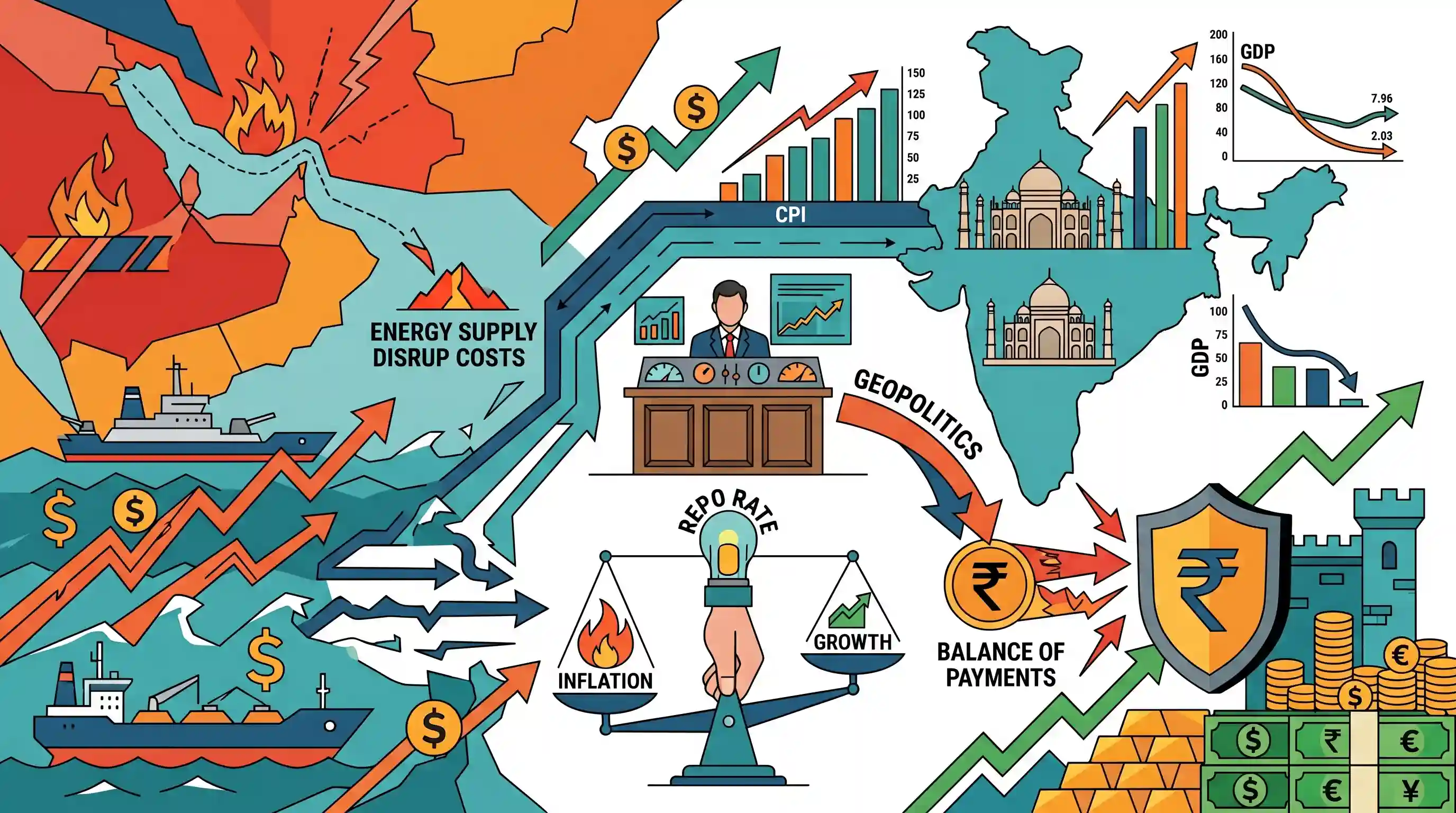
Minutes from the latest Monetary Policy Committee (MPC) meeting reveal that the ongoing conflict in West Asia is the foremost risk to India's economic trajectory. Disruptions around the Strait of Hormuz threaten energy supplies and inflate shipping and crude oil costs, fueling supply-side inflation. In response, the MPC revised its CPI inflation projection for 2026-27 upwards to 5.1% and downgraded GDP growth to 6.6%. Navigating this inflation-growth trade-off, the RBI maintained the repo rate at 5.25% with a neutral stance. While geopolitical shocks create pressure on the rupee and balance of payments, India's resilient macroeconomic fundamentals, such as strong forex reserves, continue to buffer the economy.
Key Points
- The RBI's Monetary Policy Committee (MPC) identified the prolonged West Asia conflict as the most significant downside risk to India's economic outlook due to its impact on crude oil prices and shipping costs via the Strait of Hormuz.
- Consequently, the MPC raised the expected Consumer Price Index (CPI) inflation for 2026-27 to 5.1% and lowered the GDP growth forecast to 6.6%.
- The MPC maintained the policy repo rate at 5.25% and held a 'wait-and-watch' neutral stance to navigate the trade-off between supply-driven inflation and economic growth.
- Despite external vulnerabilities like FPI outflows and a depreciating rupee, India's strong macroeconomic fundamentals, including robust forex reserves and resilient service exports, provide a crucial cushion.
Important Terms
Monetary Policy Committee (MPC)

A statutory body under the RBI Act, 1934, comprising six members that determines the policy interest rate (repo rate) required to achieve the government-mandated inflation target.
UPSC context
GS III: Indian Economy; tests understanding of institutional frameworks for price stability and the inflation-targeting mandate.
Strait of Hormuz
A strategic maritime chokepoint between Oman and Iran connecting the Persian Gulf to the Arabian Sea; it handles approximately 20% of global oil and 35% of LNG trade.
UPSC context
GS II/III: International Relations and Energy Security; critical for analyzing India's energy import vulnerability and geopolitical risks.
Supply-side inflation
Inflation triggered by a decrease in the aggregate supply of goods or an increase in production costs, such as rising crude oil prices or shipping disruptions.
UPSC context
GS III: Indian Economy; essential for distinguishing between demand-pull and cost-push factors in macroeconomic stability.
Repo Rate
The interest rate at which the Reserve Bank of India lends short-term funds to commercial banks against government securities to manage liquidity and inflation.
UPSC context
GS III: Indian Economy; the primary instrument of monetary policy tested in Prelims and Mains regarding economic growth trade-offs.
Forex Reserves
Assets held by the central bank in foreign currencies, gold, and SDRs to buffer against external shocks, maintain exchange rate stability, and meet import obligations.
UPSC context
GS III: Indian Economy (External Sector); relates to Balance of Payments (BoP) stability and currency resilience.
Consumer Price Index (CPI)
A measure that tracks changes in the price level of a weighted average basket of consumer goods and services purchased by households.
UPSC context
GS III: Indian Economy; the primary anchor used by the MPC for its flexible inflation-targeting framework.
Neutral Stance
A policy posture where the central bank remains flexible to either increase or decrease interest rates depending on evolving macroeconomic conditions.
UPSC context
GS III: Indian Economy; tests understanding of policy signaling and the RBI's approach to the inflation-growth trade-off.
Prelims Trap
"The Strait of Hormuz connects the Red Sea to the Arabian Sea, disrupting oil flows during conflicts."
Hormuz connects the Persian Gulf to the Gulf of Oman. The Bab-el-Mandeb connects the Red Sea to the Gulf of Aden. Aspirants frequently confuse these.
Static Concepts Connected
What is the composition and core mandate of the Monetary Policy Committee (MPC)?
- Composition: 6 members (3 RBI, 3 GoI-appointed). The RBI Governor chairs the committee and has a casting vote in case of a tie.
- Mandate: Determines the benchmark policy repo rate to keep CPI inflation at the target of 4% with a +/- 2% tolerance band.
- Decision Making: Decisions are taken by a majority vote. The MPC is legally required to meet at least four times a year.
How does 'Imported Inflation' operate in the Indian macroeconomy?
- Mechanism: Occurs when general price levels rise due to higher global costs of imported goods, especially critical inputs like crude oil and fertilizers.
- Currency Effect: Depreciation of the Rupee (due to FPI outflows during global shocks) makes imports structurally more expensive, compounding the inflation in Rupee terms.
- Policy Dilemma: Supply-side imported inflation is difficult to control via domestic interest rate hikes (repo rate) without suppressing domestic economic growth.
Cross-Topic Patterns
Maritime Chokepoints & Imported Inflation
UPSC increasingly fuses geography with macroeconomics. Disruptions at critical chokepoints like Hormuz or Bab-el-Mandeb directly translate to supply-side inflation, dictating RBI's Monetary Policy Committee rate decisions.
FPI Flight & Rupee Defense
Geopolitical shocks trigger 'safe haven' capital flight, depreciating the Rupee. This forces the RBI to deploy forex reserves, linking global conflicts directly to India's Balance of Payments resilience.

Expect a 2026 Prelims question linking RBI's 'neutral stance' mechanics with imported inflation driven by West Asian maritime chokepoints.
Linked PYQs · 5
Linked PYQs · 5
- 2017PrelimsGS1
Which of the following statements is/are correct regarding the Monetary Policy Committee (MPC)? 1. It decides the RBI's benchmark interest rates. 2. It is a 12-member body including the Governor of RBI and is reconstituted every year. 3. It functions under the chairmanship of the Union Finance Minister. Select the correct answer using the code given below:
- 2022PrelimsGS1
With reference to the Indian economy, consider the following statements: 1. If the inflation is too high, Reserve Bank of India (RBI) is likely to buy government securities. 2. If the rupee is rapidly depreciating, RBI is likely to sell dollars in the market. 3. If interest rates in the USA or European Union were to fall, that is likely to induce RBI to buy dollars. Which of the statements given above are correct?
- 2022PrelimsGS1
In India, which one of the following is responsible for maintaining price stability by controlling inflation?
- 2025MainsGS2
"Energy security constitutes the dominant kingpin of India's foreign policy, and is linked with India's overarching influence in Middle Eastern countries.” How would you integrate energy security with India's foreign policy trajectories in the coming years?
- 2017MainsGS2
The question of India's Energy Security constitutes the most important part of India's economic progress. Analyze India's energy policy cooperation with West Asian countries.
