Delhi Government Welfare Schemes and Financial Status
Source:The Hindu ↗
Why It Matters
The article highlights the persistent debate around welfare schemes, populist measures ('freebies'), and their strain on state finances. It is highly relevant for GS2 (Social Justice/Welfare) and GS3 (Public Finance) in analyzing the trade-offs between immediate poverty alleviation strategies, infrastructural development, and fiscal prudence.
Summary
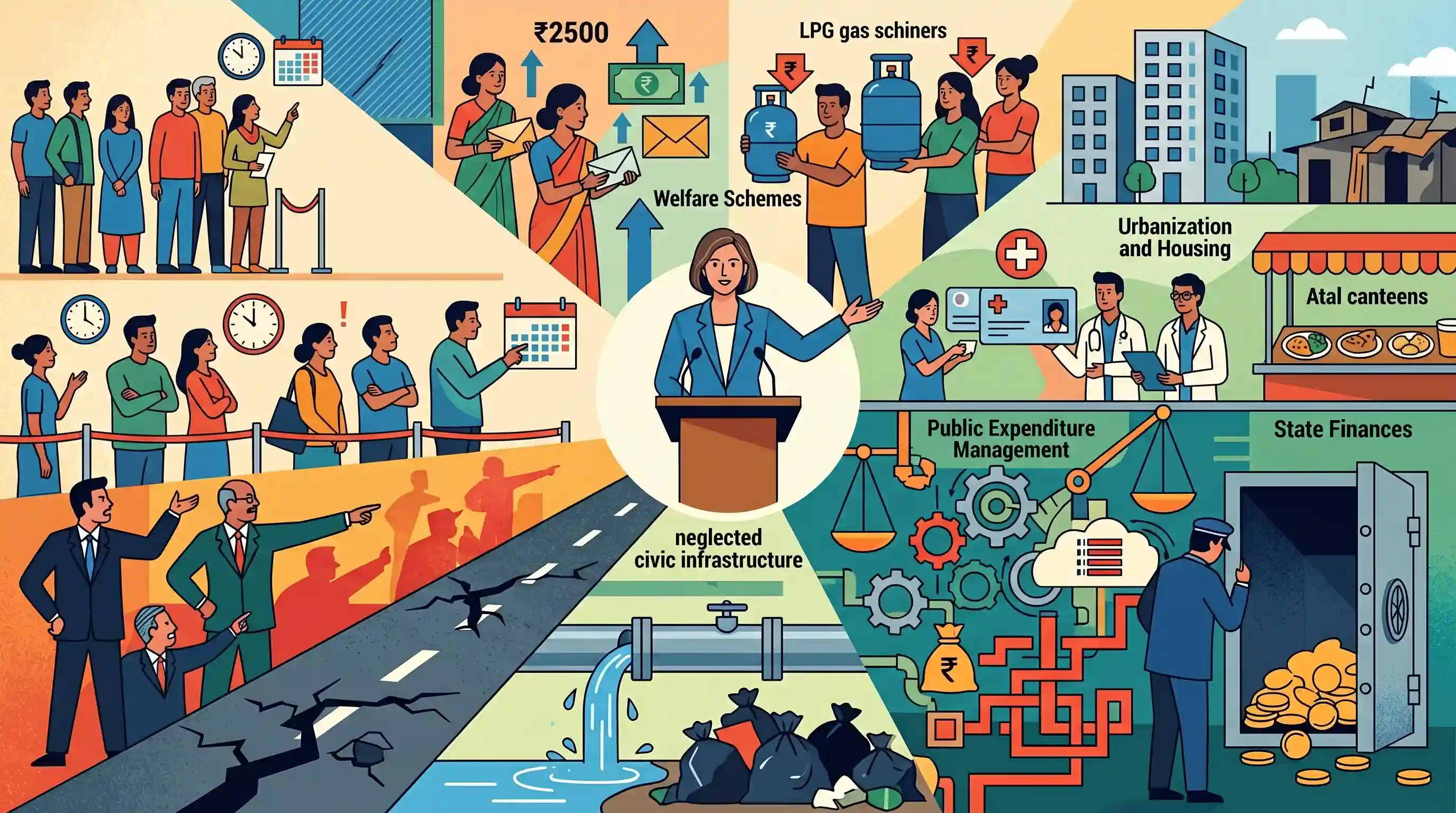
Delhi Chief Minister Rekha Gupta has reassured the public that her government will soon deliver on its welfare promises, particularly targeting women and the urban poor. Key initiatives include a ₹2,500 monthly financial assistance for women, subsidized LPG cylinders, permanent housing for slum residents, the rollout of Ayushman Bharat, and opening Atal canteens. She noted that these plans are temporarily delayed as the government needs time to stabilize state finances, alleging that the previous administration left the treasury depleted. Meanwhile, opposition leaders have criticized the government for non-delivery and neglecting basic civic infrastructure.
Key Points
- Delhi CM Rekha Gupta assured that welfare promises for women, such as ₹2,500 monthly aid and subsidized LPG, will soon be fulfilled.
- Gupta claimed the previous AAP government left the state treasury empty, necessitating time to stabilize finances before launching new schemes.
- The BJP has launched the Jhuggi Swabhiman Sabha initiative, promising permanent housing for slum dwellers.
- The government plans to implement the Ayushman Bharat Yojana and open Atal canteens, while continuing free power and water supply.
- Opposition parties like AAP and Congress criticized the BJP for delays in implementation and failing to address ongoing civic issues.
Important Terms
Ayushman Bharat Yojana

A flagship national health insurance scheme providing ₹5 lakh annual coverage per family for secondary and tertiary care to the poor and vulnerable.
UPSC context
GS Paper II (Health/Social Justice); tests understanding of universal health coverage and federal scheme implementation.
Atal Canteens
A subsidized meal program providing affordable, nutritious food to laborers and urban poor, aimed at ensuring food security and dignity.
UPSC context
GS Paper II (Welfare Schemes); tests knowledge of food security and urban poverty alleviation.
Jhuggi Swabhiman Sabha
A platform for outreach to slum (jhuggi) residents, focusing on grievance redressal, civic infrastructure, and awareness of housing rights.
UPSC context
GS Paper II (Governance); illustrates grassroots political mobilization and empowerment of marginalized urban sections.
Fiscal Consolidation
Policies aimed at reducing government deficits and debt-to-GDP ratios to maintain long-term macroeconomic stability and sustainable public finances.
UPSC context
GS Paper III (Economy/Budgeting); tests the trade-off between fiscal prudence and populist welfare spending.
In-situ Slum Redevelopment (ISSR)
A component of PMAY-U that redevelops existing slums into permanent housing by using land as a resource with private sector participation.
UPSC context
GS Paper III (Urbanization/Housing); tests inclusive urban planning and housing policy for the poor.
Prelims Trap
PM-JAY (Ayushman Bharat) is mandatorily implemented by all States and Union Territories.
Health is a State list subject under Schedule VII. States can voluntarily choose whether to implement Centrally Sponsored Schemes like PM-JAY.
Static Concepts Connected
How does the Constitution and FRBM framework regulate State government borrowing?
- Article 293(3): States must obtain the Centre's consent to raise new loans if any previous central loan remains outstanding, acting as a fiscal check.
- FRBM Limits: State legislations generally cap fiscal deficits at 3% of GSDP to prevent unchecked populist revenue expenditures from destabilizing the treasury.
What distinguishes 'in-situ' slum rehabilitation from traditional relocation models?
- Same-site Development: It rehabilitates slum dwellers on the exact land they currently occupy, preventing the severe disruption of established urban livelihoods and networks.
- Land as Resource: Private developers are often incentivized with extra Floor Space Index (FSI) to cross-subsidize the construction of free housing for the poor.
Cross-Topic Patterns
Women's DBTs and Intra-household Agency
Targeted cash transfers for women function beyond simple poverty alleviation; they alter intra-household bargaining power, directly improving maternal health and child nutrition outcomes.
Revenue Deficit vs. Capital Expenditure
Fulfilling populist promises via direct cash and subsidies increases revenue expenditure, often crowding out essential capital investments needed for urban civic infrastructure and long-term economic growth.

Expect a 2026 Mains question linking competitive state populism with shrinking capital expenditure and Article 293 borrowing constraints.
Linked PYQs · 5
Linked PYQs · 5
- 2023MainsGS2
“Development and welfare schemes for the vulnerable, by its nature, are discriminatory in approach.” Do you agree? Give reasons for your answer.
- 2022MainsGS2
Besides the welfare schemes, India needs deft management of inflation and unemployment to serve the poor and the underprivileged sections of the society. Discuss.
- 2019MainsGS3
The public expenditure management is a challenge to the Government of India in the context of budget making during the post-liberalization period. Clarify it.
- 2023MainsGS1
Does urbanization lead to more segregation and/or marginalization of the poor in Indian metropolises?
- 2015MainsGS2
Public health system has limitations in providing universal health coverage. Do you think that the private sector could help in bridging the gap? What other viable alternatives would you suggest?
