Telangana Indiramma Housing Scheme and Welfare Governance
Source:The Hindu ↗
Why It Matters
Provides a concrete state-level case study (Telangana's Indiramma Housing Scheme) for GS-2 answers regarding welfare schemes, inclusive growth, and poverty alleviation. It highlights how state governments mobilize large-scale housing and cradle-to-grave welfare initiatives to address multi-dimensional poverty.
Summary
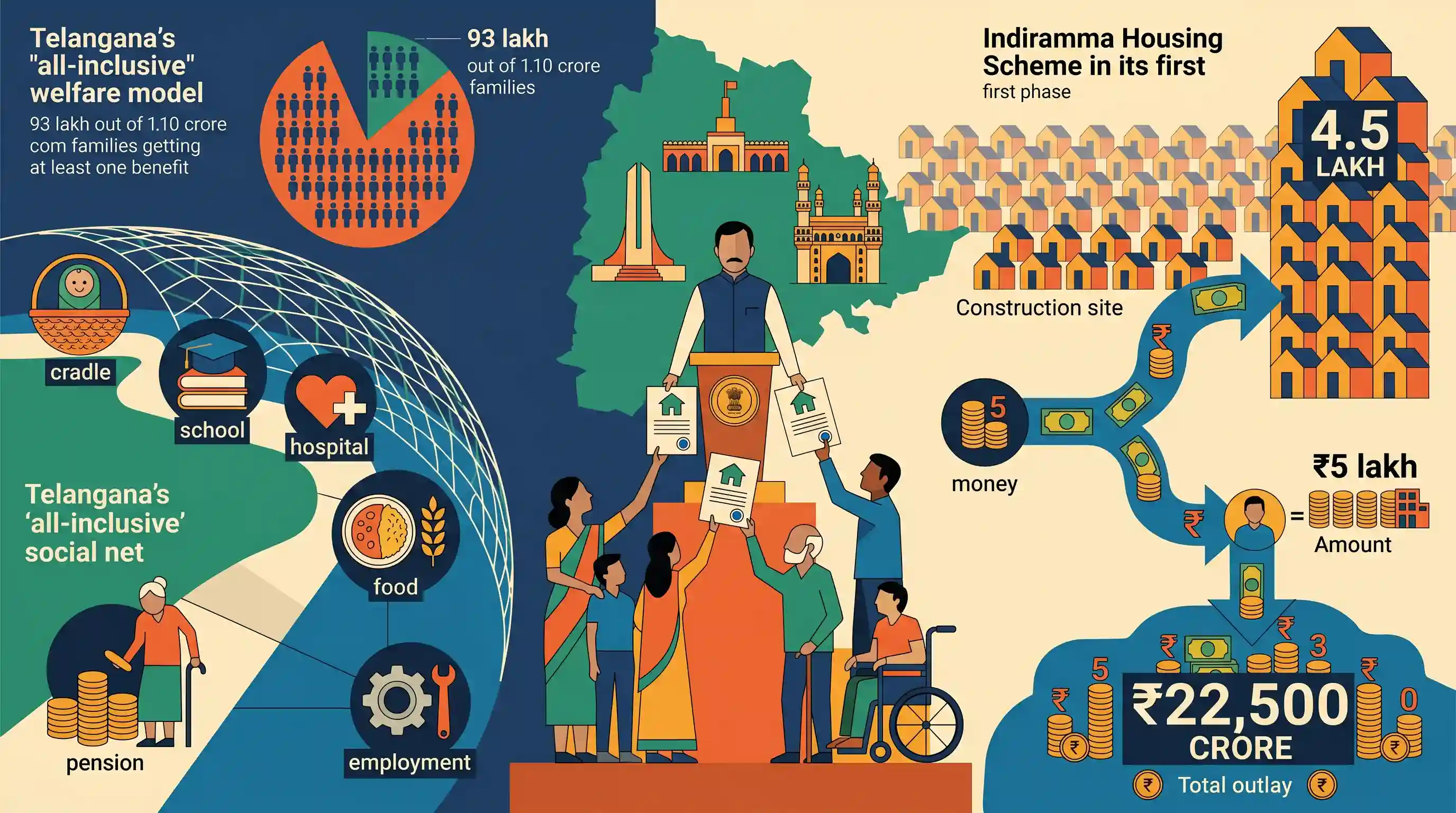
Telangana's Deputy Chief Minister highlighted the state government's "all-inclusive" welfare model while distributing sanction letters for the flagship Indiramma Housing Scheme. The administration claims to provide at least one welfare benefit to 93 lakh out of 1.10 crore families in the state, emphasizing a comprehensive cradle-to-grave welfare net. In its first phase, the housing scheme will fund the construction of 4.5 lakh houses for the poor, spending ₹5 lakh per house with an overall outlay of ₹22,500 crore for the year.
Key Points
- Telangana Deputy Chief Minister Mallu Bhatti Vikramarka highlighted the state's comprehensive welfare approach, claiming it benefits nearly 93 lakh out of 1.10 crore families.
- He distributed sanction letters for the flagship 'Indiramma Housing Scheme' to beneficiaries in Khammam district.
- The scheme's first phase targets the construction of 4.5 lakh houses, allocating ₹5 lakh per house for a total outlay of ₹22,500 crore in the first year.
- The government asserts its welfare model spans all life stages, contrasting its rapid implementation with the alleged failures of the previous BRS administration.
Important Terms
Indiramma Housing Scheme

A flagship Telangana government program providing ₹5 lakh financial assistance and free plots to homeless, low-income families, and Telangana Movement activists for constructing permanent (pucca) houses.
UPSC context
GS Paper 2: Welfare schemes for vulnerable sections; tests understanding of state-level social security and poverty alleviation mechanisms.
Inclusive Growth
Economic growth that creates opportunities for all segments of the population and distributes the dividends of prosperity fairly across society, reducing poverty and inequality.
UPSC context
GS Paper 3: Issues related to planning, mobilization of resources, and growth; a core mandate for sustainable development.
Social Justice
A political and legal concept ensuring equitable distribution of resources, opportunities, and privileges, often achieved through affirmative action and targeted welfare for marginalized communities.
UPSC context
GS Paper 2: Fundamental pillar of the Indian Constitution (Preamble, DPSP); tests knowledge of equity and government obligations.
Direct Benefit Transfer (DBT)
A mechanism to transfer subsidies or benefits directly into the bank accounts of beneficiaries to reduce leakages, eliminate intermediaries, and ensure transparent delivery of government services.
UPSC context
GS Paper 2: Governance and e-governance; assesses efficiency in government delivery systems and fiscal management.
Rajiv Arogyasri
A state-funded community health insurance scheme in Telangana providing financial protection (up to ₹10 lakh) to BPL families for catastrophic health expenses and specialized medical treatments.
UPSC context
GS Paper 2: Issues relating to development and management of Social Sector/Services relating to Health and Education.
Directive Principles of State Policy (DPSP)
Constitutional directive (Article 38) where the state plays a key role in the protection and promotion of the social and economic well-being of its citizens.
UPSC context
GS Paper 2: Indian Constitution; tests understanding of the non-justiciable but fundamental principles of state governance.
Prelims Trap
Housing provision directly improves the 'Health' dimension of the National Multidimensional Poverty Index (MPI).
Housing is a deprivation indicator under the 'Standard of Living' dimension of the MPI, not the 'Health' dimension. Health only includes nutrition, mortality, and maternal health.
Static Concepts Connected
What is the difference between Targeted and Universal welfare models?
- Targeted Welfare: Focuses resources on specific vulnerable groups (e.g., BPL lists) to optimize fiscal efficiency but risks high 'exclusion errors'.
- Universal Welfare: Provides baseline benefits to all or a vast majority (e.g., 85% coverage), minimizing exclusion errors but causing heavy fiscal strain and 'inclusion errors'.
- Identification Dilemma: Universal approaches are often justified by the difficulty of accurately identifying the poor in highly informal economies.
How does the Centre control state borrowing for massive welfare schemes?
- Article 293(3): States cannot raise loans without the Centre's consent if any previous central loan remains outstanding, giving the Centre leverage.
- FRBM Limits: States must adhere to fiscal deficit targets (typically 3-3.5% of GSDP) to qualify for their standard and additional borrowing quotas.
- Off-budget borrowings: States previously used Special Purpose Vehicles to fund welfare without showing it as debt. The Centre now counts this within state borrowing limits.
Cross-Topic Patterns
Competitive Welfarism vs Fiscal Limits
State-level 'cradle-to-grave' welfare schemes directly strain FRBM targets, frequently pushing states toward off-budget borrowings, thereby linking GS2 (Governance/Elections) with GS3 (State Fiscal Management).
Housing as an MPI Catalyst
Affordable housing initiatives directly lift populations out of multidimensional poverty by satisfying a core 'Standard of Living' deprivation indicator under the NITI Aayog National MPI.

Expect a GS2/GS3 Mains Q evaluating 'competitive welfarism' on state exchequers, linking massive state subsidies to off-budget borrowing.
Linked PYQs · 3
Linked PYQs · 3
- 2019MainsGS2
Performance of welfare schemes that are implemented for vulnerable sections is not so effective due to absence of their awareness and active involvement at all stages of policy process. Discuss.
- 2023MainsGS2
“Development and welfare schemes for the vulnerable, by its nature, are discriminatory in approach.” Do you agree? Give reasons for your answer.
- 2017MainsGS3
What are the salient features of 'inclusive growth'? Has India been experiencing such a growth process? Analyse and suggest measures for inclusive growth.
