CDSCO Approval for First GLP-1 Therapy for Fatty Liver Disease
Source:Indian Express ↗
Why It Matters
The rise of metabolic diseases like MASH and obesity is a major public health challenge in India. Understanding new medical technologies (like GLP-1 therapies) and the role of regulatory bodies (CDSCO) is essential for answering questions on health, biotechnology, and the management of non-communicable diseases in GS2 and GS3.
Summary
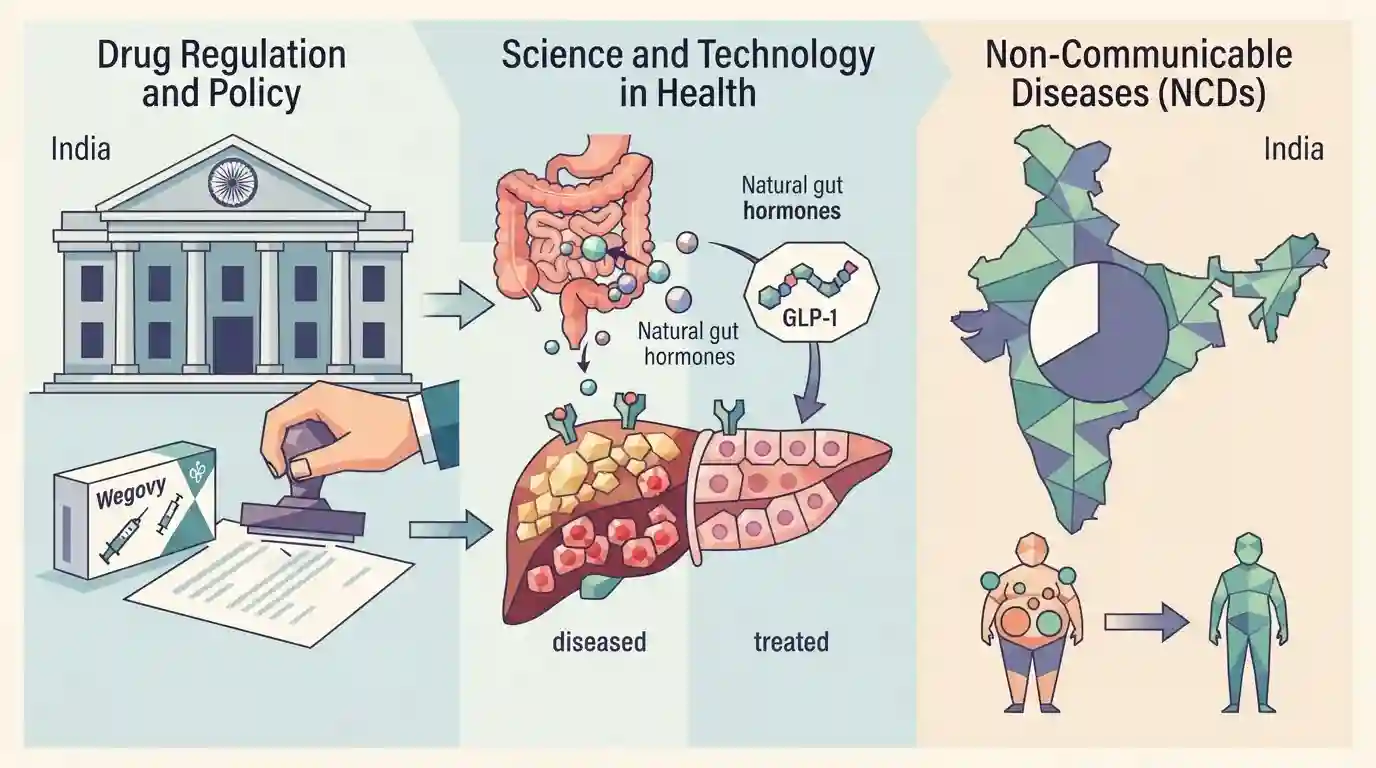
India's Central Drugs Standard Control Organisation (CDSCO) has approved Novo Nordisk's Wegovy (semaglutide) as the country's first GLP-1 therapy specifically targeted at treating Metabolic Dysfunction-Associated Steatohepatitis (MASH). MASH is a severe, progressive stage of fatty liver disease leading to chronic inflammation and fibrosis. GLP-1 drugs, which mimic natural gut hormones to regulate blood glucose and metabolism, have been shown to directly reduce liver fat and inflammation. With an estimated two-thirds of the Indian population affected by fatty liver disease, this approval represents a crucial biotechnological advancement in tackling the country's growing burden of non-communicable and metabolic diseases.
Key Points
- CDSCO has approved Wegovy (semaglutide 2.4 mg) as the first injectable GLP-1 therapy in India for treating Metabolic Dysfunction-Associated Steatohepatitis (MASH).
- MASH is a serious and progressive form of fatty liver disease that causes chronic liver inflammation and scarring (fibrosis).
- GLP-1 drugs mimic natural gut hormones to regulate blood sugar, reduce appetite, and slow digestion, but they also have direct effects on reducing liver fat and inflammation independent of weight loss.
- The approval was supported by the ESSENCE trial, which demonstrated resolution of steatohepatitis in 63% of patients.
- This is highly relevant to India's public health, as an estimated two in three Indians have some form of fatty liver disease.
Important Terms
Central Drugs Standard Control Organisation (CDSCO)

India's national regulatory authority under the Ministry of Health and Family Welfare. It is responsible for approving new drugs, regulating medical devices, overseeing clinical trials, and ensuring pharmaceutical quality standards.
UPSC context
Relevant to GS Paper 2 (Health/Governance), testing knowledge of India's statutory regulatory frameworks and public health administration.
Metabolic Dysfunction-Associated Steatohepatitis (MASH)
A severe, progressive stage of fatty liver disease caused by excess fat buildup, leading to chronic liver inflammation and fibrosis. It was previously known as Non-Alcoholic Steatohepatitis (NASH).
UPSC context
Important for GS Paper 2 (Health) and GS Paper 3 (Science), highlighting awareness of evolving disease nomenclature and metabolic disorders.
GLP-1 (Glucagon-like peptide-1)
A natural gut hormone that stimulates insulin secretion, regulates blood sugar, suppresses appetite, and slows digestion. GLP-1 receptor agonist drugs artificially mimic these mechanisms to treat metabolic disorders.
UPSC context
Significant for GS Paper 3 (Science & Technology), focusing on human biology, endocrinology, and novel pharmaceutical applications.
Semaglutide (Wegovy)
A GLP-1 receptor agonist medication, sold under brands like Wegovy, used to manage blood sugar, obesity, and now metabolic liver diseases by directly reducing liver fat, inflammation, and scarring.
UPSC context
Relevant to GS Paper 3 (Science & Tech), testing knowledge of breakthrough biotechnology therapies and drug approvals in India.
Non-Communicable Diseases (NCDs)
Chronic, non-transmissible medical conditions—like cardiovascular disease, diabetes, and fatty liver disease—often driven by lifestyle, genetic, and metabolic factors rather than acute infections.
UPSC context
Highly relevant to GS Paper 2 (Social Justice/Health), examining India's epidemiological transition and public health policy challenges.
Novo Nordisk
A Danish multinational pharmaceutical corporation that specializes in diabetes care and metabolic disorder treatments. It is the manufacturer of the pioneering GLP-1 therapy Wegovy.
UPSC context
Relevant to GS Paper 3 (Science/Economy) in the context of global pharmaceutical innovation and access to life-saving drugs.
Prelims Trap
GLP-1 receptor agonists treat fatty liver disease (MASH) solely as a secondary consequence of systemic weight loss.
While weight loss helps, GLP-1 agonists directly reduce liver fat, inflammation, and fibrosis through independent cellular pathways in metabolic tissues.
Static Concepts Connected
What is the Central Drugs Standard Control Organisation (CDSCO)?
- Parent Ministry: Functions under the Directorate General of Health Services, Ministry of Health and Family Welfare, Government of India.
- Leadership: Headed by the Drugs Controller General of India (DCGI), who approves specific categories of systemic drugs and clinical trials.
- Core Mandate: Responsible for product approval, laying down drug standards, quality control over imports, and coordinating state-level drug control organizations.
What are Incretins and GLP-1 Hormones?
- Incretin Effect: Incretins are metabolic hormones released by the gut after eating that stimulate insulin secretion to lower blood glucose.
- GLP-1 Mechanism: Glucagon-like peptide-1 is a key incretin hormone that enhances insulin release, suppresses glucagon, and delays gastric emptying.
- Receptor Agonists: They mimic natural gut hormones to regulate metabolic function, control appetite, and reduce tissue-level inflammation.
Cross-Topic Patterns
NCD burden & demographic dividend
Metabolic diseases like MASH threaten India's economic growth by increasing out-of-pocket health expenditure and reducing prime-age workforce productivity.
Pharma IPR vs. public health access
The high cost of patented GLP-1 blockbusters underscores the policy dilemma of balancing global patent protections with affordable domestic healthcare delivery.

CDSCO's mandate paired with the biological mechanism of incretins/GLP-1 is ripe for a multi-statement Science & Tech question in 2026.
Linked PYQs · 3
Linked PYQs · 3
- 2000PrelimsGS1
The blood glucose level is commonly expressed as
- 2020MainsGS2
In order to enhance the prospects of social development, sound and adequate health care policies are needed particularly in the fields of geriatric and maternal health care. Discuss.
- 2017MainsGS3
Stem cell therapy is gaining popularity in India to treat a wide variety of medical conditions including Leukaemia, Thalassemia, damaged cornea and severe burns. Describe briefly what stem cell therapy is and what advantages it has over other treatments?
