Weekly insulin therapies and diabetes management
Source:Indian Express ↗
Why It Matters
India faces an escalating crisis as the 'diabetes capital of the world.' This development highlights how biotechnology and advanced drug-delivery systems can overcome patient non-compliance, a primary barrier in managing chronic non-communicable diseases (NCDs). Understanding advancements in insulin delivery bridges the gap between scientific innovation (GS3) and public healthcare administration (GS2).
Summary
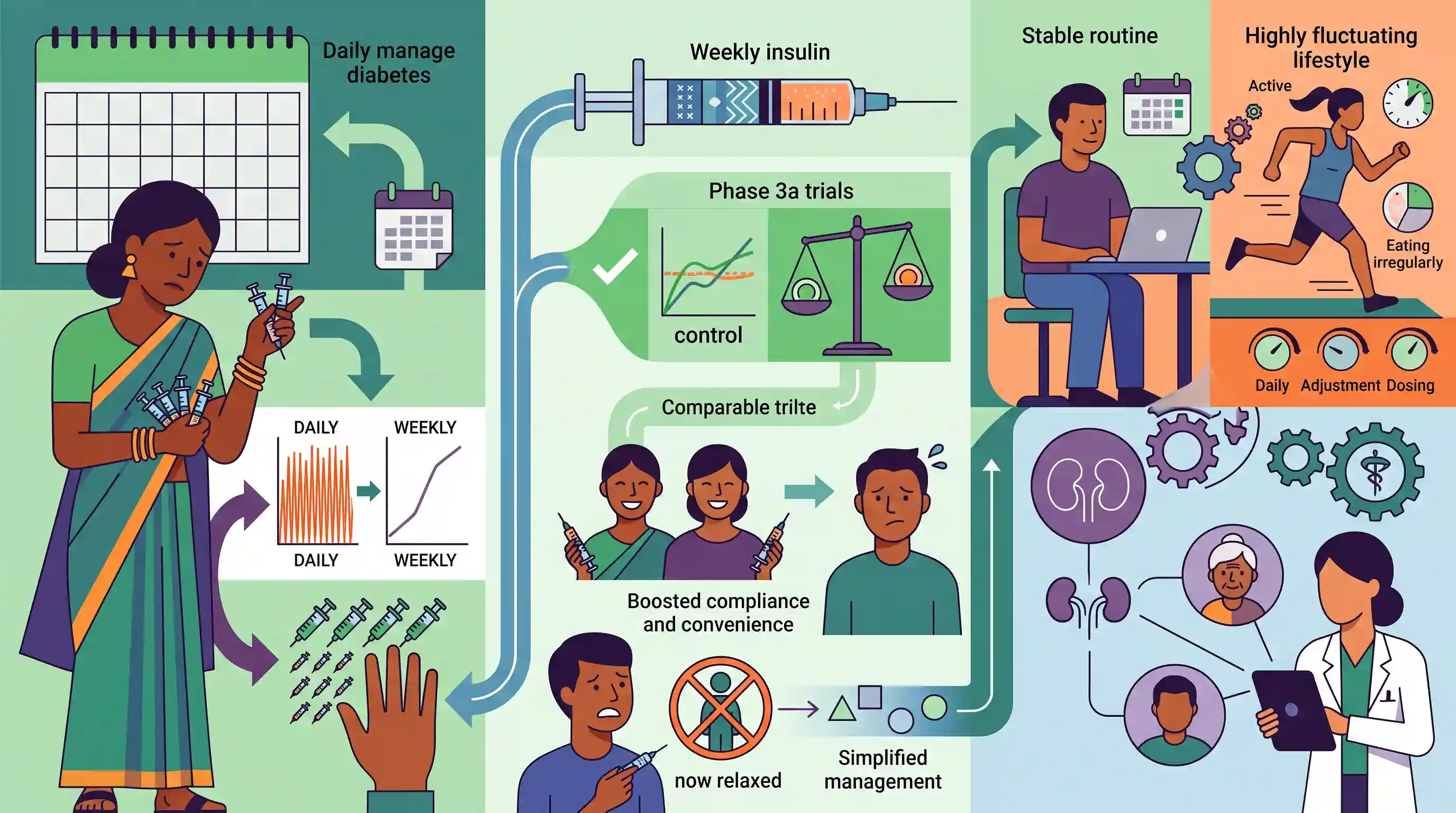
Danish pharmaceutical firm Novo Nordisk has launched Awiqli, a once-weekly basal insulin injection (insulin icodec), in India. Demonstrated in the ONWARDS Phase 3a trials to offer HbA1c control comparable to daily options, this long-acting insulin simplifies diabetes management by cutting annual injections from 365 to 52. While it significantly boosts compliance and convenience, particularly for those with needle phobia, it lacks the dosing precision of daily regimens, which are better suited for patients with highly fluctuating lifestyles or medical conditions. Clinical considerations like age and kidney function must guide its prescription.
Key Points
- Novo Nordisk has launched 'Awiqli' in India, which is a once-weekly basal insulin injection (insulin icodec) designed for type 2 diabetes management.
- The treatment reduces the frequency of insulin injections from 365 daily injections a year to only 52 weekly injections, greatly simplifying long-term care.
- Results from the global ONWARDS Phase 3a clinical trials (involving over 4,000 adults) indicate that insulin icodec delivers HbA1c reductions comparable to, or slightly better than, daily basal insulin, with a similar safety profile.
- The weekly schedule enhances treatment compliance, adherence, and quality of life, particularly for patients who struggle with daily needles or consistent routines.
- A major limitation is the lack of precision; daily insulin allows for rapid dosage adjustments based on immediate factors like meals, sickness, and exercise, which once-weekly insulin cannot easily accommodate.
- Prescribing once-weekly insulin requires clinical evaluation of patient age, kidney function, risk of hypoglycemia, and overall stability of diabetes. It is not a replacement for fundamental lifestyle changes like diet and exercise.
Important Terms
ONWARDS clinical programme

A global Phase 3a clinical development programme comprised of six trials evaluating the efficacy and safety of once-weekly basal insulin icodec (Awiqli) versus daily basal insulins in over 4,000 adults with diabetes.
UPSC context
GS Paper III (Science & Technology/Biotechnology); tests understanding of global clinical trials, drug development protocols, and therapeutic innovations.
Novo Nordisk
A Danish multinational pharmaceutical company specialising in diabetes care. It engineered and launched Awiqli (insulin icodec), the world's first once-weekly basal insulin injection, in India in July 2026.
UPSC context
GS Paper III (Science & Technology/IPR); tests awareness of multinational pharmaceutical giants, biomedical innovations, and healthcare technology transfer in India.
Zandra Healthcare
A specialized metabolic and diabetes care provider in India whose clinical experts have endorsed innovative, long-acting basal insulin treatments to improve patient compliance and therapeutic adherence.
UPSC context
GS Paper II (Social Sector/Health); tests understanding of private healthcare systems, expert clinical advisory roles, and localized metabolic care solutions.
KIMS Hospitals
A major corporate hospital chain in India (Krishna Institute of Medical Sciences) that offers tertiary care and specialized diabetology services, representing private-sector infrastructure in managing chronic diseases.
UPSC context
GS Paper II (Governance/Health); tests knowledge of private sector healthcare infrastructure, accessibility, and management of non-communicable diseases in India.
Insulin Icodec
A first-in-class, once-weekly basal insulin analogue that binds reversibly to albumin in the blood, creating an inactive reservoir that slowly releases active insulin to maintain steady glycemic control.
UPSC context
GS Paper III (Science & Technology/Biotechnology); tests familiarity with biomedical engineering, genetic modification, and advanced drug delivery mechanisms.
Basal Insulin
A type of long-acting insulin designed to keep blood sugar levels steady and stable during periods of fasting, such as between meals and during sleep.
UPSC context
GS Paper III (Science & Technology/Biotechnology); tests basic biological understanding of human physiology, hormonal regulation, and non-communicable disease treatments.
Prelims Trap
Once-weekly basal insulin completely eliminates the need for daily insulin injections in all diabetic patients.
It is a basal (background) insulin. Type 1 diabetics and advanced Type 2 diabetics still require daily short-acting (bolus) insulin for mealtime glycemic control.
Static Concepts Connected
How is recombinant DNA (rDNA) technology used to manufacture therapeutic human insulin analogues?
- Host Systems: Utilizes genetically engineered Escherichia coli or Saccharomyces cerevisiae (yeast) containing human insulin DNA sequences to express insulin precursors.
- Post-Translational Processing: Requires enzymatic cleavage and chemical modifications to fold and link the separate A and B peptide chains via disulfide bonds.
- Analogue Engineering: Alters specific amino acid sequences or attaches fatty acid side chains to chemically modify absorption rates, creating rapid or ultra-long-acting analogs.
Cross-Topic Patterns
Biotech IPR vs Public Health
Balances patent protection of advanced MNC biologics against India's use of Section 84 (Compulsory Licensing) of the Patents Act to secure affordable medicine.
NCDs and Demographic Dividend
High NCD prevalence among young working-class Indians increases out-of-pocket health expenditure, directly threatening the economic dividends of India's demographic transition.

Biotechnology application questions in 2026 are shifting from basic rDNA definitions to clinical properties of engineered protein therapeutics.
Linked PYQs · 3
Linked PYQs · 3
- 2013PrelimsGS1
Recombinant DNA technology (Genetic Engineering) allows genes to be transferred 1. across different species of plants 2. from animals to plants 3. from microorganisms to higher organisms Select the correct answer using the codes given below.
- 2021MainsGS3
What are the research and developmental achievements in applied biotechnology? How will these achievements help to uplift the poorer sections of the society?
- 2021MainsGS2
“Besides being a moral imperative of a Welfare State, primary health structure is a necessary precondition for sustainable development.” Analyze.
